Get Full Government Meeting Transcripts, Videos, & Alerts Forever!
Get email alerts on the Emergency Management Flash Flooding topic
No spam. Unsubscribe anytime.
Nash County endorses Spring Hope flash‑flood action plan; commissioners adopt resolution of support
Summary
The board unanimously adopted a resolution supporting Spring Hope’s effort to join a statewide flash‑flood action initiative and pilot regional sensor, gauge and warning projects after the town reported two recent flood deaths and urged rapid state‑local coordination.
NASH COUNTY, N.C. — The Nash County Board of Commissioners on Sept. 22 adopted a resolution endorsing Spring Hope’s request to participate in a statewide flash‑flood action effort and a regional pilot to improve short‑term flood detection and warnings.
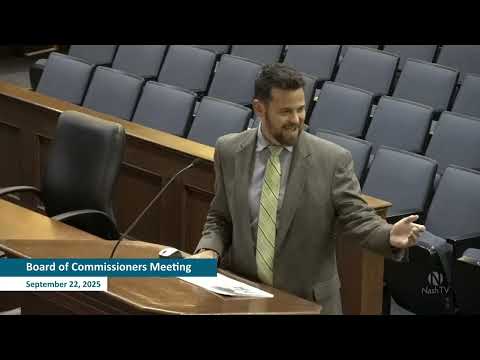
Mayor Kyle Pritchard of Spring Hope told the board the town lost two residents to flash flooding about six weeks earlier and said state and federal agencies have asked for actionable, short‑term projects that would complement longer hazard‑mitigation plans. “About a month and a half ago, we lost 2 lives in Spring Hope from flash flooding,” Pritchard said during his presentation.
Pritchard described a multi‑partner approach that includes deploying or linking existing USGS and NCDOT sensors, improving communications between agencies, piloting low‑water crossing treatments, installing automated depth markers and flashing beacons at identified hot spots, and cleaning stream channels and culverts in known problem areas. He said the goal is to create 30‑ to 90‑day operational tasks — such as connecting upstream sensors so an automated alert can trigger flashing beacons at downstream crossings — that can save lives ahead of longer‑term basin projects in the state’s “blueprint” hazard‑mitigation tool. He also told the board that the flash‑flood alert reached Spring Hope residents’ phones about 10 minutes after a 911 call in the recent event, highlighting a communications gap.
Pritchard said Spring Hope and partners are pursuing a pilot across Franklin, Nash and Edgecombe counties and are coordinating with the North Carolina Department of Environmental Quality, North Carolina Emergency Management, USGS, the National Weather Service and local DOT offices. He said private developers and home‑builders are at the table for design and permitting conversations.
Commissioners expressed support for the concept and for Spring Hope’s request that Nash County adopt a resolution of support. The board voted to adopt the resolution; the request was presented in the packet and staff noted the resolution language needed an adopted‑date update.
Why this matters: presenters and state officials told commissioners that long‑term basin planning is already under way but that an operational “action arm” is needed to identify immediate, low‑cost life‑safety measures — sensors, alarms and clearing hot‑spot channels — that can be deployed rapidly.
What’s next: staff will record the county’s resolution of support and coordinate with Spring Hope and state partners on the proposed pilot work.