Get Full Government Meeting Transcripts, Videos, & Alerts Forever!
Get email alerts on the Military Division Public Safety topic
No spam. Unsubscribe anytime.
Idaho Military Division seeks supplemental funding for public‑safety communications, vehicle backlog and hazmat equipment
Summary
The military division and adjutant general asked JFAC for supplemental funds to finish communications equipment in state vehicles, expand installation capacity, and replace decades‑old hazardous‑materials gear for seven regional teams.
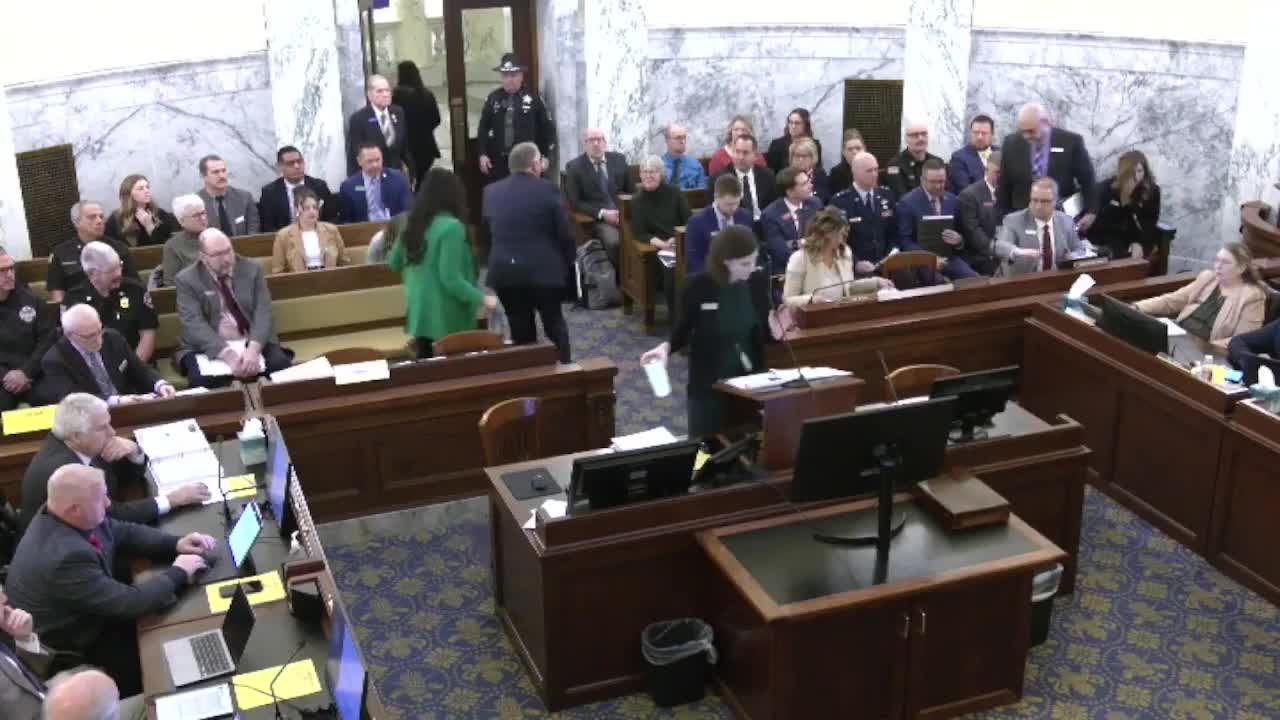
The Idaho Military Division appeared before the Joint Finance‑Appropriations Committee on Oct. 24 to explain a supplemental package to finish public‑safety communications work, resolve a vehicle‑installation backlog and modernize hazardous‑materials response equipment.
Frances Lippett, budget and policy analyst with the Legislative Services Office, summarized the division’s budget. Major General Tim Donilon, the adjutant general and commander of the Idaho National Guard, answered members’ questions about timing and execution.
The governor recommended a supplemental that covers two main areas: funding to clear a backlog of 40 Dodge Durango vehicles owned by the Idaho State Police whose critical communications equipment has not been installed, and IT and licensing funding to create an independent network for public‑safety communications. The committee was given an estimated private‑contract cost of $240,000 for equipment installation and an estimated $300,000 for construction work to add four installation bays.
The governor’s recommendation also included $759,200 for IT infrastructure and licensing so that public‑safety communications can establish a separate network for security reasons, and an $8,600,000 cash transfer from the state emergency relief fund to buy equipment for regional hazardous‑materials teams.
Major General Donilon said the vehicle backlog resulted from chip shortages and the later simultaneous delivery of many vehicles; the supplemental splits the work between a contractor to clear the backlog and construction to expand installation capacity so the state can prevent future backlogs. He told the committee the division expects to be able to execute the work quickly and said the state will perform quality control on contractor work.
On hazardous‑materials response, Donilon said the division has not updated hazmat equipment since about 2005 and that seven regional teams rely on aging gear. Representative Petzke asked why the governor used a cash transfer from the state emergency relief fund; Donilon said the funds will be routed through the Idaho Office of Emergency Management, which will purchase and distribute equipment to the seven regional teams.
The division also requested a small deficiency warrant of $34,200 to cover hazardous‑substance response costs it could not recoup from incident originators, and replacement‑item requests of $425,000 and $92,100 for vehicle and IT hardware replacement, respectively.
Questions focused on timing (Senator Cook), the cost/benefit of private contractors versus in‑house work (Representative Handy), the composition and mission of the seven hazmat teams (Senator Wintrow) and vacancies in the federal‑state agreement program (Chairman). Donilon said 28 of about 38 vacancies were in active hiring, while the remainder depend on federal budget authorities.
Donilon also briefed the committee on the federal‑state composition of the military division, the youth challenge program (a federally funded residential program for at‑risk high‑school‑age youth that operates two classes per year) and emergency‑aid distributions handled by the Office of Emergency Management.
No formal vote was taken during the presentation. Committee members asked staff to continue oversight and monitor execution timing for the supplemental to ensure timely deployment of vehicles and hazmat equipment.