
Tarrant County OKs contracts with Collin County for juvenile detention amid concern over distance and cost
Get AI-powered insights, summaries, and transcripts
Subscribe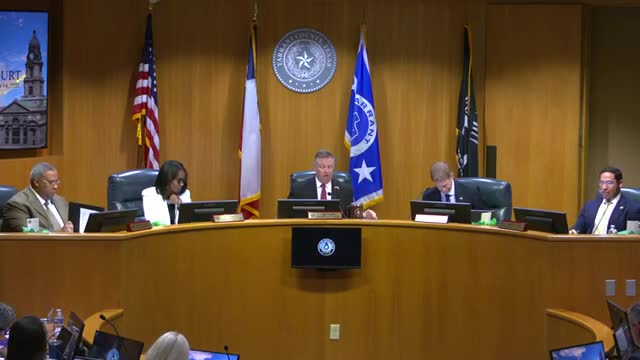
Summary
Tarrant County commissioners approved three contracts with Collin County on Oct. 14 to provide pre‑ and post‑adjudication detention and post‑adjudication treatment placements for youth after officials said county facilities have no in‑county capacity for some services.
Tarrant County commissioners on Oct. 14 approved three fiscal‑year 2026 contracts with Collin County to provide detention and treatment placements for youth under Tarrant County Juvenile Services jurisdiction. The court approved (1) a contract for post‑adjudication offender treatment placements, (2) a contract for pre‑adjudication detention space, and (3) a contract for post‑adjudication detention beds.
Juvenile Services Director Riley Shaw told the court the county does not currently operate an in‑county post‑adjudication program and has lacked capacity. “We do not offer those services” in Tarrant County, Shaw said, and the new contracts would serve as a backstop when county detention approaches or exceeds capacity. Shaw said Collin County and other vendors would be additional options; the department had not needed out‑of‑county pre‑adjudication beds in the prior 12 months but has faced overcrowding episodes in recent months.
Public commenters and juvenile‑justice advocates urged the court to reduce reliance on detention and to preserve youth connections to family and attorneys. Catherine Godby of The Justice Network said the county’s point system for detention decisions has increased the number of youth held and that sending young people to Collin County will reduce family visits and access to counsel. “This contract moves us backward,” Godby said. Geralyn Cox, a former legal aid attorney, warned that remote placements can sever community supports and urged investment in diversion and community‑based services.
Commissioners pressed Juvenile Services for data: Shaw said average pre‑adjudication length of stay is “in the 20s” of days but did not provide a multi‑year trend during the meeting and offered to supply more detailed breakdowns on offense types, lengths of stay, and prior out‑of‑county expenditures. Commissioners also pressed the department on oversight: Shaw said the county inspects contracted facilities and maintains weekly contact with counties supervising Tarrant County youth and will assign a certified probation officer to each out‑of‑county child.
The court approved the contracts with differing vote tallies: the post‑adjudication treatment contract (N3) passed unanimously; the pre‑adjudication detention contract (N4) passed 4–1; and the post‑adjudication detention contract (N5) passed 3–2. Commissioners and speakers noted daily costs discussed during the hearing: officials said the county had paid about $175 per child per day for pre‑adjudication detention in 2022 and that proposed rates in newer out‑of‑county agreements are higher (speakers cited figures in the $227 per day range for pre‑adjudication and higher daily rates for post‑adjudication placements). Advocates argued the county should pursue changes in court detention decisions and stronger community alternatives rather than rely on out‑of‑county beds.
The juvenile services director described negotiations with other counties (including Dallas) for nearer‑term capacity and said the Collin County contracts would be used only as needed. The court’s approvals authorize the department to contract for those beds; no directive to relocate specific youth was issued at the meeting.
The county said it will provide additional data at commissioners’ requests, including current counts of youth by offense type, average lengths of stay over time, and recent out‑of‑county costs.
Votes at a glance: N3 (post‑adjudication treatment) — approved unanimously; N4 (pre‑adjudication detention) — approved 4–1; N5 (post‑adjudication detention) — approved 3–2.
The juvenile services department will return with supporting data and the department’s plan for oversight and family access when placements occur outside Tarrant County.