Get Full Government Meeting Transcripts, Videos, & Alerts Forever!
Get email alerts on the Agriculture Farmland Preservation topic
No spam. Unsubscribe anytime.
Nash County approves farmland preservation program with $200,000 cap for purchase of development rights
Summary
The Board of Commissioners on Sept. 22 approved a proposed Nash County Farmland Preservation Program that sets a $200,000 maximum per purchase of development rights, uses a third‑party land trust to hold easements, and establishes an application and anonymous ranking process for landowners.
NASH COUNTY, N.C. — The Nash County Board of Commissioners on Sept. 22 approved a farmland preservation program that establishes eligibility rules, a local funding cap and a third‑party easement holder to conserve agricultural land in the county.
The program sets a maximum local allocation of $200,000 per purchase of development rights, requires that 75 percent of any applicant parcel be agricultural land (defined as grassland, cropland or pasture), and calls for a third‑party land trust to hold and monitor perpetual conservation easements. Working Lands Trust was identified in the presentation as the county’s intended partner to hold and monitor easements under a term contract.
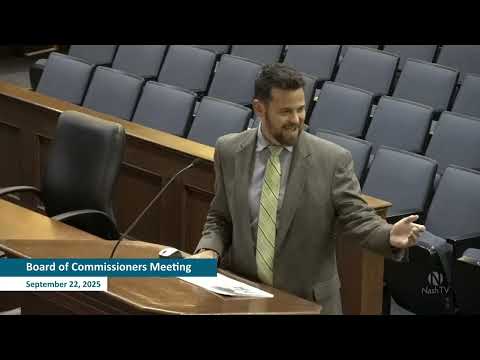
The county’s soil and water staff framed the proposal as an option for landowners rather than a mandate. Cole Strickland, who presented the proposal on behalf of Nash County Soil and Water staff and the Nash County Agricultural Advisory Board, said the program “would just be an added option in Nash County.” He also cited national and local farmland‑loss projections, including an American Farmland Trust 2020 finding, and told the board county projections show about 33,000 acres locally could be at risk of development without preservation efforts.
The program is structured around three documents included in the board packet: a program outline that establishes eligibility and process, a landowner application, and a 22‑question ranking form with a top score of 115 points. Strickland described an application workflow in which staff assign an application ID, the advisory board reviews projects by ID only to avoid name‑based bias, and approved projects move to the Board of Commissioners for funding allocation.
Staff told commissioners the Working Lands Trust partnership would be a term contract with a fixed annual rate and a target number of projects; an initial estimate presented to the board placed the contract cost at roughly $25,000–$30,000 per year, to be paid from a Present Use Value (PUV) rollback account already set up by the county. The presenter said the program’s planned start date is Jan. 1, 2026, and that the Agricultural Advisory Board plans a landowner summit on Jan. 9, 2026, to inform property owners about the option.
Commissioners asked how participation would work; Strickland and board members clarified the program is voluntary, saying landowners can opt in or not. After discussion, Commissioner Howell moved to approve the proposal; the motion was seconded by Commissioner Bellfield. The board voted in favor and the motion passed.
Why this matters: organizers said North Carolina faces substantial projected farmland loss and that a county program offering a local match and a land‑trust‑held easement option adds a preserved‑land option for owners who want it. The program does not create a county‑held easement program and relies on an identified external easement holder to ensure perpetual monitoring.
What’s next: staff will begin implementation tasks, finalize a contract with the identified land‑trust partner, and hold the planned Jan. 2026 landowner summit, and applicants will be evaluated through the packet’s ranking form and advisory‑board review process.