Get Full Government Meeting Transcripts, Videos, & Alerts Forever!
Get email alerts on the Public Health Budget topic
No spam. Unsubscribe anytime.
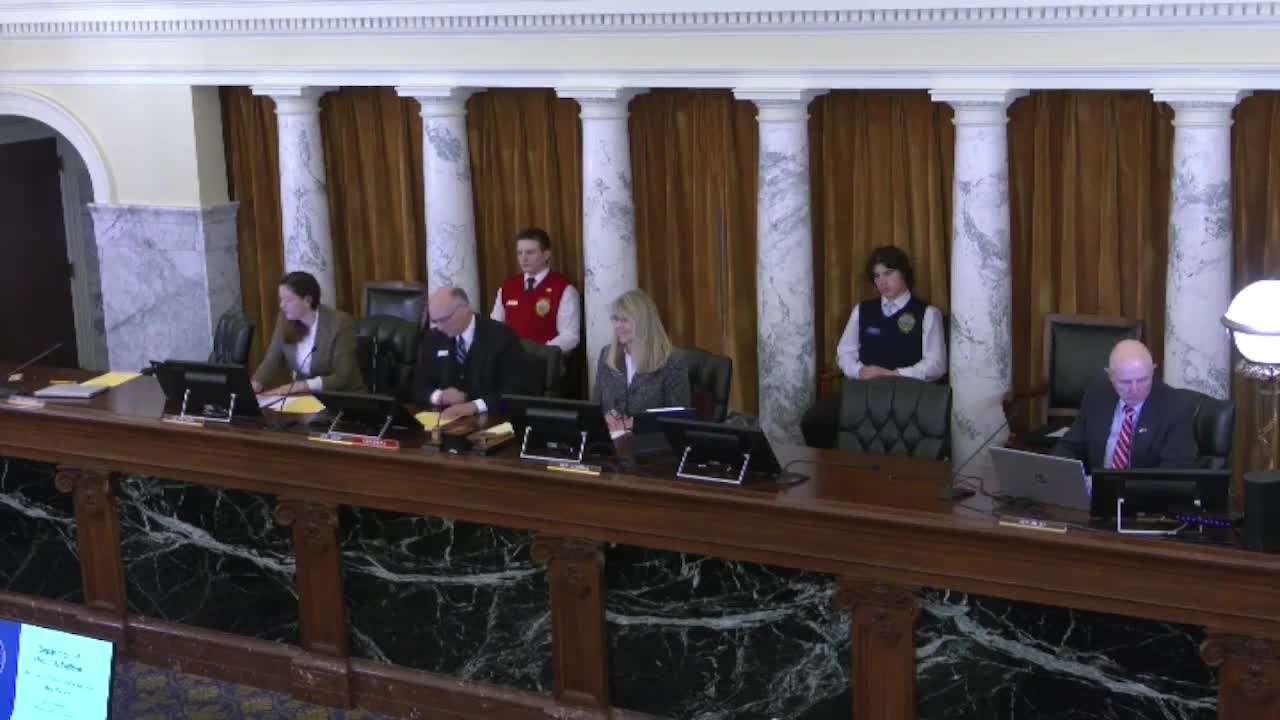
JFAC reviews public health services budget; agency seeks restorations, data modernization and rural physician incentives
Summary
The Joint Finance‑Appropriations Committee on Monday reviewed the Department of Health and Welfare’s Division of Public Health Services budget request for fiscal 2026, including agency requests to restore programs shifted to one‑time funding, fund data‑modernization projects and continue a rural physician loan‑repayment incentive.
The Joint Finance‑Appropriations Committee on Monday reviewed the Department of Health and Welfare’s Division of Public Health Services budget request for fiscal 2026, hearing officials outline a plan to restore programs moved to one‑time funding, fund data modernization projects and continue incentives to attract physicians to underserved parts of Idaho.
Division budget staff told the committee the governor’s recommendation for fiscal 2026 is about $154 million, down roughly 6% from the 2025 appropriation largely because of prior one‑time federal funds and structural changes that shifted ongoing programs into one‑time appropriations. "I would characterize it as a healthy exercise," Director Alex Adams told the committee, referring to a zero‑based review of the division’s programs.
The Division of Public Health Services is organized around five program areas: physical health services (contracts with local public health districts and providers for immunizations, maternal and child health, food safety and other services); emergency medical services and preparedness; laboratory services; suicide prevention and awareness; and health care policy initiatives, including administration of the State Health Care Innovation Plan (SHIP). Analysts said most of the division’s spending flows out in trustee and benefit payments for services, with personnel and operating costs representing smaller shares.
Major items discussed
- Program restorations: Committee staff and department officials described agency requests to restore a number of ongoing programs that were converted to one‑time appropriations last year. Among them: suicide prevention (request includes $1,807,700 general fund and $195,000 federal funds); a drug overdose prevention program (request for $2,820,200 and four FTE); refugee health screening (request to restore 1.5 FTE and $991,000 ongoing); Alzheimer’s and related dementia coordination ($275,200 general fund); Fit and Fall Proof (community exercise program for older adults, $140,000 ongoing); diabetes prevention and health equity ($1,063,700 ongoing); HIV prevention ($957,300 ongoing); oral health workforce ($379,600 ongoing); integrated hepatitis surveillance ($599,200 ongoing); and WIC/Food Program restorations.
- One‑time enhancements and data modernization: The department requested about $8.75 million in one‑time enhancements on top of ARPA carryovers to support public health infrastructure, workforce hiring and a set of data‑modernization efforts. Officials said modernization work includes automating vital records (births, deaths, stillbirths), WIC system upgrades and consolidating scores of siloed public health data systems to improve data exchange and reporting to CDC systems.
- Communicable disease and laboratory support: The agency requested federal one‑time funds (about $2,041,800) to support limited‑term positions under a year‑four communicable disease prevention grant and emphasized the ongoing role of state laboratory services in surveillance and response.
- Immunization and vital records authorities: The division requested $2,500,000 ongoing from dedicated funds for the Idaho immunization program to help ensure children under age 19 can access vaccines at low or no cost; it also requested an additional continuing authority for vital records receipts to support timely processing of birth, death and related records.
- Rural physician incentive: The governor’s initiative includes $500,000 ongoing for the Rural Physician Incentive Program to provide medical education loan repayment for physicians serving in federally designated Health Professional Shortage Areas. Division administrator Elke Shaw Tullock told the committee the loan repayment programs have high retention: "Almost 91% of the providers that receive these loan repayments stay in the state and practice in the state."
Committee process and next steps
Committee members asked routine and substantive questions about accreditation activity, the effects of prior federal funding (CARES/ARPA) running down, and which programs might be better housed in other agencies. Director Adams said some functions, such as EMS, have been discussed previously for transfer to agencies with closer synergies (for example, the state Office of Emergency Management) and that he is open to agency role realignment where appropriate. Several legislators asked for follow‑up detail on data modernization deliverables and on prior ARPA expenditures before approving additional funding.
No final committee action or vote was recorded in the hearing transcript. Committee staff encouraged members to work with the department analysts and requested follow‑up materials on data modernization and program performance.
Why it matters
The Division of Public Health Services administers functions such as communicable disease surveillance, vital records, immunizations, public health preparedness and suicide prevention — core public‑health infrastructure that state and local agencies rely on for outbreak response, public‑safety planning and health‑services delivery. Decisions this session will affect whether previously one‑time programs are restored as ongoing services and how quickly Idaho modernizes systems that manage birth, death and immunization data.
Looking ahead
Committee members asked the department to return more detailed documentation on ARPA and data modernization progress; no final appropriation decision was made during the hearing.