Get Full Government Meeting Transcripts, Videos, & Alerts Forever!
Get email alerts on the Urban Forestry topic
No spam. Unsubscribe anytime.
Mill Creek council approves up to $50,000 study and possible treatment for sycamore tree fungus
Summary
The Mill Creek City Council voted unanimously Feb. 24 to appropriate up to $50,000 for a sycamore tree program to study a fungus affecting large street trees and explore treatments, including a potential cost-share for homeowners.
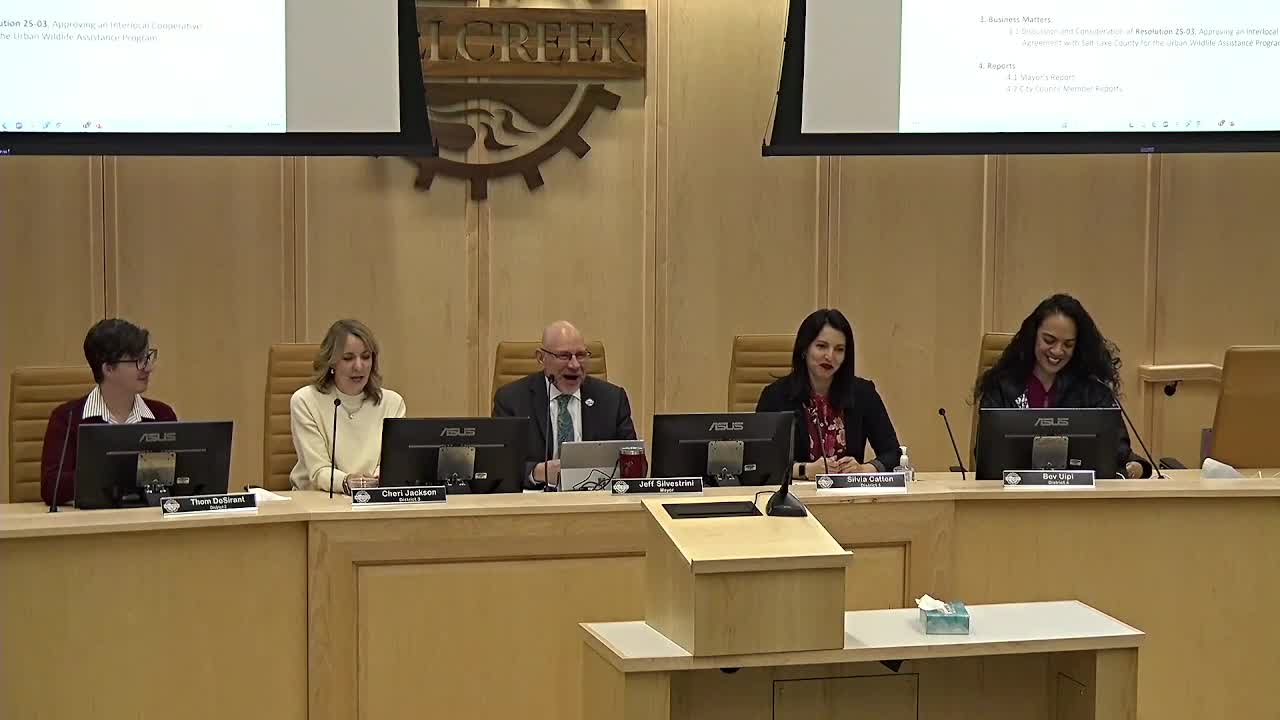
The Mill Creek City Council on Feb. 24 adopted Ordinance 25-03 to approve a monetary contribution of up to $50,000 for a sycamore tree program aimed at studying and, if feasible, treating a fungus afflicting mature sycamore trees across parts of the city. The measure passed unanimously after a brief public hearing at which no members of the public spoke.
The program is intended to let Mill Creek participate in and learn from a larger study already funded by Salt Lake City. Mayor Jeff Silvestrini told the council the city wants to "piggyback" on Salt Lake City’s work and be prepared to act if a treatment is identified. "We might do a fifty-fifty program," he said, referring to a possible cost-share model with homeowners for treatment or pruning work.
Why it matters: large, mature sycamores are prominent street trees in several Mill Creek neighborhoods. Council members said preserving them would protect canopy, shade, wildlife habitat and stormwater benefits. At the same time, several council members noted the potential cost to homeowners: one councilmember cited two pruning bids last year — about $1,700 for a single tree in one example — underscoring that city assistance could be necessary to preserve trees without imposing large costs on individual property owners.
What the ordinance does: the appropriation frees up funds for a study and preliminary remedies. Staff described the money as "up to" $50,000 for research, arborist fees, participation in Salt Lake City’s study and possible initial treatment measures. Planning Director Francis Lilly told the council that Salt Lake City has appropriated $150,000 for its study and that Mill Creek’s participation would likely be smaller; the council discussed committing a third of that amount as an initial contribution.
Council discussion clarified ownership and administrative differences with Salt Lake City: in Salt Lake, the city owns many park-strip trees; in Mill Creek the trees on park strips are privately owned, which affects how a treatment program would be structured and funded. Council members said the appropriation covers both a study phase and potential early steps to implement a treatment or cost-share program if a credible treatment is identified.
Public process and next steps: the council opened and closed a public hearing on the appropriation the same evening with no public commenters. Councilmember Sherry Jackson moved adoption of Ordinance 25-03; Councilmember Bev Wiepie seconded. The motion passed by roll call vote: Jackson, Wiepie, Sylvia Catton, Tom Desirant and Marcela Struney all voted aye. Staff will coordinate with Salt Lake City and an arborist to scope the study and return with recommendations on specific treatments, homeowner cost-share options and an implementation plan.
The council framed the appropriation as an early, precautionary step: if the study identifies effective treatments, the city may propose a partnership or 50/50 cost-share for homeowners; if not, the funds will have clarified the problem and options going forward.