Get Full Government Meeting Transcripts, Videos, & Alerts Forever!
Get email alerts on the Transportation topic
No spam. Unsubscribe anytime.
UDOT presents Tooele Valley Connectivity study, urges corridor preservation and local network upgrades
Summary
UDOT officials presented findings from the Tooele Valley Connectivity Study, showing rising vehicle-hours and increasing delays through 2050, and recommended corridor preservation, local network buildout, and coordinated agreements with municipalities to protect future rights-of-way and manage access.
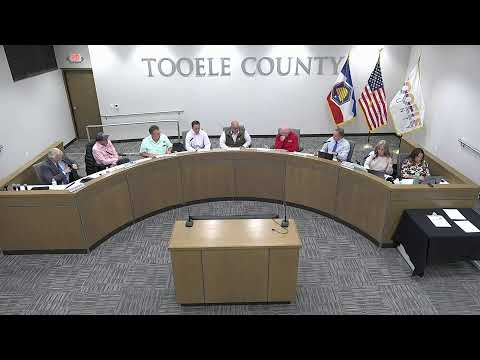
The Utah Department of Transportation on Oct. 7 briefed the Tooele County Council on the Tooele Valley Connectivity Study and urged county and municipal officials to preserve corridors and coordinate local street connections as the valley grows.
UDOT planning manager Jeff DuPay said the study shows the state and local network already struggles in places and will face significantly higher congestion if improvements are not made. “One of the key takeaways we want you to take into consideration is the conditions today on the local and the state network in some locations are struggling,” DuPay said.
UDOT and its central-office project manager, Travis Hair, told the council the study used local growth inputs from cities and the county to model travel demand out to 2050. The modeling produced three illustrative outcomes: current network conditions, a 2032 scenario with planned local improvements, and a 2050 scenario that includes multiple widenings and segments of the Mid Valley Highway. UDOT’s statewide model found daily vehicle-hours traveled rising from roughly 33,000 today to 53,000 by 2032 under a basic-build scenario, and to roughly 104,000 by 2050 in the model runs that include all planned widenings and segments. Reported network delay climbed from about 6% today to 8% in 2032 and as high as 18% in the full 2050 scenario.
Why it matters: UDOT said the county’s future mobility will depend on a combination of a stronger local street network plus coordinated state routes. DuPay and Hair recommended corridor preservation (acquiring or protecting rights-of-way early), predictable intersection spacing and managed access on state routes, and revisions to local transportation plans to align with the regional network.
Key recommendations and details: UDOT’s recommendations include (a) preserving corridors for Mid Valley segments and several east–west and north–south collectors; (b) creating or updating corridor agreements with the county and municipalities to identify where signals should go on SR‑112 and SR‑138; (c) adding local east–west connections and collector routes (for example, extensions like 30th Parkway, 2000 North and north-side connections near the depot) to provide redundancy; and (d) pursuing corridor preservation funding as a priority for locally held quarter‑preservation dollars.
UDOT emphasized that the state long-range plan and the Statewide Transportation Improvement Program (STIP) determine which projects receive funding. DuPay said the long-range plan is on a four‑year update cycle and that projects or phases can move between periods based on changing needs or new funding, but that currently the central Mid Valley segment is unfunded in the current financial plan. He said corridor identification and the environmental document are complete for the Mid Valley alignment, which helps make the corridor eligible for preservation and future funding consideration.
Design and land-use trade-offs: The study presented typical cross sections showing a corridor width on SR‑112 and SR‑138 approaching roughly 115–120 feet when shoulders, multiuse paths and other amenities are included. UDOT staff warned that narrower sections — for example where a port developer plans only an 88‑foot right‑of‑way — would require tighter lane geometry and could eliminate shoulders, trails and other edge amenities. DuPay said shoulders are important for snow storage, truck pullouts and safety, especially where heavy truck traffic to the inland port is expected.
Funding and timing: UDOT staff outlined funding sources and recommended local jurisdictions prioritize corridor preservation in their quarter‑preservation and grant strategies. DuPay estimated that corridor acquisitions alone could require “another 20-plus million dollars” by 2050 for the county portion and that road construction will require substantially more — local officials should expect to pursue grants, COG funds and state programs. DuPay also flagged technical‑planning assistance (TPA) grants and other UDOT programs as potential near‑term tools for local plan updates.
Council questions and UDOT responses: Council members asked for comparisons to other congested corridors and for clarification about what a reported 15–18% delay means in travel time; UDOT staff explained that 15–18% network delay can translate to multi‑minute travel time increases on key corridors (for example, a 25‑minute trip could increase by 10–15 minutes in the modeled worst areas). Staff also clarified that many elements of the modeled 2032 network reflect committed local projects but that the unfunded middle Mid Valley segment was not included in earlier financial runs; 2050 scenarios included a wider set of planned segments.
Next steps: UDOT said it is finalizing corridor agreements with the county, Grantsville and the transit provider and will continue working with municipal planners, the Gardner Policy Institute (on employment and population inputs) and COG partners. The presentation concluded with UDOT asking local jurisdictions to adopt the mapped corridors into local transportation plans, pursue corridor preservation funds and consider the recommended intersection spacing and access management strategies.
UDOT and county staff will circulate draft corridor agreements to the county manager for legal review and signatures, UDOT said.
Ending note: The study frames mobility in Tooele Valley as a combined state–local challenge: UDOT can fund and build some state routes, but the county and cities must adopt coherent local networks and preservation strategies to protect future options and reduce long‑term costs.