Get Full Government Meeting Transcripts, Videos, & Alerts Forever!
Get email alerts on the Medical Cannabis Delivery topic
No spam. Unsubscribe anytime.
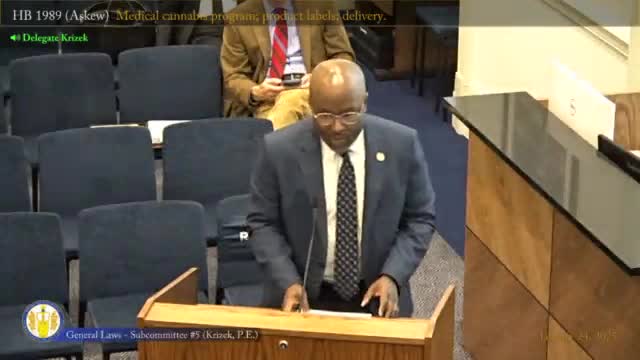
Substitute for HB 1989 advances to clarify medical cannabis labeling and delivery, 6–0
Summary
A House subcommittee unanimously reported a substitute for HB 1989 that updates medical cannabis labeling (milligrams for edibles/topicals, THC/CBD percentages for inhalables) and clarifies delivery rules for qualified patients, prompting discussion about regulatory preemption and patient access in rural areas.
A Virginia House subcommittee unanimously reported a substitute for HB 1989 that clarifies product labeling rules for medical cannabis and updates statutory language on delivery to qualified patients.
Why it matters: Sponsors and medical providers said the substitute removes ambiguity that has made dosage and labeling harder for patients to understand, and it preserves patient access — especially in rural areas — by clarifying when and how medical cannabis may be delivered. The Cannabis Control Authority told the panel it is in the process of drafting delivery regulations and asked that statutory language not unduly preempt its regulatory work.
What the substitute does
- Labeling: The substitute directs edible and topical medical cannabis products to be labeled using milligrams, while inhalable products must include percentages of THC and/or CBD. Proponents said this change will make serving sizes and dosages easier for patients and clinicians to interpret. - Delivery and verification: The substitute clarifies where and how medical cannabis can be delivered to qualified patients. Deliveries must be made to patients or registered agents, and identity verification at the time of delivery is required. The bill includes limits on locations to prevent delivery to large public events; the patron said the substitute prohibits deliveries to festivals and similar venues. - Access in rural areas: Testimony emphasized that some patients live hours from a dispensing facility; supporters said delivery is essential for equitable access, particularly for patients displaced in emergencies (for example, during the Richmond water crisis) or in remote communities.
Public testimony and agency perspective
Supporters included licensed medical processors, pharmacists, nurse practitioners who certify patients, and advocates for patient access. Jack Page, a founder of Dharma Pharmaceuticals, said patients need clear dosage information: “Nobody understands if you tell them a gummy has point four percent THC in it. They want to know if it's 5 milligrams, 10 milligrams, etc.” Several witnesses described delivery as a longstanding part of the medical program, particularly in large rural health service areas.
Medical practitioners emphasized patient access. Dr. Dawn Adams, who has worked in the program since its inception, said delivery to a patient’s temporary or permanent location is “not just a matter of convenience, access, equity, and common sense.” Dr. Adams cited emergency displacement during a local water crisis as an example where delivery to temporary housing could be necessary for continuity of care.
The Cannabis Control Authority (CCA), represented by Jake Shreveard, told the subcommittee it is actively promulgating delivery regulations under existing code authority and that the regulations should become effective in the coming weeks. The CCA asked that statutory changes not unnecessarily preempt the agency’s regulatory process; the agency reported receiving some complaints about deliveries to large events but said it has not identified safety incidents tied to delivery practices.
A practicing pharmacist with industry testimony said delivery of prescription medications is common in pharmacy practice, subject to documentation and ID verification, and that many delivery practices already in use for medical cannabis mirror pharmacy practice.
Vote and outcome
The subcommittee adopted the substitute and reported HB 1989 to the full committee by a unanimous 6–0 vote.
What’s next
The substitute will proceed to subsequent House consideration and may be adjusted further as the CCA finalizes regulations and stakeholders continue to debate the interplay between statute and agency rules. Supporters asked lawmakers to preserve delivery to protect patient access in rural and emergency situations; the CCA asked for statutory language that respects ongoing regulatory work.
Ending note: The substitute aims to align statutory language with clinical practice and to reduce labeling confusion, while the discussion highlighted tension between legislated definitions and the authority of the agency charged with implementing delivery rules.