Get Full Government Meeting Transcripts, Videos, & Alerts Forever!
Get email alerts on the Court Backlog Covid topic
No spam. Unsubscribe anytime.
King County committee acknowledges second report on COVID-era court backlog; leaders warn of funding cliff
Summary
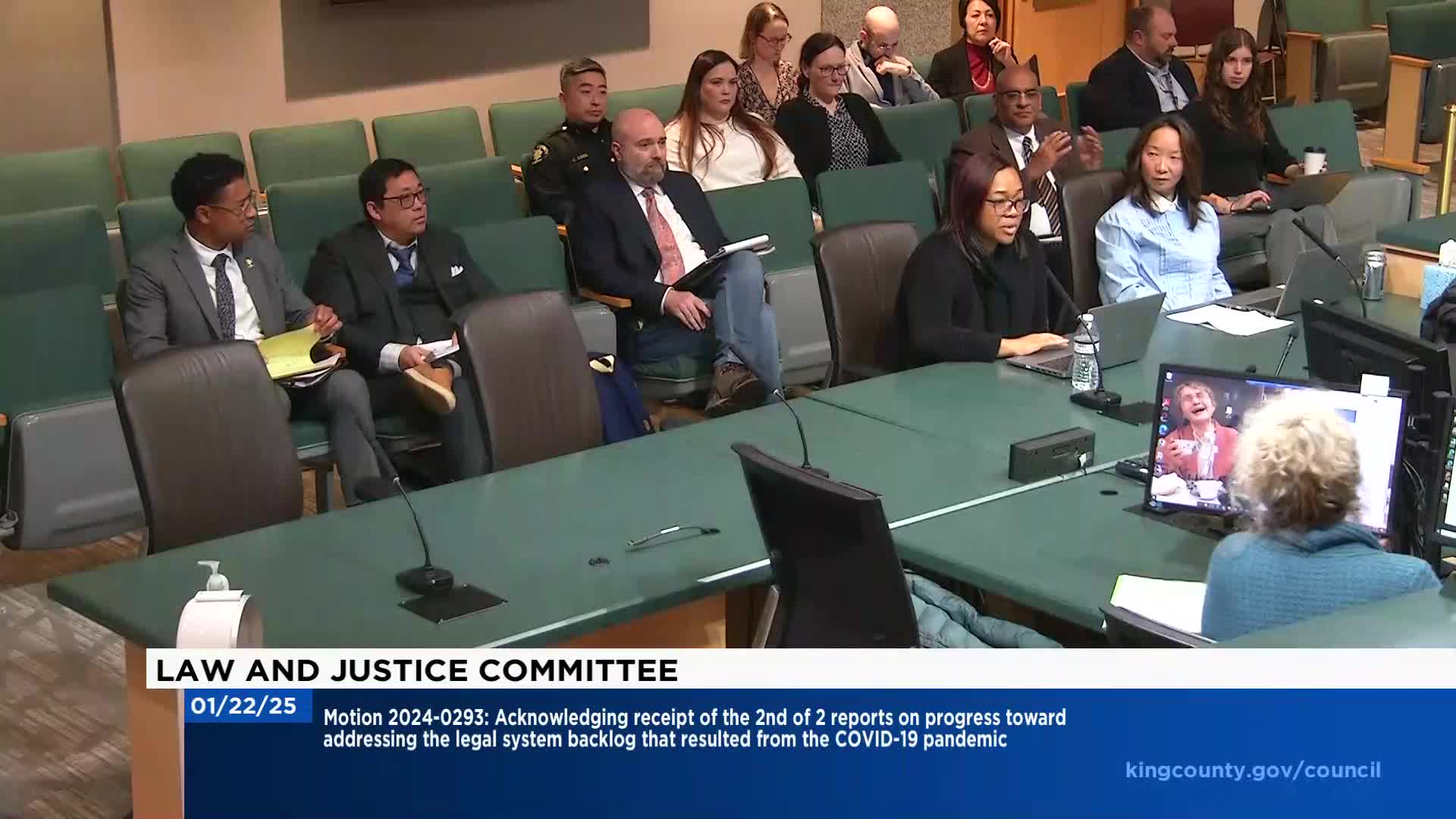
The Law and Justice Committee of the King County Council on Jan. 22 voted to acknowledge a second county report on the backlog in the criminal legal system that grew during the COVID‑19 pandemic.
The Law and Justice Committee of the King County Council on Jan. 22 voted to acknowledge a second county report on the backlog in the criminal legal system that grew during the COVID-19 pandemic. The motion (Proposed Motion 24-093) to acknowledge receipt of the report covering April 1, 2023, through June 30, 2024, passed by roll call, 3-0, with one member excused.
The report, prepared in response to a budget proviso tied to the 2023–24 biennial budget, shows that temporary pandemic-response positions funded through CLIFR (COVID-related legal funds) have largely expired and that county agencies spent roughly $20 million of CLIFR funds through June 30, 2024. Erica Newman of Council Central Staff told the committee the amount appropriated in the 2023–24 budget was about $23 million and that no additional CLIFR funds are expected in 2025.
Why it matters: County officials said the system has made progress but warned that the exit of one‑time funds will reduce capacity to process cases unless new resources or system changes are found. Prosecuting Attorney Lisa Mannion said the office had made “significant progress,” but reported 4,360 pending filed cases in Superior Court as of Jan. 22, 2025 — above pre‑pandemic averages — and noted the office dismissed 150 nonviolent cases as a one‑time measure in 2024 to reduce caseloads.
Panel members and agency leaders stressed that the most time‑intensive cases — homicides, certain sexual offenses, robbery and first‑degree assault — require disproportionate resources. Presiding Judge Shaw (Superior Court) told the committee the court still has more than 200 additional pending cases compared with February 2020 and that roughly 40% of Superior Court’s pending caseload are violent cases, which “take the most time.”
Department of Public Defense (DPD) leadership described the financial scale of county criminal legal operations and urged systemwide planning. Interim Director Matt Sanders said the county will spend roughly $200 million combined on prosecution and public defense in 2025 and argued that some non‑serious felony cases might be more efficiently handled in district court or diverted to other pathways to free capacity for the most serious matters. Sanders said the majority of backlog growth since 2019 involves less serious cases and advocated exploring filing‑venue changes and other evidence‑based reforms.
Committee members pressed for renewed cross‑agency coordination and described the need to reconvene a multi‑agency criminal justice council. Judge Shaw and other panelists supported returning to a formal collaborative forum to identify operational reforms and cost‑reducing measures while protecting the rule of law. Council member Dombowski emphasized that resource shortfalls risk eroding public confidence and could produce harmful consequences if not addressed.
Actions and outcome: The committee adopted the motion acknowledging receipt of the report, and it passed a technical amendment (Amendment 1) correcting typographical errors and aligning language with the original proviso. The committee voted to place the motion on the council consent agenda for the Feb. 4 full council meeting.
What the report said (key points): - As of June 30, 2024, county criminal‑legal agencies had 61 filled CLIFR‑backed positions and roughly 12 CLIFR‑funded vacancies (per the transmitted report). The majority of vacancies were reported in judicial administration. - Approximately $20,000,000 of CLIFR funds had been spent through 06/30/2024; the 2023–24 budget appropriation for those funds was just over $23,000,000. - By June 2024 the county had about 109 more pending serious felony cases than the 2019 average for the reporting quarters; overall pending filed cases in Superior Court were 4,360 as of Jan. 22, 2025 (PAO figure), which the prosecutor said was a notable improvement from pandemic highs but still above pre‑pandemic averages.
Outlook: Panelists urged the council to consider a mix of: (1) short‑term funding to preserve capacity, (2) renewed systemwide coordination across prosecution, defense, courts and law enforcement to redesign case flow, and (3) options such as refiling certain matters in district court or expanding diversion‑oriented, evidence‑based programming. No new budget appropriation was adopted at the committee meeting; the motion merely acknowledged receipt of the transmitted report.
Votes at a glance: Proposed Motion 24‑093 — Acknowledge receipt of second backlog report (04/01/2023–06/30/2024). Mover: Council Member Dombowski. Amendment 1 (technical corrections) adopted. Committee vote: 3 ayes, 0 nos; Council Member Dunn excused. Motion placed on Feb. 4 consent agenda for full council.
Ending note: Committee members said the report met the proviso requirement but emphasized the need for an updated, current assessment and a multi‑agency, convening mechanism to translate analysis into operational changes and to address an impending drop in capacity after one‑time funds expire.