Get Full Government Meeting Transcripts, Videos, & Alerts Forever!
Get email alerts on the Transit Safety topic
No spam. Unsubscribe anytime.
Regional transit committee presses Metro on operator safety after December homicide
Summary
Following the December homicide of a King County Metro operator, the Regional Transit Committee heard Metro general manager Michelle Allison describe immediate safety measures including added transit-police funding, operator shields procurement, expanded de-escalation training and reintroduced fare enforcement.
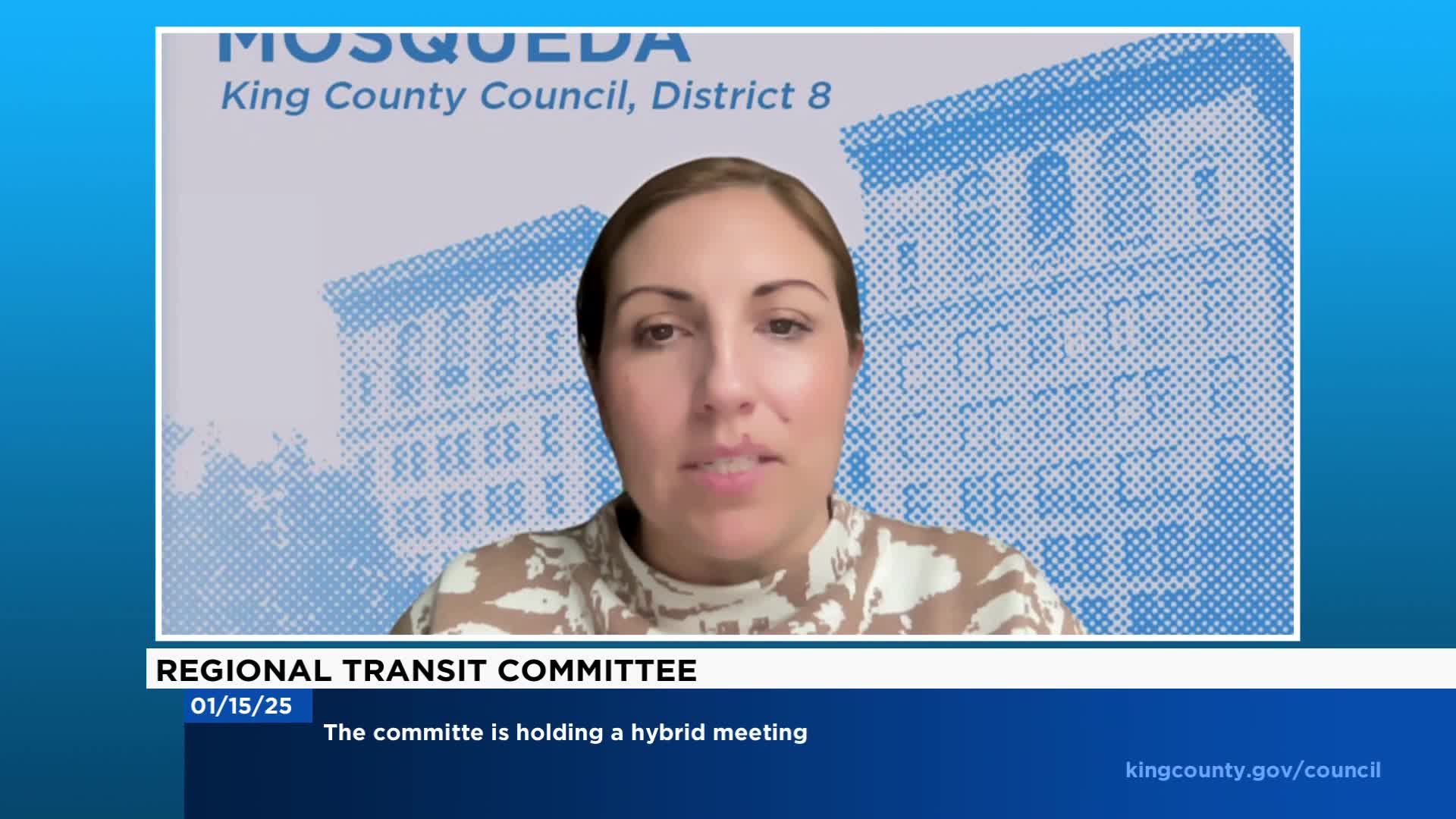
The Regional Transit Committee on Jan. 15 discussed a slate of safety and security measures King County Metro is accelerating after the Dec. 18 homicide of a bus operator, which committee Chair Theresa Mosqueda called a reminder of “the urgency of those investments.”
The committee meeting opened with remarks from Mosqueda, a King County councilmember and RTC chair, who read remarks from U.S. Rep. Pramila Jayapal and highlighted memorials and union actions following the death of operator Sean Yim. "Sean Yim died simply for doing his job," Mosqueda said, quoting Jayapal, and urged members to use the moment to implement "real, meaningful solutions" to protect transit workers.
Metro General Manager Michelle Allison told the committee Metro is taking a layered approach to safety that includes personnel, equipment and training changes. "Metro is in the process of hiring more metro transit police," Allison said, noting Metro has added 10 full‑time‑equivalent positions to its contract with the King County Sheriff's Office and is coordinating with the sheriff's office to fill vacancies. Allison said Metro and its security contractors will also make more overtime available to extend patrols into late‑night hours.
Allison described a multi‑year program to install operator barriers and said the agency is accelerating that work now. She said the market for operator shields is limited and Metro is working with the Amalgamated Transit Union and manufacturers to select an option that balances operator safety and customer service. "This has been a very large program," Allison said, adding that operator acceptance has evolved since initial conversations years ago and that future models are expected to improve.
Training and behavior‑management steps are also being expanded. Allison said Metro revised its de‑escalation training for new operators a few months earlier and will roll out refresher modules across the workforce "as early as Monday" after the Jan. 15 meeting. The agency is refreshing its code of conduct materials, she said, and plans to reintroduce fare enforcement after a training period for transit security officers; Metro’s fare enforcement program was first developed with community partners starting in 2018.
The committee and Metro staff emphasized partnership with the Amalgamated Transit Union Local 587 and other regional jurisdictions. Mosqueda said ATU Local 587 has pressed for a regional conversation and that Metro supports development of a task force; Allison said Metro will support an ATU‑led task force and expects regional partners to join.
Discussion on safety was set against Metro’s broader operational picture. Allison noted ridership growth — Metro reported a 14% increase in boardings in 2024, about 84 million annual boardings — and said Metro’s system is not yet fully recovered to pre‑pandemic levels, at roughly 85% of 2019 weekday ridership (about 320,000 average weekday boardings). She also highlighted an $80 million Federal Transit Administration grant for the RapidRide EyeLine project and recognition from the American Public Transportation Association for system growth.
King County council staff later reminded the committee that a King County Council budget proviso requires Metro to brief the RTC on transit safety and security by April 30; staff said they are coordinating with Metro to schedule that briefing and will share logistics with the committee.
Mosqueda and Metro staff emphasized that the measures described are part of a continuing effort rather than a single fix: hiring and contracting work must be completed, vendor availability affects barriers, and training and community engagement are ongoing. Allison said Metro will provide updates to RTC as work continues.
For now, the committee set a near‑term marker: Metro will present safety work in greater detail in the April briefing required by council budget language, and members said they expect to be invited to participate in any regional task force or stakeholder group the union and Metro convene.