Get Full Government Meeting Transcripts, Videos, & Alerts Forever!
Get email alerts on the Utilities Water Wastewater topic
No spam. Unsubscribe anytime.
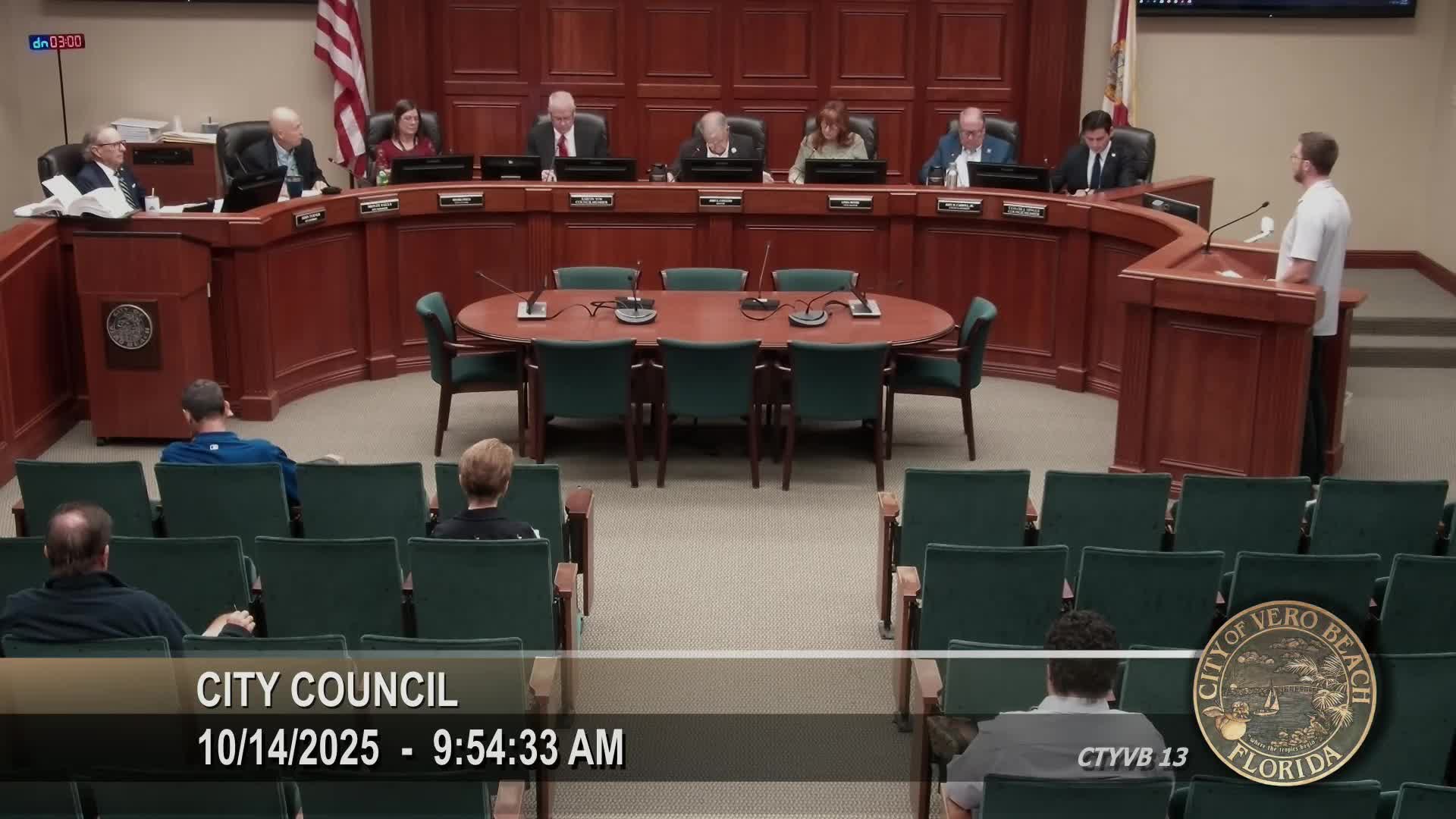
Vero Beach to borrow $55 million short term to keep water reclamation project on schedule
Summary
City staff and consultants told the council the city will seek a $55 million short-term loan this December as a bridge while it readies a long-term bond for the new Water Reclamation Facility; construction schedule remains on track with full operation targeted in mid‑2028.
Vero Beach officials told the City Council that they plan a short-term borrowing of $55,000,000 in December to maintain construction momentum on the new Water Reclamation Facility (WRF) and to buy time for audited financials and rate work needed before a long-term bond.
Will Taub, a financing consultant who briefed the council, said the short-term loan is intended as “bridge funding” while the city completes steps required to access long-term municipal bonds. “The first step forward would be to establish a short term borrowing in the amount of $55,000,000 that would take place in December,” Taub said. He and staff projected a long-term bond issuance in December 2026 with a potential bond size “in the ballpark of a $125,000,000,” subject to refinement as the project proceeds.
The financing timeline Taub presented calls for a short-term note with an 18–24 month maturity and interest-only payments during that period; staff expects to retire the note with proceeds from the long-term bond. The rate‑setting process would begin in January 2026, once audited financial statements are available, followed by a rate ordinance and final bond work with financial advisors in mid‑2026.
City staff described how grant funding will pay for equipment and parts with useful lives under 30 years while the bond would be tied to the core infrastructure of the plant and structured to align with the useful life of that equipment. Taub said preliminary cost estimates include a project contingency; council members pressed for clarity on contingency amounts and how much of the project the bond would need to cover.
Separately, city project managers updated the council on construction progress. Arjuna Verguda, acting utility director, said work on the WRF is moving and that, despite recent rain delays, Wharton‑Smith’s schedule still shows substantial completion in December 2027 and plant start‑up work through much of 2028. "We’re looking at about June 2028 to be, in fully operational," Verguda said, describing the months required for biological testing after mechanical completion.
Officials said current guaranteed maximum price (GMP) contingency for the latest construction package (GMP 3) is $12,600,000; staff reported only modest contingency use so far and said site‑preparation work accounted for most early outlays. Council members asked how decommissioning the old plant would be handled; staff said decommissioning and equipment transfer would be coordinated among the city, the contractor and consultants once the new plant is online.
Council members and staff stressed the sequence: secure the short-term borrowing in December, complete audited financials and a rate study early next year, adopt rate changes by mid‑2026, then issue long-term bonds by December 2026 to retire the short-term loan. Taub estimated interest costs on short-term borrowing in the neighborhood of 4 percent, based on market assumptions shared with the council.
The council did not vote on financing at the meeting; staff characterized the December short-term borrowing as the next planned administrative step to avoid construction delays.