
Jordan district projects multi-year enrollment decline; board refers impacted schools to facilities committee
Get AI-powered insights, summaries, and transcripts
Subscribe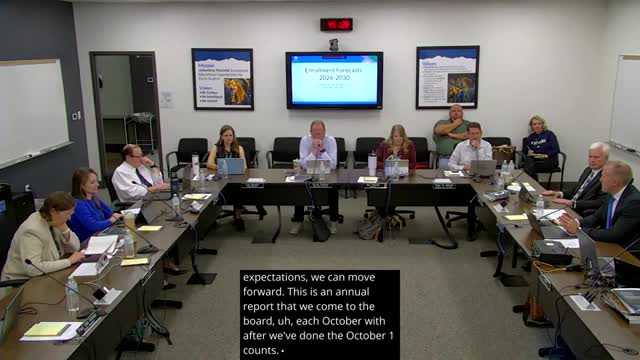
Summary
Administration presented a five-year enrollment forecast showing a projected drop of about 2,585 students (55,373 to 52,788). The board referred a list of schools — including Aspen Elementary and Joel P. Jensen — to the facilities committee for study of boundary, capacity and program options.
District planning staff presented a five-year enrollment forecast Oct. 14 that projects a decline from 55,373 students in the district’s Oct. 1 count to about 52,788, a drop of roughly 2,585 students. In light of those trends, the board referred a group of elementary and secondary schools to the facilities committee for further study of options such as boundary changes, repurposing or consolidation.
Mike Feston, the district planner who prepared the forecast, told the board long-term demographic drivers — fewer births per household and a post-pandemic slowdown in new-housing yields — are the primary causes. Feston used state birth data, local building-permit reports and national mortgage-rate trends to explain why the district’s school-age population is expected to decline over the coming decade. “We’re right here in 2025… we’re just coming off of the peak of this age wave,” Feston said, placing the district in a broader cyclical pattern.
Key findings presented to the board included: - A projected districtwide decline of about 2,585 students over five years; administrators said that equates roughly to 99 classrooms. - Kindergarten “yield” — the share of babies in district ZIP codes who eventually enroll in district kindergarten — has fallen from roughly 80% to about 70% in recent years. - Residential permits under construction total roughly 850 units in the district, concentrated in several growth pockets (Mountain Ridge, West Daybreak, Olympia Hills), but building slowed compared with the pandemic era.
At the school level, Aspen Elementary appears on the growth side; administration said short-term options such as portable classrooms and boundary changes could relieve pressure. Several West Jordan and Riverton-area elementary schools are on a potential-decline list; Joel P. Jensen and a small set of secondary schools were flagged under policy A13 because their forecasted enrollment would drop below 50% of architectural capacity and neighboring schools also fall below thresholds.
After the presentation the board agreed — without recorded opposition — to forward the identified schools to the facilities committee for analysis and possible recommendations. Board members and staff emphasized that referral is an early step: the facilities committee will analyze renovation costs, portables, boundary alternatives, permitting patterns and program placement before bringing options back to the full board.
Administration also reiterated the difference between architectural capacity and current-use capacity (the latter includes portables and altered room use), and reminded trustees that portables are a flexible but expensive short-term option.