Get Full Government Meeting Transcripts, Videos, & Alerts Forever!
Get email alerts on the Health Insurance topic
No spam. Unsubscribe anytime.
Joint finance committee approves $14,130 per‑employee health insurance funding for FY2026
Summary
On Jan. 31 the Joint Finance‑Appropriations Committee adopted a FY2026 funding level of $14,130 per eligible full‑time equivalent for state employee health insurance, choosing a compromise between a CEC recommendation and the governor’s proposal after debate over reserve balances and actuarial projections.
The Joint Finance‑Appropriations Committee on Jan. 31 voted to fund state employee health insurance at $14,130 per eligible full‑time equivalent (FTE) for fiscal year 2026, a midpoint between the committee on change in employee compensation’s recommendation and the governor’s proposal.
The committee approved the motion by voice/roll call, which produced a total of 17 ayes, 0 nays and 3 members absent or excused; the committee directed that the motion carry a due‑pass recommendation.
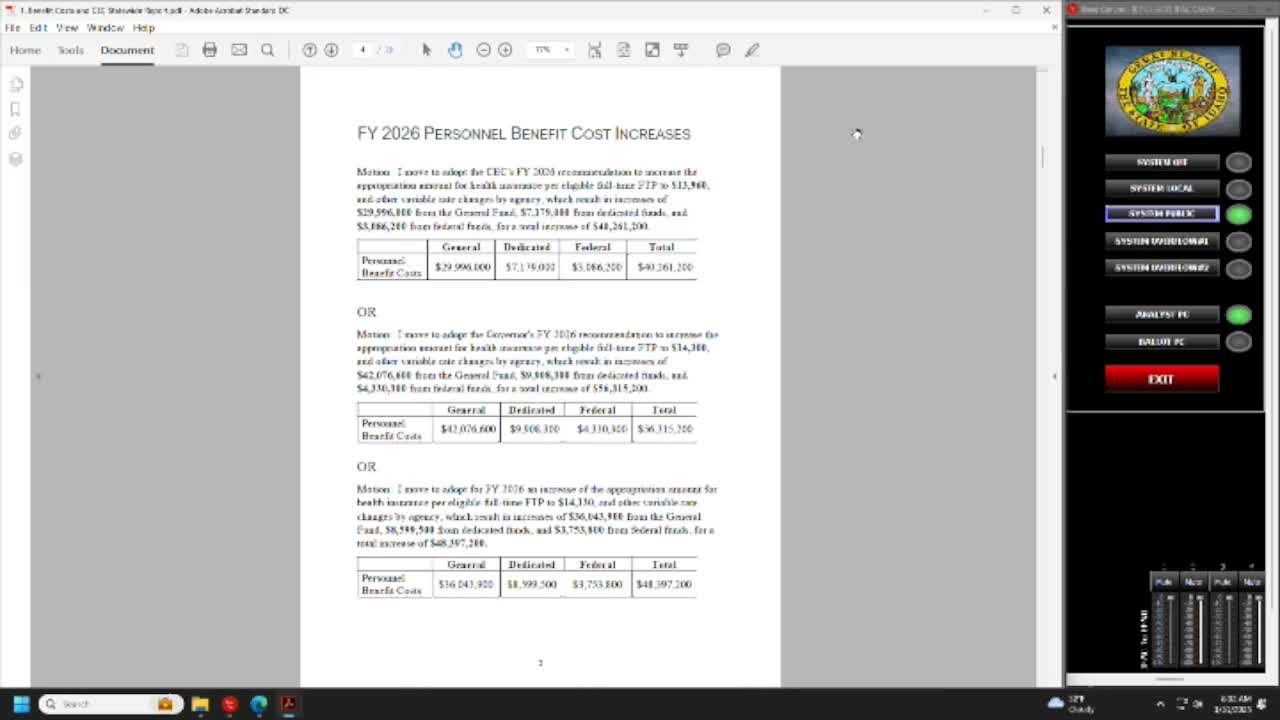
The vote settles one of three dollar options the committee considered. Staff analyst Mr. Bybee told the committee staff had prepared three alternatives: the CEC recommendation of $13,960 per FTE, the governor’s recommendation of $14,300 per FTE and a midpoint option of $14,130 per FTE. Bybee said the health‑insurance line was the largest single variable in the personnel benefit costs package and noted related employer‑paid adjustments (workers’ compensation and Social Security) are also included in agency budgets.
Committee members debated the choice on two main points: (1) whether to reflect the “actual cost” of insurance in the base number or to use reserve funds to buy down premiums, and (2) the appropriate reserve balance to maintain solvency. Senator Ward Engelking said the higher figure better reflects current costs and cautioned that using reserves to smooth premiums would make future increases look larger. Representative Furness challenged the actuarial projections cited by staff, saying Milliman’s projections have been ‘‘ultra conservative’’ in past years and urging a lower premium figure.
Mr. Bybee summarized projected reserve balances associated with the options: the $13,960 option projects an ending reserve balance of about $51.6 million for FY2026, the $14,300 option projects about $61.4 million, and the $14,130 midpoint falls between those figures.
The adopted $14,130 motion carries the following fiscal effect as stated in the motion: an increase of $36,043,900 from the general fund, $8,599,500 from dedicated funds and $3,753,800 from federal funds, for a total increase of $48,397,200.
Committee staff and members said the action is intended to align appropriation levels with near‑term premium projections while preserving a reserve balance judged sufficient by staff. Representative Furness and others urged caution about overfunding reserves, noting historical reserve balances and the stated goal of prior benefit changes to reduce costs.
The committee moved next to separate Change in Employee Compensation (CEC) motions; the CEC items were debated later in the same hearing and are reported separately.