Get AI Briefings, Transcripts & Alerts on Local & National Government Meetings — Forever.
Seattle forecast council adopts baseline October revenue forecast; office flags elevated uncertainty
Loading...
Summary
The forecast council adopted a baseline economic and revenue forecast on Oct. 20 that raises the city—s 2025—26 general fund projection by $12.1 million over two years but warns of elevated uncertainty, a roughly 33% chance of recession in the next 12 months, and regional job declines in 2025.
Chair Dan Strauss called the Oct. 20 Select Budget Committee meeting to consider the city—s updated economic and revenue forecast, which the Forecast Council recommended adopting as the official October forecast.
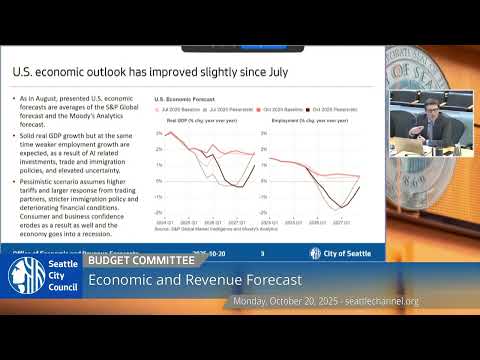
The Forecast Office recommended the baseline scenario and presented an update showing a modest upward revision to general fund revenues: a $12.1 million net increase across 2025 and 2026 and roughly $7.6 million of that reflected as ongoing revenue in 2026. "In the forecast council meeting this morning, the forecast office has recommended the baseline scenario to be used as the official October forecast," said Jan Douris, interim director and chief economist at the Office of Economic and Revenue Forecast.
Why this matters: the October forecast is the principal revenue estimate the City Council uses to set budgets and evaluate councilmember proposals. The presenters said the baseline shows slightly better economic growth than the forecasted pessimistic path, but they warned the outlook carries more uncertainty than usual because of recent policy changes and volatile indicators.
Key figures and drivers
- General fund: net upward revision of $12.1 million for 2025—26, with about $7.6 million reflected as an ongoing increase in 2026. - Regional jobs: Washington State Employment Security Department revisions show a 0.7% decline in Seattle Metro Area employment (King and Snohomish counties) year over year for the first eight months of 2025, about 13,000 jobs lost. - Recession probability: presenters estimated the likelihood of a recession in the next 12 months at roughly 33% (the pessimistic scenario remains that possibility, while the council adopted the baseline scenario). - Policy and tax changes: the forecast incorporates state changes identified as "Senate Bill 5814" and the city—s new 0.1% public safety sales tax; the presenters said those changes are expected to raise revenues but the precise magnitude is uncertain pending new data. - Major line items called out by staff: a $4.1 million upward revision to property tax estimates (driven by new construction and lower-than-expected refunds), an upward revision to sales and business-and-occupation (B&O) tax receipts tied to stronger collections year to date, and a multiyear interest-income decline expectation tied to anticipated Federal Reserve cuts.
Presenters also highlighted several non-general-fund changes: payroll expense tax interest income (2024 actuals $11.2 million; estimated 2025 interest receipts around $10.1 million, revised to about $9.726 million), sweetened beverage tax collections that were stronger than expected with projections of roughly $20.3 million for 2025 and $22.3 million for 2026, and an anticipated increase in automated traffic camera revenues due to expanded school-zone cameras coming online later this year and early next year.
Discussion and uncertainty
Committee members asked how the forecast team accounted for the missing federal employment report (not released because of a federal shutdown) and for steep volatility in markets this year. "It would be better to have that extra month of data available," Douris said, but added that national forecasts from S&P Global and Moody—s Analytics (used as inputs) had already been released in early October and the forecast methodology accounts for a lag in local employment releases. Councilmembers pressed staff about the regional job losses and modeling assumptions; presenters said the forecast uses national scenario projections combined with regional statistical models that translate national indicators into local employment, income, home-price and other inputs, and then links those regional indicators statistically to revenue streams.
The committee and Forecast Office repeatedly emphasized that uncertainty has risen this year for several reasons: recent tax-base changes at the state level, shorter history for newly created revenues (notably the payroll expense tax), volatility in stock prices concentrated in the tech sector, and Federal funding reductions at higher levels of government.
Outcomes and next steps
The Forecast Council—s recommended baseline forecast was adopted as the official October forecast at the morning Forecast Council meeting and presented to the Select Budget Committee. No formal committee votes were taken during this Select Budget Committee meeting on policy or budget items; the presentation was informational and intended to inform the upcoming budget calendar and councilmember proposal process. Chair Dan Strauss reminded members that initial councilmember budget proposals are due to central staff by noon on Oct. 21 and that the committee will reconvene on Oct. 28 to consider council proposals.
What staff and council said
Douris: "There is a large amount of uncertainty regarding the revenue forecast," and staff expect that realized revenues for 2026 could differ more from the forecast than in past years.
Chair Dan Strauss said the Oct. forecast showed cautious optimism but warned that federal funding reductions could require local budget action despite a positive revenue update.
Councilmember inquiries focused on the assumptions behind the pessimistic scenario, the implications of missing federal employment data, and the historically short data series for some new tax streams.
Taper/looking ahead
The forecast office told the committee it will continue to update the forecast as new data arrive and monitor the impacts of state tax changes and large events (including major sports and tourism events). The October baseline will be the working figure for councilmembers preparing budget proposals next week.