Get Full Government Meeting Transcripts, Videos, & Alerts Forever!
Get email alerts on the Prisons Security And Transport topic
No spam. Unsubscribe anytime.
After staff shooting, Idaho DOC seeks technology, transport expansion and body‑worn camera funds
Summary
Following an ambush of staff during a transport last spring, the Department of Correction requested surveillance and transport bureau expansions, body‑worn camera pilot funds and other equipment in its state prisons budget.
The Idaho Department of Correction asked the Joint Finance Preparations Committee on Feb. 4 for multiple supplements and ongoing appropriations intended to reduce contraband, improve transport safety and add investigative capabilities after an incident last spring in which staff were shot during a transport.
Analyst Noah Peterson said the supplemental requests were prompted by the spring incident. "These supplementals and enhancements, are proposed by the agency to address vulnerabilities that were discovered within the agency," he told the committee.
State prisons division requests include a suite of advanced surveillance items (digital mail scanning, drone detection and phone‑call transcription/analysis) listed as a $795,000 supplemental for the remainder of fiscal 2025 and $2,397,000 ongoing in a full year. Peterson broke down the ongoing costs: digital mail scanning $1,011,000; drone detection $385,500; and LEO phone‑transcription/analysis $1,000,000. Peterson said digital scanning would divert mail to an off‑site location to be opened, scanned and delivered digitally to residents; LEO would transcribe and analyze inmate‑civilian phone calls; drone detection would use layered sensors to detect approaching unmanned aircraft.
Director Josh Tewalt told the committee the level of sophistication used to introduce contraband has increased. "The level of sophistication that is being deployed today to introduce contraband into correctional facilities is unlike anything any of us in the field have ever seen," he said, adding that mail scanning would "completely eliminate our most porous point of entry for contraband in our facilities." Tewalt argued mailing scanning would let staff be redeployed to other security tasks.
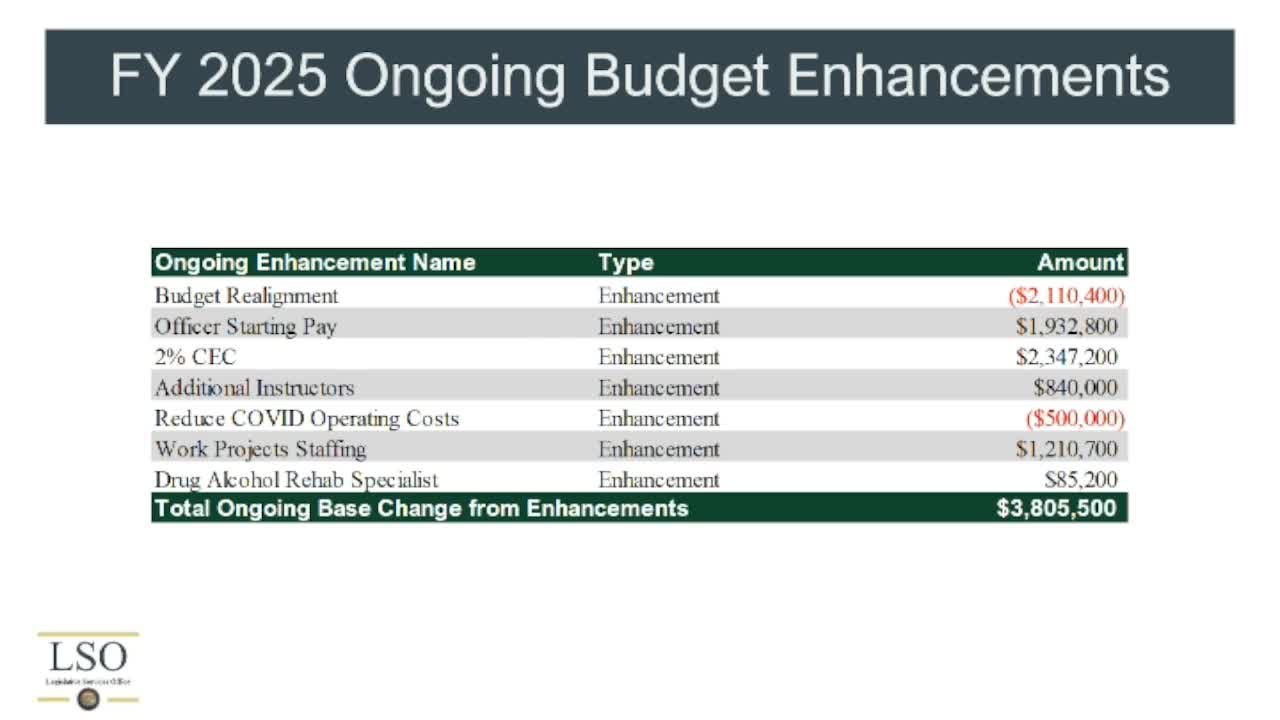
The prisons division also sought a one‑time $1,148,000 supplemental to expand the transport bureau to conduct emergency and high‑risk transports. Peterson said the request included funding for 12 positions ($455,000 for personnel costs for the remainder of the fiscal year and $693,000 for operating costs, including seven fully equipped vehicles). The agency proposes 12 ongoing FTP and $965,500 in annual personnel and operating costs to sustain the expanded transport bureau; Tewalt described significant overtime hours in the aftermath of the ambush and said the bureau would provide a trained statewide resource for high‑risk moves rather than diverting multiple facility staff.
Peterson described a federal body‑worn camera grant pilot costing $1,051,000 in fiscal 2025 (about $1.024 million federal and $27,000 general fund) that would equip three IDOC sites in year one. The agency noted a continued state match will be required in later fiscal years if the pilot continues and that ongoing license costs of about $505,000 would appear in later budgets.
Other prison items included a proposed $83,200 capital purchase for a skid‑steer (snow removal) at the St. Anthony work camp; the governor recommended contracting snow removal for $30,000 ongoing instead. The governor otherwise recommended most requested items, Peterson said.
Committee members asked how the transport expansion creates 12 new FTP when facility staff already handle some transports. Tewalt said emergency transports have historically been handled as an "other duty as assigned" that disrupts facility posts and generates large overtime; creating a trained transport resource avoids shifting facility staffing relief factors that would require a far larger hiring increase.
No formal votes were taken at the hearing; analysts and agency staff agreed to provide detailed lists of replacement items, equipment life estimates, and written explanations of transport bureau staffing and overtime costs to the committee.