Seattle committee reviews Human Services Department budget, flags sustainability risks for wage increases, shelter expansion and downtown pilot
Loading...
Summary
The Select Budget Committee met Oct. 17 to review the Human Services Department’s proposed 2026 budget and to discuss several sustainability risks tied to ongoing costs, including a 2% provider wage equity increase, phased shelter expansion and a $4 million downtown pilot.
The Select Budget Committee met Oct. 17 to review the Human Services Department’s (HSD) proposed 2026 budget and to discuss several policy risks tied to ongoing costs.
Chair Dan Strauss opened the committee’s agenda item and the department and Council central staff delivered the briefing. Director Ben Noble, Human Services Department, and Council Central staff members Jennifer Lebreque and Jasmine Marwaha presented the budget overview and several central‑staff policy considerations.
The 2026 proposed budget for HSD was presented as an increase of 11.6% — roughly $45 million — compared with the 2026 endorsed budget. Central staff said the increase reflects new funding for homelessness, community safety, food and nutrition, public health, and increases to provider wages and contracts.
Central staff described personnel changes in the proposal: 11 new full‑time positions are included in the 2026 proposed budget. Nine of those positions, added in a mid‑year supplemental ordinance, are intended to support the state Washington Cares long‑term care program and are supported by state grant funds; two new case manager positions were described as additions to HSD’s post‑overdose team and would be supported by revenue from a proposed public safety sales tax.
Policy considerations: wage equity
Jennifer Lebreque, Council Central staff, told the committee the proposed budget provides an ongoing 2% human‑services provider wage equity increase, estimated at $5.1 million, in addition to a 2.6% inflationary adjustment required under the Seattle municipal code. Lebreque warned the council that sustaining that ongoing increase will be a decision point for the 2027 budget cycle because the city faces a projected $140 million general‑fund deficit in 2027.
"Failure to sustain these new investments would mean that wages would decrease for human services workers," Lebreque said, clarifying later that employees would experience a loss relative to the higher baseline if future budgets do not continue the increase. Central staff noted the wage‑equity effort stems from a 2022 University of Washington report the city commissioned and that a 2% increase was provided in 2024; the 2026 proposal would add another 2% toward a multi‑year goal.
Policy considerations: shelter expansion
Central staff also reviewed the mayor’s proposed multi‑year shelter expansion, which aims for roughly 305 new units by 2027. The 2026 proposed budget includes about $7.0–$7.8 million intended to cover startup costs and approximately three months of operating support for 150 beds projected to begin late in 2026. Staff said about $10 million per year would be required to operate those 150 beds for a full year, meaning an additional roughly $3 million would be needed beyond the 2026 appropriation when the units are fully operational. For the full 305 units, staff estimated annual operating costs of about $26 million once all phases are in service.
Lebreque told the committee the 2026 funding as presented is not sufficient to maintain full‑year operations for the phase of beds scheduled to open in 2026 and that council should anticipate identifying additional ongoing funding in future budgets if it intends to sustain the expansion.
Policy considerations: Community Solutions innovation pilot
The 2026 proposed budget includes a $4 million one‑time general‑fund allocation for a downtown pilot described as the Community Solutions innovation pilot. Central staff said HSD would administer the funding (rather than the King County Regional Homelessness Authority, which manages the city’s other shelter contracts). The Downtown Seattle Association (DSA) was described as the proposed lead entity, with a subcontract to Purpose Dignity Action (PDA) for implementation.
Central staff emphasized that the pilot remains in early design; a program budget and details on geographic focus, outcomes and administrative costs had not been provided to the committee. Staff flagged three primary options for the council: (a) proviso the $4 million pending more details about design and an operations continuity plan, (b) require administration by KCRHA so the pilot aligns with existing shelter contracting, or (c) reallocate the funds to a use better suited to one‑time funding. Staff warned that one‑time funding is a poor fit for a program that may require ongoing funding to avoid service disruptions.
Councilmembers asked questions about administrative overhead if DSA subcontracted to another provider and about lessons learned from the earlier Partnership for Zero program that focused on downtown approaches.
Policy considerations: sweetened beverage tax fund swap
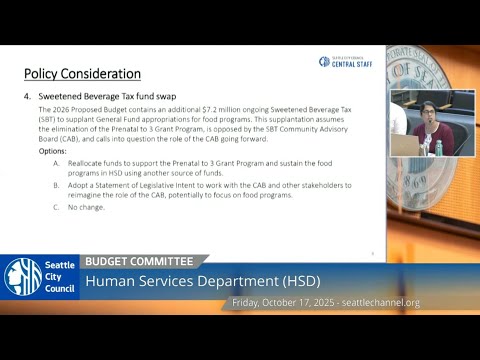
Central staff described a proposed reallocation that would use additional sweetened beverage tax (SBT) revenues — presented as roughly $7.2 million ongoing in the 2026 proposal — to supplant some general‑fund spending on food programs. Staff said the proposed budget would rely on a fund swap with the Families, Education, Preschool and Promise (FEPP) levy and that the SBT community advisory board had not been consulted and opposed the proposed use and the proposed elimination of the prenatal‑to‑3 grant program. Staff said the prenatal‑to‑3 program as discussed in the briefing carries approximately $1.5 million in funding and is proposed for elimination in the 2026 package.
Director Ben Noble and central staff noted that SBT revenues have been volatile and, while they have stabilized since pandemic declines, they are not growing and the fund could be projected out of balance after 2028 if used for ongoing expenses. Noble said that some programmatic decisions tied to SBT could create longer‑term sustainability risks.
Committee requests and next steps
Committee members asked for additional program budgets, details on administration and subcontracting costs for the downtown pilot, and clarifications on the startup versus ongoing costs for shelter phases. Central staff recommended that council expect requests to continue one‑time pilots in 2027 unless a clear ongoing funding strategy is identified. Several members urged caution about using one‑time funds for programs with ongoing service needs.
No formal motions or votes were recorded on HSD items during the session; councilmembers and central staff discussed options and information needs ahead of amendment deadlines and forthcoming hearings.
Ending
The committee scheduled remaining procedural steps in the budget calendar and asked staff to provide the requested program budgets and a clearer breakdown of startup versus ongoing operating costs for the shelter expansion and for the Community Solutions pilot. The briefing closed with a reminder that the broader budget process will require the council to reconcile one‑time allocations with ongoing needs in the face of a projected 2027 general‑fund shortfall.