Lifetime Citizen Portal Access — AI Briefings, Alerts & Unlimited Follows
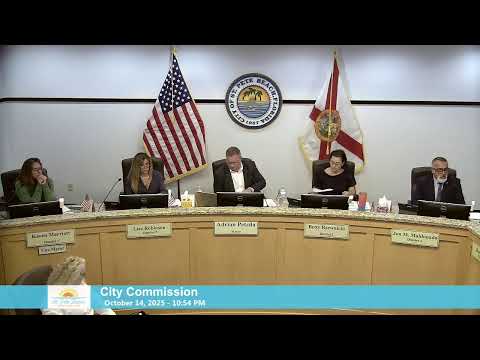
Commission continues Corey Landings density allocation and CUP to Oct. 28 after hours of testimony and technical review
Loading...
Summary
The St. Pete Beach City Commission continued first reading of ordinance 2025-20 (density allocation) and postponed action on resolution 2025-23 (conditional use permit) to Oct. 28 after developer presentations, technical reports and public comment raised questions about traffic, sewer infrastructure, park maintenance and public boat access.
St. Pete Beach commissioners continued the first reading of an ordinance to allocate residential density to the Corey Landings mixed‑use project and postponed action on the project's conditional use permit until Oct. 28 after more than three hours of presentations, technical testimony and public comment.
The measure on first reading was ordinance 2025‑20, the developer's request to draw 25 residential units from the city's residential density pool for the modified Quarry/Corey Landings project at and near 10 Corey Avenue. The companion resolution, 2025‑23, would approve the conditional use permit for a mixed‑use development that proposes 133 condominium units, about 11,000 square feet of retail and restaurant space and 39 boat slips (4 Class A transient slips and 35 private slips). Staff and the applicant requested additional time to refine conditions and answer outstanding questions; the commission voted unanimously to continue both items to Oct. 28.
Core details and why it matters
The applicant told the commission the modified project reduces potential traffic compared with a previously vested approval. Transportation consultant Becca Bond of Kimley‑Horn said the 2025 modification is projected to generate 82 PM peak‑hour trips, 75 fewer PM peak‑hour trips than the 2022 vested development the property currently holds. "This subject request results in a decrease of 75 PM peak hour trips when you compare to the 2022 vested development," Bond said during her presentation.
The developer and project team described other changes since the 2022 approval: the site will contain three residential structures, a public plaza, a public park at the end of Corey Avenue, a public promenade along the north edge of the property, and the same total of 39 dock slips as previously permitted but with a reallocation from public to private slips (the earlier approval included more public slips). The proposal would return 125 units to the city's residential density pool for future allocation elsewhere in the city, the applicant said.
Supporting testimony and analyses
Project experts delivered technical testimony on architecture, landscape, utilities, stormwater and transportation. Architect Robert Hall described building massing, façade treatments and podium design intended to create a pedestrian‑oriented street edge and a view corridor to Boca Ciega Bay. Landscape architect Keith Morrow said planted areas would use at least 50% Florida native and drought‑tolerant species and an irrigation system tied to reclaimed water where feasible.
Civil and stormwater engineer Scott Gilner (Kimley‑Horn) described plans to replace seawalls, rebuild the bulkhead, collect and treat stormwater in on‑site vaults and discharge to Boca Ciega Bay under applicable water‑quality requirements; he said treatment would be an improvement over current, largely untreated runoff. Gilner and other staff said the developer proposes to build new seawall sections, street realignment, underground utilities and on‑site stormwater vaults at the applicant's expense.
Traffic consultant Becca Bond said the project's PM peak hour analysis followed Forward Pinellas and city methodology and found no level‑of‑service deficiencies at the intersections studied. Commissioners and residents pressed that the method used the standard PM peak hour (4–6 p.m.) rather than the midday or weekend peaks more typical of beach areas; several commissioners and neighbors asked the applicant and staff to revisit counts, weekend effects and turn‑lane capacity at the Mangrove/70th Avenue approach to Gulf Boulevard.
Concerns raised by commissioners and the public
Commissioners and dozens of residents pressed the developer and staff on multiple topics:
- Traffic and cut‑throughs: Neighbors said vehicles will divert onto narrow residential streets (Bay Street, Gulf Winds and 70th Avenue runs) and asked for traffic‑calming measures, enforcement and an FDOT review of turn‑lane geometry at Mangrove and 70th. Commissioners asked staff to return with options that could be enforced during construction and after occupancy.
- Sanitary sewer condition and capacity: Commissioners and residents flagged an aging gravity sewer trunk running toward Pump Station 1. The team said the county has capacity to serve the project but acknowledged the line is old in places; the applicant offered up to $250,000 (noted as a not‑to‑exceed contribution) to help with repairs once CCTV inspections identify needed point repairs. The city attorney cautioned that Florida law limits how municipalities may spend developer contributions and that any payment must be structured to comply with state case law.
- Park ownership, maintenance and liability: The proposal includes a public park on city property and a public plaza and promenade on the applicant's property; the applicant said it would construct the park but not perform long‑term maintenance. Commissioners asked for an estimate of annual city maintenance costs and suggested negotiating a temporary developer contribution to maintenance during an initial transition period so the city is not left with unbudgeted ongoing expense.
- Boat slips and public water access: The 2022 approval contained eight public transient slips; the modified plan shows four transient (public) slips and 35 private slips. Multiple speakers urged more public transient slips or a dedicated kayak/paddle‑craft launch to support Corey Avenue businesses and future waterborne transit. The applicant said existing submerged‑lands permits and the project's current dock configuration constrain change; technical permitting agencies (Army Corps, FDEP, Water Management District) must also approve any modification.
- Phasing and commercial occupancy: Commissioners asked how and when retail and restaurant space would be delivered. The applicant said residential shell certificates of completion and tenant build‑out will be sequenced so mixed‑use components are available as the residences occupy; the applicant agreed to a condition tying final residential certificates to completion of the retail shell for each building.
Actions recorded and next steps
- Ordinance 2025‑20 (first reading; density pool allocation): continued to Oct. 28, 2025 (vote to continue: 5–0). - Resolution 2025‑23 (conditional use permit 25069): continued to Oct. 28, 2025 (vote to continue: 5–0).
The commission asked staff and the applicant to return with clarified and tightened conditions addressing traffic calming, a proposed contribution and mechanism to address sewer repairs if needed, clearer guarantees on timing and sequencing for retail/restaurant build‑outs, refined public‑access language for the promenade and transient docks, and costed estimates for park construction and short‑term maintenance funding.
Public comment and neighborhood reaction
Dozens of residents, business owners and neighborhood representatives spoke for and against the project. Several small‑business owners on Corey Avenue and a local theater operator urged approval, saying the project would bring customers and economic activity. Boat operators and recreational users urged more public transient slips or at least a kayak/paddleboard launch for greater water access. Many nearby homeowners stressed traffic, safety and sewer‑system concerns and asked for enforceable mitigation measures.
Why the commission delayed final action
Commissioners said they wanted a single clean package of conditions and numerical estimates (seawall and park costs, sewer repair cost and the proposed not‑to‑exceed contribution, and traffic‑calming measures) so the public and the commission could review changes before final votes. The applicant and staff agreed to return with revised paperwork at the Oct. 28 hearing.
Ending note
The project team said the developer expects to commence construction once approvals, permits and market conditions align; the commission’s request for more precise conditions and budgeted mitigation will shape whether the project advances on the schedule the applicant described.