Get AI Briefings, Transcripts & Alerts on Local & National Government Meetings — Forever.
Forecast council concurs with October 2025 baseline revenue forecast; staff warn of elevated uncertainty
Loading...
Summary
Seattle's Economic and Revenue Forecast Council on Monday, Oct. 20, 2025, recorded its concurrence with staff'recommended October 2025 baseline revenue forecast, which will guide city budget deliberations for 2026.
Seattle's Economic and Revenue Forecast Council on Monday, Oct. 20, 2025, recorded its concurrence with the Office of Economic and Revenue Forecasts'recommendation to use the October 2025 baseline revenue forecast as the official forecast that will guide the remainder of the city's 2026 budget process.
The action was taken at a public meeting in the council chambers at Seattle City Hall and by virtual participants; Chair Dan Strauss said the council would record its concurrence in the minutes after staff recommended the baseline and no members objected. That forecast will be the basis for City Council deliberations on the mayor's proposed 2026 budget and other near-term budget decisions.
Forecast staff led by Interim Director Jan Duras presented three scenarios'baseline, pessimistic and optimistic'and recommended the baseline despite a wider-than-normal range of risk. "We are recommending to use the baseline scenario of the presented forecast as the official revenue forecast," Duras said during the presentation. He and other staff warned that elevated economic uncertainty, weak regional employment data and recent policy changes mean the city should budget conservatively.
Staff highlighted several specific drivers behind the recommendation. Seattle-area employment estimates were revised downward by the Washington State Employment Security Department, showing a roughly 0.7% year-over-year decline (about 13,000 jobs) in the Seattle metropolitan division through August 2025. That decline was broad-based, with the largest losses in professional and business services (about 11,000 fewer jobs through August 2025) and a notable downturn in construction.
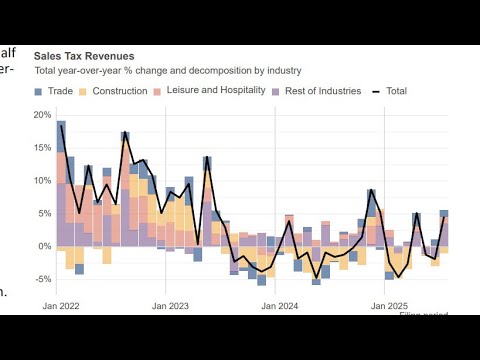
Sales tax collections have weakened in 2025, with five of the seven months for which obligations are available showing year-over-year declines. Forecast staff attributed the weakness primarily to the construction downturn and soft retail and leisure-and-hospitality receipts. At the same time, staff noted policy changes that materially affect forecasts: the estimate incorporates the effects of state Senate Bill 5814 and House Bill 2015 and the city's new 0.1% public safety sales tax. The forecast office cautioned that the effect of these law changes remains uncertain because of limited data.
Payroll-related revenues were singled out for volatility. The payroll expense tax has been on the books for fewer than five years, and forecast staff said it will take multiple years to understand its steady-state behavior. Staff noted that stock-market gains concentrated in a handful of large technology firms materially affect payroll-tax receipts. The forecast showed an expected rise in payroll-related receipts in 2025 but large downside risk: under the pessimistic scenario payroll expense tax receipts would be roughly $37 million lower relative to the August baseline.
Staff provided several headline numbers: the update raises general-fund revenues by about $12.1 million across 2025'26 excluding grants and transfers (roughly 0.3% in 2025 and 0.5% in 2026). Sales and use tax collections were projected to rise from $340 million to $344 million in 2025 and approach roughly $402 million in 2026 in the baseline. The forecast team reported the payroll-expense-tax fund accrued about $11.2 million in interest in 2024 and noted that interest income is expected to decline as the Federal Reserve cuts interest rates. Staff told the council that about $15 million of the city's 2026 interest-income estimate comes from general-fund investment income.
On alternative scenarios, staff reported the pessimistic scenario would lower general-fund revenues by about $114.4 million over two years versus the baseline; the optimistic scenario would raise revenues by about $94 million. The forecast office said the pessimistic scenario would resemble a mild recession (closer to 2001 than 2008 or the pandemic), with employment losses and weaker consumer spending; it recommended the baseline as a balance between upside and downside risks but urged policymakers to recognize the unusually wide uncertainty interval.
During the meeting Council President Sarah Nelson and other council members pressed staff on regional employment trends and on how the business-and-occupation (B&O) tax restructuring on the ballot could change volatility in future collections. Staff said the B&O restructure would narrow the tax base and could increase revenue volatility because fewer payers would account for a larger share of receipts. The forecast office also flagged an internal error in the presentation: a grant-line item should have shown no change for 2025 and 2026; staff said they would correct the tables after the meeting.
After the presentation the council proceeded with the formal steps on the agenda. The agenda and minutes from the Aug. 4, 2025 meeting were adopted earlier in the session by unanimous consent. When the forecast recommendation was presented, Chair Dan Strauss said that, per the establishing ordinance, if no member objected the minutes would reflect concurrence with the staff recommendation; no members objected and staff were directed to record the concurrence. Strauss noted that overriding the forecast office's recommendation would require a three-member vote under the ordinance.
Forecast staff and budget office staff asked members to use caution when spending any newly forecasted revenues, citing the wide range of potential outcomes in the next 6'12 months and the possibility of further federal-level policy shocks. "That's more than typical what we have seen in past regarding where we might be a year from now," Duras said, summarizing the risk assessment.
The council adjourned after the concurrence was recorded. Staff said they will continue to monitor national and regional data, correct the grants line in the published tables and prepare the next scheduled update.