Get Full Government Meeting Transcripts, Videos, & Alerts Forever!
Get email alerts on the Municipal Finance Roads Stormwater topic
No spam. Unsubscribe anytime.
Committee recommends 2.5% city property‑tax increase to fund multi‑year road and stormwater program
Summary
City finance committee reviewed an engineer‑driven pavement-management plan and a stormwater program totaling several million dollars and recommended submitting a 2.5% city property‑tax increase to the county; the group discussed borrowing options, inflation risk and a multi‑year funding plan.
The Woodland Hills City finance committee recommended submitting a 2.5% city property‑tax increase to the county as part of a plan to fund multi‑year road repairs and stormwater projects, committee members said during a budget workshop. The committee set a truth‑in‑taxation public hearing for Aug. 12 and scheduled follow‑up budget discussions for later August and September.
Committee members said engineers used a pavement‑management plan and aerial/video condition assessment to score the city’s roughly 17 miles of roads and recommend treatments ranging from microseal to pulverize‑and‑repave. Staff also presented a separate stormwater runoff assessment, done with some FEMA funding, that identified several detention‑basin reconstructions and infiltration measures to reduce runoff leaving the city.
The plan presented breaks the work into bite‑sized projects across six years to limit the one‑year impact on residents. Staff identified an estimated $1.2 million in the city’s general savings that could be applied to roads but warned that paying for the full program from savings alone would deplete reserves. Under the scenario the committee approved submitting to the county, the city portion of property taxes would rise 2.5% annually; combined with state valuation increases, staff estimated an average homeowner could see roughly a 10% overall property‑tax change this year.
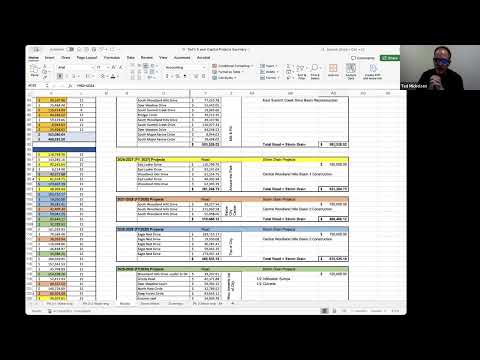
Staff outlined project costs and timing: a microseal project already under contract and budgeted for about $525,000 is scheduled for August; an additional mill‑and‑fill package and other FY2026 road segments total roughly $500,000; stormwater repairs and basin work were estimated in the hundreds of thousands (one stormwater subtotal cited at about $780,000). Taken together, staff said the remaining unfunded need beyond projects already under contract ranged from roughly $1.7 million (for a subset) up to $3.6 million if the committee chose to finance the entire program immediately. Committee members asked staff to provide a refined amortization comparison showing multiple borrowing terms and construction‑inflation scenarios.
Discussion focused on three financing options: (1) use a larger portion of reserves and build projects over several years; (2) borrow the full amount and complete the program now to capture construction‑pricing efficiencies; or (3) a hybrid: borrow part and use reserves to preserve liquidity and leverage better loan terms. Staff and several members flagged construction‑cost inflation as the largest unknown and said doing everything now could reduce future inflation risk but would increase near‑term debt service and reduce flexibility for emergency repairs.
The committee did not take a formal roll‑call vote on an ordinance or bond authorization at the meeting. It did, however, confirm that the council’s finance staff submitted a 2.5% city tax increase figure to the county for the property‑tax notices and set the public truth‑in‑taxation hearing for Aug. 12. Staff agreed to return with three borrowing scenarios (shorter/medium/longer terms and different assumed construction‑inflation rates), an amortization schedule, and a clearer split of which projects staff would recommend for immediate financing versus those to phase in.
The workshop also included operational notes: the city will use separate funds for water‑fund work (waterline replacement to be paid by the water fund), and some stormwater basins were built by developers (Summit Creek developer agreed to pay half the cost of one outlet fix). Staff said a subset of basins sit on city property and others might be built by future developers, which could reduce city cost if development occurs in those basins.
Committee members emphasized caution about over‑borrowing, citing neighboring jurisdictions that struggled with multiple lease and debt payments. The committee asked staff to model a 4% construction‑inflation scenario and to present multiple loan‑term options (including 5, 7 and 10 years) so the council can weigh the tradeoffs before final adoption. The committee also scheduled a finance‑committee review on July 29 and the council’s broader budget discussion later in August.
The committee’s next steps are to circulate the refined financing comparisons to council members, use Zions Bank (staff suggested) and other lenders as rate comparators, and prepare answers for the Aug. 12 truth‑in‑taxation hearing so residents can see the cost and timing alternatives for the pavement and stormwater program.