
Council hears SDOT budget briefing as streetcar subsidy rises, camera rollout stalls and transportation fund shows $49M gap
Get AI-powered insights, summaries, and transcripts
Subscribe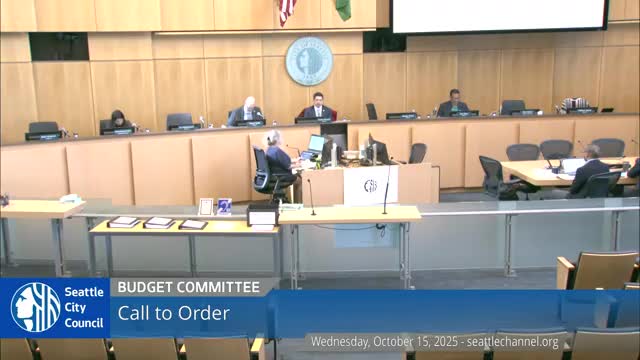
Summary
Central staff and Seattle Department of Transportation officials briefed the Select Budget Committee on the department's 2026 proposal, highlighting a growing operating subsidy for the city's streetcars, funding for FIFA World Cup preparations, a delayed rollout of expanded automated speed cameras, and a projected $49 million deficit in the city's
Calvin Chow, council central staff, told the Select Budget Committee on Oct. 15 that the Seattle Department of Transportation's (SDOT) 2026 proposal is "largely consistent with the 2026 endorsed budget," while noting several mayoral priorities that increase general-fund support.
Chow said the department requests new operating funds for FIFA World Cup preparations, additional subsidies for the Seattle streetcar system, and resources for downtown activation and enhanced permit enforcement. "For 2026, the streetcar operations are going to require 13,600,000 of subsidy for the continued operations," Chow said, attributing most of the increase to the end of a prior Sound Transit payment agreement.
Why it matters: Council members pressed SDOT and central staff on when and how promised programs will be implemented and on long-term sustainability. Chow warned that the transportation fund is balanced for 2026 but projects a roughly $49 million deficit in 2027, and he reminded the committee that the transportation funding task force called for in the 2024 transportation levy will convene in early 2026 with recommendations expected in 2027.
Key budget changes and items discussed
- Streetcar subsidy: Chow said the city will need about $13.6 million in operating subsidy in 2026 for streetcar operations, citing the end of a Sound Transit contribution that previously covered roughly $5 million per year. Committee members questioned whether the South Lake Union streetcar continues to be needed and noted the system's role as both transit and an economic-development investment.
- FIFA World Cup: Chow reported $1.8 million in operating funds for FIFA 2026 support and separate capital allocations including $1.8 million for right-of-way improvements and $2 million for removable vehicle barriers at Pike Place Market.
- Automated camera enforcement: The committee reviewed the expanded camera program. Chow said the city doubled school-zone cameras last year and that SDOT plans to add up to 20 new general speed-zone cameras at as many as 10 locations in 2026, including one FTE to manage camera programs. He and council members described the rollout as slowed by third-party contractor coordination and contracting arrangements, with central staff concluding "this is not a funding issue" but rather a coordination and contractor capacity issue.
- Transit ambassadors and security: Council members described prior provisos that funded transit ambassadors and left room for a King County behavioral health team. Chow said the $1 million proviso was spent on transit ambassadors deployed in the University District and on Rainier Avenue; the proposed 2026 budget does not include a dedicated appropriation specifically earmarked for the behavioral health team. Committee members emphasized the county and Sound Transit are the primary service providers and that the city buys transit service hours through the Seattle Transit Measure.
- Seattle Transit Measure and other revenue tools: Chow reminded the committee the voter-approved Seattle Transit Measure (a 0.15% sales tax) generates roughly $56 million next year and expires in April 2027; to place continuation on the November 2026 ballot the Council must authorize legislation by August 2026. He also noted the city has authority to seek up to 0.3% sales tax or up to a $50 vehicle license fee for transportation purposes.
- District project fund and Sound Transit engagement: Chow noted the council recently approved operating procedures for a $7 million district project fund in both 2025 and 2026 to support district transportation priorities. He also described a city office housed in SDOT that will coordinate Sound Transit 3 engagement for the mayor's office.
What council members asked and directed
Council member Saka pressed for concrete actions to accelerate the camera deployments and, after discussions with SDOT and SPD, acknowledged the delays stem from contractor capacity and contracting through SPD. Several members urged stronger regional coordination on transit security and noted King County Metro and Sound Transit operate and staff most security functions. Council members flagged the need for the Council to consider funding choices next year given the expiration of the Seattle Transit Measure and the structural pressures on transportation revenues.
Next steps and outstanding items
No formal SDOT actions or votes were taken at this briefing. Council members asked for more detailed timelines and implementation plans for the camera program, staff said they will follow up on scooter corral deployment and the specific status of permit and signage work, and central staff noted the transportation funding task force will bring recommendations in 2027.
Ending note: Committee members framed the 2026 SDOT proposal as workable for the coming year but raised several concerns about contractor coordination, long-term revenue sustainability, and regional partnerships needed for transit security and operations.