Get Full Government Meeting Transcripts, Videos, & Alerts Forever!
Get email alerts on the Public Safety Sales Tax topic
No spam. Unsubscribe anytime.
Seattle panel authorizes 0.1% public‑safety sales tax; council votes 8–1 to advance bill
Summary
The Select Budget Committee voted 8–1 to send council bill 121083 — authorizing a 0.1% sales tax for public‑safety purposes — to the full council. Supporters urged using part of the estimated $39 million to restore LEAD long‑term case management funding; opponents criticized the regressive nature of a sales tax.
The Seattle Select Budget Committee on Oct. 8 voted 8–1 to advance Council Bill 121083, authorizing the city to impose a 0.1 percentage‑point local sales tax to fund public‑safety programs. Chair Dan Strauss moved the recommendation and the committee sent the bill to the full City Council for final consideration at the Oct. 14 meeting.
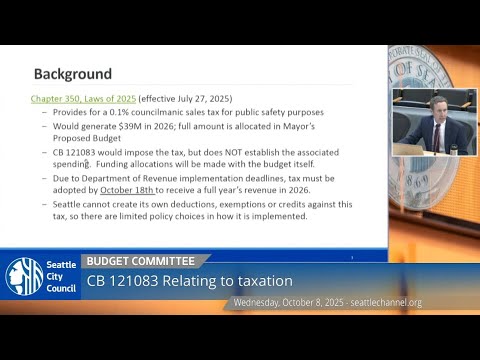
The bill authorizes the tax; it does not appropriate money. "The bill that you're looking at today would authorize the city to impose this tax," Tom Meiksel of Central Staff told the committee, adding, "the tax, as Tom will explain, has somewhat limited uses at a technical level, but because of opportunities to supplant it, it's effectively a general fund resource." Meiksel and Director Ben Noble said the state Department of Revenue requires council action before Oct. 18 for the city to collect a full year of revenue in 2026.
Why it matters: The executive's preliminary forecast, cited by central staff, estimates roughly $39 million in revenue in 2026 if the tax is adopted and implemented on the timeline presented. Mayor and executive budget proposals assign that revenue to public safety priorities in the 2026 budget; committee members emphasized that authorizing the tax now preserves revenue options and helps avoid deeper cuts across city departments.
Public comment focused heavily on LEAD (Law Enforcement Assisted Diversion) and other long‑term case‑management programs. Sam Wolf, Seattle LEAD program director, said LEAD became the default SPD response for public‑use ordinance violations in 2023 and that "75% of encounters by SPD for public use were referred to LEAD case‑management services and subsequent recovery services." Several service providers asked the council to use $5,000,000 of the proposed revenue to restore LEAD funding to pre‑cuts levels; Christopher Chipoli, a LEAD senior project manager, asked the council to "restore LEAD's funding" with that amount.
Supporters at the microphone and in the council’s debate argued the tax would allow the city to invest in alternative response, addiction treatment and other programs that sit at the seam of public safety and public health. Council member Kettle—chair of the council's Public Safety Committee—said the investments proposed in the executive’s budget are aimed at strengthening the criminal‑justice system and the public‑health services that reduce repeat legal encounters.
Opposition and limits: Council member Rivera said she would not support the measure, calling a sales tax "the most regressive tax" and noting Seattle already has among the highest local sales tax rates in the country. Rivera also reminded colleagues that county and other local levies can be passed on to renters and low‑income households.
Central staff stressed statutory constraints. Meiksel told the committee that "Seattle cannot create its own deductions, exemptions, or credits against this tax" because the authority is granted by the state. He also noted that most food for home consumption remains exempt and that the tax is a 0.1 percentage‑point increment to the city's existing sales tax.
Vote and next steps: The clerk called the roll on recommendation of passage of Council Bill 121083. The vote list recorded Council member Rivera as No; Council members Osaka, Solomon, Hollingsworth, Juarez, Kettle, Council President Nelson, Rink and Chair Strauss voted Yes. The clerk reported "8 in favor, 1 opposed." Committee leadership said the bill must be passed and signed by the mayor before Oct. 18 to secure the full‑year revenue forecast for 2026; the committee recommended the bill be sent to the Oct. 14 City Council meeting.
Context and caveats: Central staff and the chair repeatedly distinguished the authorization vote from budget appropriations. Meiksel reminded the committee that "the tax ... does not spend the money" and that allocations for 2026 are contained in the mayor’s proposed budget. Committee materials and discussion showed about $24 million of the proposed revenue in the mayor's plan would fund new spending while roughly $15 million would supplant existing appropriations; staff warned that adopting the tax changes the city's revenue picture but does not itself create those spending appropriations.
The committee hearing included roughly two dozen public commenters by in‑person and online registration. Many LEAD staff and partner providers described multi‑year outcomes and case examples they said demonstrate LEAD's ability to link people with treatment, housing and legal support. At least one commenter, David Haynes, criticized LEAD and questioned the program's housing outcomes. Several speakers urged the council to preserve or restore LEAD funding in any package the city adopts.
The committee’s action is an authorization step; the measure will come before the full City Council on Oct. 14 for final vote and, if passed, must be signed by the mayor and implemented by the state Department of Revenue for collections to begin in 2026.