Get Full Government Meeting Transcripts, Videos, & Alerts Forever!
Get email alerts on the County Budget Expenditures topic
No spam. Unsubscribe anytime.
Spokane County continues 2026 budget roundtable; public urges restore medical examiner post and Extension funding
Summary
Spokane County commissioners continued a public hearing and roundtable on Oct. 14, 2025, to review the expenditure side of the 2026 preliminary budget.
Spokane County commissioners continued a public hearing and roundtable on Oct. 14, 2025, to review the expenditure side of the 2026 preliminary budget. County budget staff presented a $266,300,000 revenue projection and a preliminary target expenditure rollup that reflects a flat-budget directive from the board and leaves roughly $6,700,000 of capacity against about $34,000,000 in departmental requests.
The presentation, given by county budget staff Jeff and Tessa, said the preliminary general-fund expenditure estimate is $259,600,000 and that the county faces a roughly $20,000,000 shortfall unless commissioners identify additional reductions or new ongoing revenue. “We are required at the county level just as at the state level to pass a balanced budget,” a staff member said during the presentation.
Why it matters: the justice and public-safety system accounts for the largest share of the general fund, and staffing reductions there could affect response, court operations and related services. The preliminary budget shows the justice system at 76.3 percent of the general fund and salaries and benefits comprising 67.8 percent of submitted expenditures.
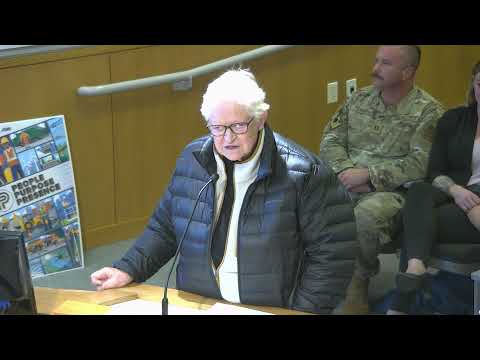
During public testimony, multiple residents urged commissioners to prioritize restoring specific positions and to protect Cooperative Extension programs. Johnny Ennis, who identified himself as a member of the Air National Guard and as the spouse of a Spokane County Medical Examiner’s Office employee, said the county is proposing to cut one deputy medical-legal death investigator position. “I’m just here really today to advocate for my wife,” Ennis said, describing extended shifts and staffing strain at the medical examiner’s office and warning that cutting the position would worsen workloads and slow coordination with law enforcement.
Several speakers, including Anne Alexander, Marsha Sands and Pat Muntz, asked commissioners to limit cuts to the county’s Cooperative Extension and Master Gardener programs. “The extension programs are run by volunteers,” Alexander said, and she and other testifiers said a relatively small county investment supports a large volunteer effort that provides research-based education on gardening, fire prevention landscaping, small-farm support and 4‑H youth programming. Muntz said extension work provided rapid local food distribution during the pandemic and argued extension funding is a long-term investment in economic development and public welfare.
Commissioner French, a member of the Board of County Commissioners, noted that some budget pressures come from state-level decisions beyond county control, citing recent state caseload standards that increase workload for public defenders and ripple into prosecutors’ and clerk offices. French also highlighted the county’s conservative debt posture and credit rating, saying debt service is about 2.5 percent of total revenue and that the county maintains a strong bond rating by limiting borrowing.
Staff and commissioners described the next steps in the calendar: a budget roll-up is scheduled for Nov. 4, property-tax decisions are planned for Nov. 17, and the county must complete its final budget vote by Dec. 1 under state law. The board continued the public hearing to the Nov. 4, 2025, 2:00 p.m. roundtable for further review and prioritization.
Commissioners asked staff to return with matrices showing items that could be bought back and to clarify where restoring items would affect active full‑time equivalents rather than only savings from attrition. That direction was raised explicitly after public testimony so commissioners could understand personnel impacts of prioritizing specific requests.
The presentation also noted other factors shaping revenue projections: a 2 percent sales-tax growth projection; about $1,000,000 estimated net gain to the general fund from $1,450,000,000 in new construction assessed value; and no assumed 1 percent property-tax increase or road‑shift in the revenue forecast. Staff said the preliminary 2026 budget currently does not incorporate capital projects that may be added later in the process.