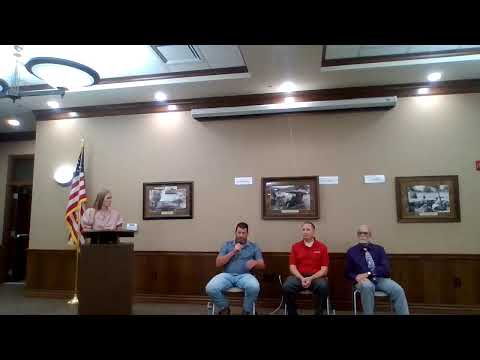
Santa Clara candidates at county forum emphasize water storage, housing limits and opposing property-tax increases
Loading...
Summary
At a Washington County Republican Women forum in Santa Clara, mayoral and council candidates discussed water storage and rights, housing density and deed restrictions, the changing electric market, and approaches to city budgets and property taxes ahead of ballots being mailed.
At a candidate forum hosted by the Washington County Republican Women at the Dixie Center in Santa Clara, candidates for mayor and city council addressed water supply and storage, housing affordability and density, city budgets and property taxes, the local power system, and plans for the downtown historic district and orchard.
The forum included statements from absent candidates Kristen Hinton and Mark Hendrickson read to the audience, opening remarks from several council members and candidates, and a question-and-answer session with voters. Ballots were noted to be mailed “tomorrow, the 14th,” and one announcement reminded attendees that ballots must be received by 8 p.m. on Nov. 4.
Why it matters: Santa Clara is experiencing growth and infrastructure pressure. Candidates framed the immediate choices facing the city around securing water storage, responding to housing demand while preserving neighborhood character, and protecting municipal finances without large tax increases.
Water and infrastructure
Candidates repeatedly identified water as a top challenge. One candidate said the city has water rights that could produce roughly 385,000,000 gallons and credited past leaders for securing wells in Snow Canyon State Park. Forum speakers pointed to conservation measures already taken — including turf removal and “smart metering” — and said additional storage is needed to manage storm runoff and seasonal variability.
“We live in a desert,” a candidate said, arguing that building reservoirs and storage must be part of planning. Candidates also described recent projects and costs: a local road project presented as about $2.5–3.0 million and a Crestview water project referenced as roughly $500,000, both cited as examples of pay-as-you-go financing rather than new long-term bonding.
Housing and density
Candidates described housing as a difficult trade-off between preserving Santa Clara’s single-family character and adding units for residents and returning children. Several candidates said the city has used accessory dwelling units (ADUs) and smaller single-family lot options — as small as 4,000 square feet in existing ordinances — as tools to add supply. One candidate urged use of deed restrictions to preserve long‑term affordability for particular units, so resale gains remain tied to the property rather than creating a path for rapid investor profit.
Speakers criticized examples where townhome developments intended as “attainable” housing were sold to single investors and converted to higher‑rent units, saying that undermined affordability. Rent and sale price ranges mentioned during the forum included recent small‑lot single-family sales reported in the roughly $375,000–$425,000 range and townhome rents cited around $2,000 a month, which several speakers said is unaffordable for many residents.
Taxes and city finance
Candidates described Santa Clara’s recent fiscal position as favorable, noting that sales tax revenue has grown substantially after commercial development in the area — one candidate said sales-tax receipts rose from about $600,000 to an expected more-than-$2 million this year. Several speakers said the city has generally avoided large property-tax increases and has used fund balance or pay‑as‑you‑go financing for major projects.
Views on taxation diverged. An attendee running for council said he personally favored eliminating property taxes entirely and would seek to pay for necessary services by cutting nonessential spending and using other revenue sources. Other candidates said they opposed raising property taxes and favored exploring alternatives before considering any increase, while emphasizing that public safety should remain fully funded.
Power and utility issues
Speakers described changes in the regional power market that could affect local utility costs. Candidates said the “day‑ahead” energy market and broader regional transmission arrangements increase forecasting complexity for the city’s municipal power system and could raise costs if not managed carefully. The city has pursued solar plus battery projects in Central Utah to stabilize supply, and candidates said a recent power-cost adjustment helped the local power utility avoid insolvency.
Historic district, orchard and downtown planning
Several candidates supported maintaining design guidelines for the historic downtown and conserving portions of the downtown orchard. One candidate described the orchard’s transfer from church ownership to city stewardship and said tree removal and replanting with more manageable varieties had been discussed; another described pursuing public–private partnerships to fund an orchard restoration, events space, and a downtown blueprint without using tax dollars.
Public engagement and council style
Candidates repeatedly said the city needs to “listen more” to residents. Multiple speakers said many residents feel they are not being heard and urged the council to slow down on major changes and increase outreach before approving developments. Several candidates highlighted experience on councils, training attendance, business ownership or community volunteer roles as qualifications for listening and executing city projects.
Quotes from the forum
Kristen Hinton, in a statement read by the moderator, said: “Santa Clara’s small town character is worth protecting.”
Mark Hendrickson, in a statement read to the audience, said: “My focus is not on making noise. It's on doing the work.”
Jimmy Kesten said he was running for city council for personal reasons tied to family and preserving the community for future generations: “My daughter came to me last year ... ‘Dad, please don't ever sell this house.’”
What happens next
No formal council actions or votes were taken at the forum. Candidates urged voters to use the upcoming ballot; moderators and one organizer announced a candidate event later in the week and reminded attendees about ballot drop‑box and early‑voting options.
The forum offered voters side‑by‑side statements on how candidates would handle water storage, housing policy and municipal finances as ballots were set to be mailed and returned ahead of the Nov. 4 deadline.