Get Full Government Meeting Transcripts, Videos, & Alerts Forever!
Get email alerts on the Climate Policy topic
No spam. Unsubscribe anytime.
Corte Madera council backs 'Polluters Pay' Climate Superfund resolution after split vote
Summary
The Corte Madera Town Council voted 4-1 to adopt a resolution supporting state-level legislation commonly called the "Polluters Pay Climate Superfund Act." The item drew public comment both for and against and prompted council discussion about local climate adaptation costs and the adequacy of staff materials.
Corte Madera — The Corte Madera Town Council voted 4-1 on October (date not specified) to adopt Resolution No. 402025 supporting state legislation commonly described in meeting materials as the "Polluters Pay Climate Superfund Act."
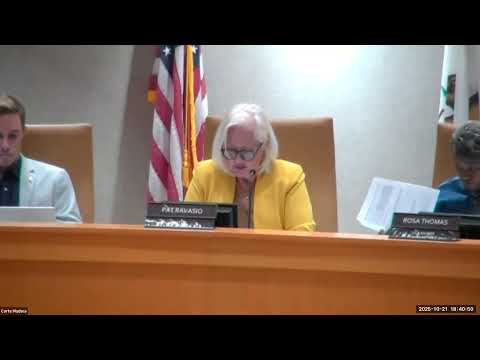
The resolution was pulled from the consent calendar for separate discussion after a member of the public and council requested fuller debate. Council member Eli moved adoption and a colleague seconded; Council member Andrews voted no while Council members Beckman and Casiza, Vice Mayor Thomas and Mayor Rovasio voted yes.
The measure drew competing public comments. Melody Schumacher, who identified herself as a Paradise Drive resident and parent of students at Neil Cummins and Hall Middle School, urged the council to support the resolution, saying it would direct funds to resilience. "This is a bill that gives you money for those expenses," Schumacher said, adding that the proposal would take roughly 3.5% of specified industry profits and place revenues with CalEPA for resiliency and rebuilding. Opposing the resolution, Roy Wolford called the measure "confiscatory" and said its costs would be passed on to consumers and harm underrepresented and lower-income households. Wolford criticized several factual claims he said appeared in the resolution and asked the council for clarification on the status of the two state bills linked in the staff report.
Council debate focused on two central points: (1) whether companies profiting from fossil fuels should share the cost of local climate adaptation projects, and (2) whether the town's taxpayers should be asked to bear adaptation costs alone. Council member Eli framed the resolution as a way to help local taxpayers meet projected adaptation needs, saying, "There's more than $200,000,000 of work in Corte Madera's Climate Adaptation Plan, projects that we have determined have to happen in order to protect our homes and our businesses and our infrastructure." Council member Jim stressed the need for process and noted he wanted to see legislative developments play out at the state level before drawing conclusions. Mayor Rovasio and other council members spoke in favor, citing long-term local risks from sea level rise, flooding and wildfire.
At the start of the discussion, a council critic said the staff report lacked the full text of the bills the town was being asked to "support"; staff later pointed out the report included links to AB 1243 and SB 684 and that the full texts could be provided in the packet or in a future attachment. Several council members suggested that including the bill text in paper packets for members who receive printed materials would be helpful in future.
Outcome and what it means: The council's vote is a formal expression of support by the town for the concept in the resolution and for the linked state bills; adoption does not change town law or impose local taxes. The resolution as discussed cites state bills AB 1243 and SB 684 (referenced in the staff report link). Council members did not adopt implementing local regulations or levy taxes at the meeting.
Votes at a glance: The motion to adopt Resolution No. 402025 passed 4-1. Recorded roll call: Council member Andrews — No; Council member Beckman — Yes; Council member Casiza — Yes; Vice Mayor Thomas — Yes; Mayor Rovasio — Yes.
The council heard public comment both for and against the resolution and asked staff to ensure full bill texts and legislative status be provided to council and in the public packet for future meetings. No implementation steps (ordinances, local taxes, or funding authorizations) tied to the resolution were adopted at this meeting.
Ending: Council members said they expect continued public discussion and possible follow-up as the state legislative process proceeds; the resolution is an expression of local support and not a binding municipal policy change.