Get Full Government Meeting Transcripts, Videos, & Alerts Forever!
Spokane County lays out three growth alternatives and a new "neighborhood" zoning to absorb projected growth
Summary
Spokane County planning staff presented three alternatives for accommodating roughly 100,000 new residents over the next two decades, proposing regulatory reforms, denser neighborhood zoning and selective urban growth-area expansion.
Spokane County planning staff presented three alternatives for accommodating roughly 100,000 new residents over the next two decades at a community workshop, proposing a mix of regulatory reforms, denser neighborhood zoning and, if needed, expansion of the county’s urban growth area (UGA).
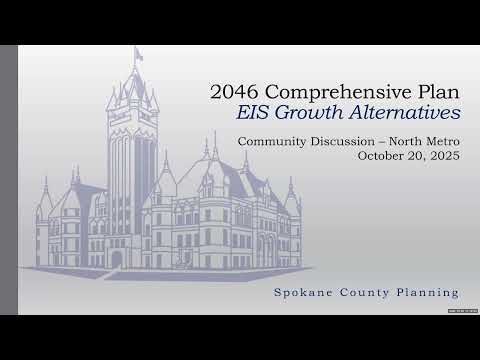
At the start of the meeting, Spokane County planning staff said, “We’re here tonight to talk about growth alternatives, generally speaking,” and then walked through an environmental impact analysis process the county is using to compare: (1) a no-action or limited-change approach, (2) an infill/regulatory-reform approach to allow denser development inside current boundaries, and (3) a mixed strategy that combines new neighborhood-style zoning with selective UGA expansion.
Why it matters: the county expects major growth and must show how it can accommodate housing while protecting groundwater, wetlands and habitat. Planning staff said Spokane County is projected to grow by about 100,000 people and that roughly 35,000 of the additional households are expected to be in the unincorporated county; the city of Spokane and Spokane Valley are forecasted for about 24,000 and 22,000 residents respectively. The county must either fit those households inside existing UGAs through denser development or amend UGA boundaries under state rules.
Planning staff described how the alternatives differ. The infill option tests whether updated development regulations — for example permitting duplexes, triplexes, cottage homes and small multifamily buildings by right — could accommodate most projected growth without changing the UGA. The neighborhood zoning concept would create a blended category allowing a mix of…
Already have an account? Log in
Subscribe to keep reading
Unlock the rest of this article — and every article on Citizen Portal.
- Unlimited articles
- AI-powered breakdowns of topics, speakers, decisions, and budgets
- Instant alerts when your location has a new meeting
- Follow topics and more locations
- 1,000 AI Insights / month, plus AI Chat