Get Full Government Meeting Transcripts, Videos, & Alerts Forever!
Get email alerts on the Public Comment Policy topic
No spam. Unsubscribe anytime.
Public commenters urge Farmington board to push back on NEA materials and proposed state health standards
Summary
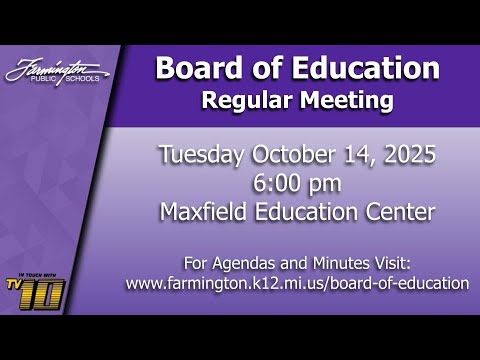
During the Oct. 14 public-comment period, multiple residents urged the Farmington Public School District Board of Education to respond to NEA-distributed materials and to oppose proposed state health-education revisions they described as introducing sexual and gender-identity content in early grades.
During the Oct. 14 public-comment period, multiple residents urged the Board of Education to respond to recent national and state education developments. One commenter, identifying material from what she called the "NEA's Jewish Affairs Caucus" and reading related text, said resources distributed under the NEA's name included antisemitic content and materials that "glorify terrorism" and "deny the Holocaust." She said the resources were removed only after public outcry and criticized what she described as an inadequate NEA statement that offered "no apology to the Jewish members." The commenter asked the board to "champion a response to the NEA itself and the Michigan Education Association."
Other speakers raised concerns about revisions to state health education standards that they said would incorporate sexual and gender-identity topics into kindergarten through 12th-grade health curricula. A public commenter cited a defeated 2024 bill (referred to in the remarks as HB 6068) and a watchdog website (saltlightglobal.org) as context for the complaint, and urged local trustees to oppose any changes that would, in the commenters' view, reduce parental control or introduce "inappropriate" content in early grades.
Speakers asked the board to delay or reject adoption of any new statewide framework until the Michigan Department of Education provides full transparency and community review. Board members did not take formal action during the meeting; the remarks were received during the public-comment portion of the agenda. The district did not announce any immediate policy changes in response to the comments on Oct. 14.
The board moderated public comment with standard rules (three minutes per speaker) and closed the session after several speakers. The record shows the board acknowledged the comments but retained no public-resolution or directive on the NEA materials or state health-education standards at that meeting.