Council staff flags Office of Housing PET shortfall, Northgate Commons transfer and $28M operating stabilization RFP
Loading...
Summary
The Office of Housing’s (OH) 2026 proposed budget would transfer $5 million in PET for Seattle Housing Authority’s Northgate Commons to Finance General, potentially reducing OH oversight, while staff warned OH’s PET commitments exceed anticipated PET revenue and highlighted a new $28 million operating‑stabilization RFP.
The Office of Housing’s (OH) 2026 proposed budget would shift $5 million in public‑equity‑tax (PET) capital from OH to Finance General for the Seattle Housing Authority’s Northgate Commons project, and council central staff warned that move may reduce OH oversight of the project.
Council central staff presented the budget and four policy considerations to the Select Budget Committee on Oct. 16. “The executive has stated that OH will not provide any ongoing compliance monitoring to this project once it is complete,” Jennifer Lebrecht, Council Central staff, told the committee, adding this would be “a significant departure from past practice” because OH currently provides compliance monitoring to roughly two dozen SHA projects it has funded.
Why it matters: the $5 million transfer is the first tranche of a planned $20 million city investment in Northgate Commons. Council central staff said moving PET to Finance General—rather than keeping it in OH—was the executive’s approach because a direct allocation to SHA would not comply with the council‑adopted housing funding policies that govern OH capital dollars. That transfer raises questions about which city rules and oversight will apply, and whether OH will negotiate the contract, review feasibility or review invoices before payment.
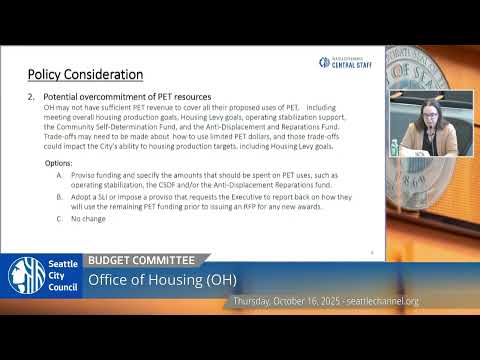
What staff reported: OH’s 2026 proposed budget shows $137 million in PET revenue but identified uses that add up to roughly $181 million if each commitment is counted separately, council staff said. Staff warned it may be unrealistic to meet all commitments simply by counting the same dollar toward multiple goals. “It may not be realistic for the executive to satisfy all the various commitments that they have made under PET,” Lebrecht said, giving examples of a single project being counted toward levy goals, a community self‑determination fund and the anti‑displacement and reparations housing fund all at once.
Operating stabilization and other funds: staff noted OH announced a planned RFP for operating stabilization funding that it expects to total about $28 million; that RFP will be released in November with the goal of having contracts under way by January 2026, staff said. The executive has also proposed using $20 million of existing PET in year 1 for a new anti‑displacement and reparations housing fund intended to total $80 million over four years; the 2026 proposed budget itself does not add new PET for that purpose.
Options for council: council central staff offered several paths: (1) refuse the $5 million transfer and direct OH to retain PET while amending housing funding policies or adopting an ordinance to permit a direct allocation to SHA while preserving OH oversight; (2) adopt provisos to specify how PET may be spent (for example, earmarking amounts for operating stabilization, community self‑determination, or anti‑displacement uses); (3) require more granular PET reporting in the annual investment report (reporting milestones such as loan closing, start of construction, and final invoices); or (4) take no change.
Committee discussion: Councilmembers pressed staff and OH about oversight, timelines and how the proposed PET uses affect the city’s ability to meet housing levy production goals. Councilmember Rink asked whether the $5 million would collect interest while held and whether payments to SHA would be lump sum or invoice‑driven; staff said contract terms had not yet been negotiated. Chair Dan Strauss and other members emphasized the tradeoffs between tapping PET for multiple goals and meeting levy obligations; staff noted OH now anticipates needing about $46 million per year of PET to help meet levy goals because of rising costs.
Ending: Councilmembers asked staff to return with additional information and to consider provisional language that would preserve OH oversight if funding is moved out of the department. Staff also noted the committee will see OH again in the budget process and that council has procedural options—ordinance, proviso, or amended policy—to preserve oversight or to accept the executive’s approach.