Get Full Government Meeting Transcripts, Videos, & Alerts Forever!
Get email alerts on the Tax Increment District Creation topic
No spam. Unsubscribe anytime.
CDA opens public hearing for new TID 21 to support 147-unit housing project at former St. Aloysius site
Summary
The CDA opened a public hearing on creating Tax Incremental District No. 21 at 90th and Greenville for a developer-proposed 147-unit housing project; staff described the blight findings, projected costs and set-asides for nearby parks and corridor improvements.
The Community Development Authority on Sept. 30 initiated the statutory process to create Tax Incremental District No. 21 at 90th and Greenville, the former St. Aloysius site, and held a public hearing on the draft project plan.
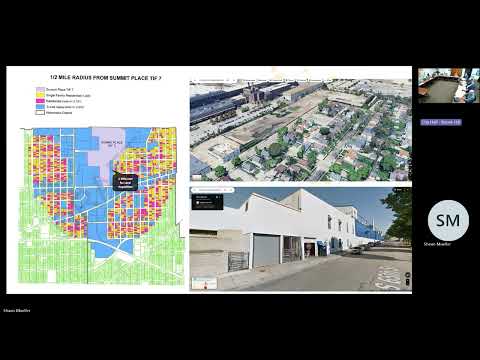
Mister Slade, introduced in the meeting as the authority’s executive director, said the parcel (listed as 1405 S. 90th St.) and adjacent right-of-way would form a district of roughly 3 to 5.67 acres depending on whether the right-of-way is included in the measurement. Slade said the CDA currently holds the property under a land contract with an entity identified in the record as F Street and that the church, school and rectory buildings have been razed under a prior agreement.
Slade said a blight finding under Wis. Stat. § 66.1105 supports the proposed TID: more than half of the district area meets the statutory definition of blight. The developer’s plan described in the presentation would build a 105-unit mid-rise apartment building and 42 garden-style apartments (a total of 147 units). Slade reported the developer’s construction estimate at about $37.8 million with an assessed value nearer $31 million in the city’s model. He said the current base (pre-development) value on the parcel is about $600,000.
Under the draft project plan Slade outlined, if increment is generated the plan earmarks $250,000 for nearby park improvements, $250,000 for pedestrian bump-outs or bike/ped enhancements, and $250,000 for housing or economic development incentives (for example, façade grants or housing rehab loans within a half mile of the site). Slade also said the TID model uses the statutory maximum (27 years, as applicable under Wis. Stat. § 66.1105) in its financial pro forma and that the net present value of the projected increment stream is roughly $7.8 million in today’s dollars.
Slade said negotiations with the developer were ongoing and that a development agreement would likely return to the CDA in October; the plan would then go to the Common Council (noted as scheduled for Oct. 21 in the meeting) and to a joint review board meeting once notices are posted (Slade said the next joint review board meeting would be Nov. 10 at 9 a.m.).
Board members asked questions about boundaries, inclusion of right-of-way and whether the nearby CVS site should be included. Slade said the CDA excluded the CVS parcel from the district boundary because including it could reduce projected increment in the early years and because contiguity rules constrain inclusion of noncontiguous parcels. He said corridor improvements or assistance to businesses in the half-mile area could still be funded from increment if generated.
The public hearing record on creation of TID 21 was opened and closed during the meeting; the transcript records no public speakers on the item and no final vote on formation by the CDA at this session.
Why it matters: the proposed TID would convert a vacant, razed institutional site into new housing and places TID revenue behind park and corridor improvements and incentives intended to support surrounding neighborhoods and businesses.
Next steps noted by staff: return of a development agreement in October and formal council and joint-review-board actions in late October/November.