Get Full Government Meeting Transcripts, Videos, & Alerts Forever!
Get email alerts on the Housing Section8 topic
No spam. Unsubscribe anytime.
West Allis CDA approves amendments to HUD Section 8 annual plan
Summary
The West Allis Community Development Authority approved changes to its annual plan for the U.S. Department of Housing and Urban Development’s Section 8 Housing Choice Voucher program after a staff presentation and no public objections during the noticed comment period.
The West Allis Community Development Authority approved amendments to its annual plan for the U.S. Department of Housing and Urban Development Section 8 Housing Choice Voucher program following a staff presentation and a public-notice period that produced no written comments.
Steve Sherriff, city planning staff, presented the plan and described the housing office’s operations and programs. “Our housing office and department is staffed by 3 and a half people and then 1 contracted person with family self sufficed, Lutheran social services to administer our family self sufficiency program,” Sherriff said. He told the authority the office administers Section 8 rent assistance, housing for the elderly, veterans’ VASH vouchers and a new home-buyer and housing-rehabilitation program.
Sherriff said the authority currently had about 502 active vouchers of a possible 638 and that the program’s operating budget was roughly $4,300,000, “which is roughly consistent from year to year.” He said monthly housing-assistance payments equated to about $330,000 and that each successful active voucher returned roughly $70 per month to build an administrative reserve for staffing and program administration.
The plan maintains the authority’s payment standard at 110% of HUD fair market rent (it rose as high as 120% after COVID), a figure Sherriff said helps households pay no more than about 30% of income toward rent, the HUD-affordability benchmark. The plan also includes landlord-outreach and education efforts through a proposed partnership with Opportunity Milwaukee (the Metro Milwaukee Fair Housing Council) to host workshops and to “reduce the stigma of Section 8 housing,” Sherriff said.
Sherriff outlined other items in the annual plan: continued alignment with public-health work on housing and community health; promotion of the authority’s home-buyer loan and housing-rehabilitation programs; credit- and workforce-development informational sessions; and an outreach effort run with community groups that includes a fair-housing art contest.
The presentation also addressed the authority’s family self-sufficiency program. Sherriff said the CDA currently contracts with Lutheran Social Services to administer that program but recommended hiring an in-house full-time staff member instead of continuing the contract; he said the most recent contract figure discussed at a CDA meeting had risen to about $138,000–$140,000 and that the authority believed it could operate the program in-house for less. “We’re going to be submitting a requisition to our city administrator to, hire a full time, person in house to do that work,” Sherriff said.
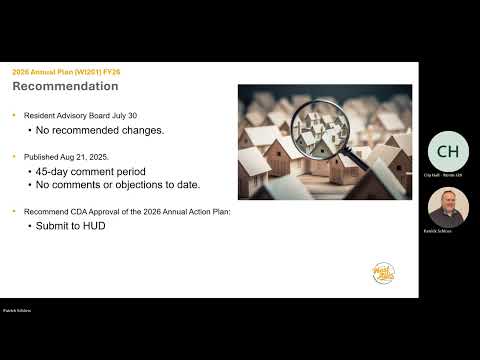
Sherriff described planned housing developments that could include project-based vouchers, including work with Habitat for Humanity and a potential tax-credit deal and rehabilitation of the Longfellow School property. He said the resident advisory board reviewed the annual plan in July and that the authority published the plan in August and had not received public objections during the required 45-day comment period.
After the presentation and the public-notice period, the CDA moved and seconded a resolution to approve the amendments. The resolution passed on a roll-call vote. The authority’s staff will provide the signed, amended plan to the mayor for submission to HUD.
Ending: The approval allows the CDA to proceed with the outreach, the staffing request, and the project-based voucher planning described in the plan; staff indicated follow-up items (hiring/requisition and development agreements) will return to the CDA for future action.