Get Full Government Meeting Transcripts, Videos, & Alerts Forever!
Get email alerts on the State Legislation topic
No spam. Unsubscribe anytime.
Commission reviews state housing and platting bills; staff to prepare UDO text amendments
Summary
Planning staff briefed the Chino Valley Planning and Zoning Commission on two recently passed state bills — one expanding accessory dwelling unit (ADU) rights and one requiring administrative approval of subdivision plats — and described potential impacts and next steps including UDO text amendments.
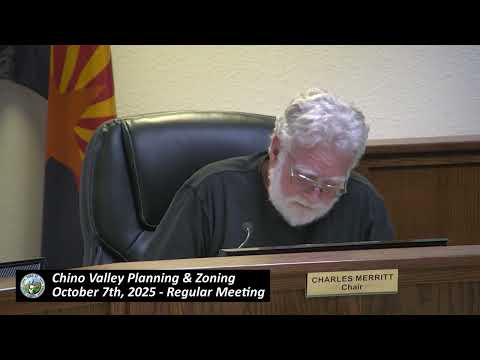
Town staff briefed the Chino Valley Planning and Zoning Commission on Oct. 7, 2025, about two state bills — HB2447 and HB2928 — that could change local development rules for accessory dwelling units (ADUs) and subdivision plats. Staff described legal language, potential impacts for Chino Valley and planned local responses.
Will (town staff) and other staff members explained HB2928 as a state mandate that would require municipalities to allow accessory dwelling units by right on single-family parcels. Under the version discussed, a single-family lot could allow one attached ADU and one detached ADU by right, and lots of one acre or larger could be allowed an additional ADU (described in staff comments as resulting in up to four dwelling units on some parcels). Staff said an exemption tied to municipal population (a 75,000-population threshold in earlier language) appears in the bill’s final language in a later subsection; town attorneys advised that Chino Valley remains exempt under that construction, but staff urged monitoring future legislative sessions in case the exemption is narrowed.
Staff described technical details raised during the commission’s discussion: the bill’s ADU provisions would supersede local lot-coverage and setback limits for ADUs where the law applies; the town could require connection to municipal water and sewer where available to address public-health limits tied to septic systems; and if a fourth unit is allowed on a one-acre lot, that unit would need to be deed-restricted at an affordable-rental level under the bill’s terms, a requirement staff said the town lacks resources to administer directly.
On HB2447, staff said the law requires that preliminary and final subdivision plats be reviewed and approved or denied administratively rather than via a town-council public hearing, unless the plat includes a zoning change. The bill also allows limited "at-risk" preliminary grading or infrastructure work to proceed under certain submittal procedures. Staff reported they are evaluating implementation details and will prepare a UDO text amendment for Planning and Zoning review and for Council adoption; staff said they will try to meet the January 1 statutory deadline but that holiday schedules may constrain timing.
Commissioners asked how the bills affect septic and well service, road-width safety standards, address/metering for multiple units, and whether private covenants (CC&Rs) would continue to apply. Staff said county health rules still govern septic permits and the town would retain building-permit authority; private CC&Rs can prohibit ADUs by private contract even if state law allows them by right. Staff also said municipalities could use safety standards (for example, required 50-foot access for emergency vehicle ingress/egress) to limit the ability to take advantage of ADU provisions in areas that do not meet life-safety criteria.
Staff told the commission they plan to present a formal UDO text amendment to Planning and Zoning (targeted for December) and will coordinate with the Town Council for any special meeting needed to meet the statutory deadline. The town also plans to continue a zoning-code rewrite and said livestock rules will be addressed early in the coming year.
Commissioners expressed strong concern about the bills’ potential to change density expectations established in the town’s general plan and urged continued monitoring and advocacy at the state level. Staff recommended pursuing targeted local regulations within what the state law permits and preparing amendment language for the commission and council to consider.