Get AI Briefings, Transcripts & Alerts on Local & National Government Meetings — Forever.
Cochise County supervisors review near-final comprehensive plan draft; debate centers on energy, water and ports
Loading...
Summary
Cochise County planning staff presented a near-final draft of the county’s comprehensive plan at an Oct. 21 Board of Supervisors work session, outlining a 20-year roadmap for land use, transportation, water and energy policy and asking the board and Planning and Zoning Commission to review the draft before required agency review and public hearings.
Cochise County planning staff presented a near-final draft of the county’s 20-year comprehensive plan at a Board of Supervisors work session Oct. 21. The document lays out goals and recommended policies for land use, transportation, water, energy, housing and public services; staff said the draft will go through a required 60-day agency review and at least two public hearings before the board considers adoption.
The draft, which staff described as a roadmap for the county’s growth over the next two decades, frames priorities around resilient infrastructure, neighborhood revitalization, and targeted economic development. Christine, county planning staff, told supervisors: “The plan is a roadmap for how the County will grow and develop over the next 20 years.” The plan team reported having engaged more than 400 residents in nine public meetings and online outreach during its preparation.
Why it matters: Supervisors said the county must use the plan to diversify an economy that staff described as heavily dependent on government and defense-related employment tied to Fort Huachuca. County leaders flagged water scarcity, wildfire response capacity, and transportation — especially a proposed new commercial port of entry and possible rail reuse — as policy priorities that will shape whether economic diversification succeeds.
Key points from the draft and the discussion
Plan scope and schedule: Staff said the draft covers required elements (land use, circulation/transportation, water, and energy) and optional elements (public services and facilities, housing, economic development). Staff asked the Planning and Zoning Commission to consider the draft on Nov. 12, start the 60-day interagency review, hold the required public hearings, then forward a recommendation to the board for adoption.
Water and natural resources: The draft notes Cochise County is largely groundwater dependent and identifies aquifer decline, drought and “intensive water-dependent uses” as pressing challenges. Staff described a five-point water strategy emphasizing coordination with partners, infrastructure investment, conservation, reuse and artificial recharge. The plan language and multiple supervisors’ comments emphasized that water availability will constrain development and requires careful mitigation in proposals such as mines or large industrial projects.
Energy policy: The energy element frames an approach that balances renewables, efficiency and “traditional” fuels. Several supervisors and commenters urged stronger language to recognize natural gas and small modular nuclear reactors as viable local energy options alongside solar and wind. An online commenter identified as Rain said the draft’s energy purpose statement should not rely on the term “sustainable” alone and should explicitly reference traditional generation that currently supports the county. The county’s utilities (named in the presentation) are pursuing a range of technologies, and staff said the plan supports responsible siting and community-benefit considerations for future projects.
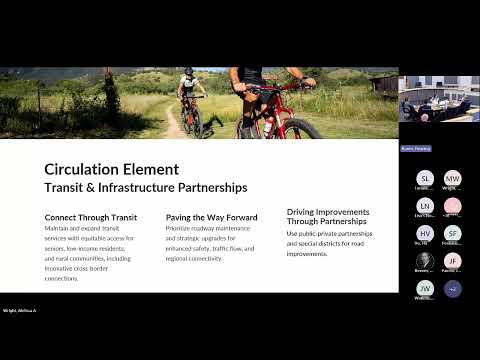
Transportation, ports and rail: Supervisors pressed the plan to emphasize a new commercial port of entry and potential rail reuse to move freight off highways. Participants suggested studying reopening lines and creating an inland transfer facility (an “inland port”) near Benson to support anticipated truck and container flows. Staff noted the plan supports preserving rail corridors, enhancing local airports for general aviation and freight, and improving multimodal connections for tourism and commuting.
Public services, emergency response and insurance: Supervisors raised concerns that gaps in fire coverage and the structure of local fire districts are hindering insurance availability and private investment in unincorporated areas. Participants discussed a long-term idea of a countywide fire service to improve mutual aid, procurement efficiency and reduce premiums for property owners; staff acknowledged pension and budget implications if the county pursues structural changes.
Air quality and PM10: The draft includes a PM10 (particulate matter) nonattainment map tied to historical smelter emissions. Jackie, county staff, confirmed Arizona Department of Environmental Quality continues periodic monitoring and that the nonattainment designation remains active; that designation can affect where industrial growth is feasible until air-quality actions remove the designation.
Economic development and regional ties: Supervisors urged the draft to more strongly promote cross‑border trade with Sonora, Mexico, and to call out targeted sectors — including minerals, agriculture, logistics, data centers, and medical tourism — as opportunities for diversification. The plan recommends regional community profiles to replace older, unevenly distributed area plans so every part of the county is represented in future amendments.
No formal action or votes were taken at the work session. Staff said the planned next steps are posting the draft for the required 60-day review with state and neighboring jurisdictions, holding at least two public hearings, seeking the Planning and Zoning Commission recommendation (noted for Nov. 12), then returning to the board for final action.
Ending: Staff asked supervisors and commissioners to send written comments; staff said revisions based on today’s feedback will be flagged in the next presentation. A formal adoption timeline will follow the statutory review process and the commission’s recommendation.