
Havens Harvest urges regional food-recovery hubs to cut waste, feed families
Get AI-powered insights, summaries, and transcripts
Subscribe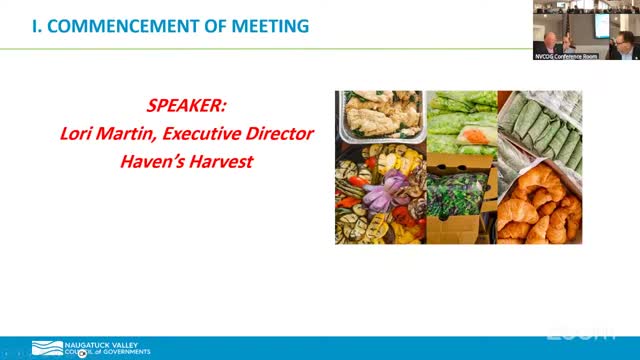
Summary
A guest presentation at the Naugatuck Valley Council of Governments (NVCOG) meeting urged municipalities to treat edible food recovery as infrastructure rather than charity and requested local support for hubs, vehicles and funding.
Laurie Martin, guest speaker for Havens Harvest, told the Naugatuck Valley Council of Governments on Oct. 24 that municipalities should treat edible food recovery as public infrastructure rather than charity.
Martin said Havens Harvest and partners recover and redistribute donated food to nonprofits and community groups across the region and asked regional officials to consider funding food-recovery hubs, vehicles and related staffing. “I want to start by reframing how we think about excess food. And in the past, it has been considered charity work, but in fact, it's around public infrastructure,” Martin said.
Why it matters: Martin and a co-presenter described both social and environmental benefits of expanded food recovery: feeding households that face food insecurity, reducing greenhouse-gas emissions from organic waste, and lowering municipal shipping and disposal costs.
Martin said Connecticut currently captures only a fraction of edible food from the waste stream. Citing presentations by Connecticut DEEP, she said “we're only capturing 5 to 10% of edible food from the waste stream,” and urged municipalities to support storage and transport capacity that preserves perishables.
The presentation described an ongoing Havens Harvest project at a former thrift-store/bakery warehouse in Naugatuck where volunteers and partners collect bread and other donations. Martin said the site typically yields “approximately 5,000 to 10,000 pounds per week” and that a recent large pickup day topped 13,000 pounds; she said Havens Harvest lacked staff and vehicles and had to leave roughly 6,000 pounds behind on that day.
Organizers asked for municipal and regional partners to: consider hosting or helping fund local food-recovery hubs; incorporate food recovery into sustainable materials management planning; and support outreach to small retail donors so they can use federal tax incentives and liability protections. “We have permanent enhanced tax deductions for donors,” Martin said, referring to federal food-donation law updates enacted in 2022, and noted Havens Harvest will offer a webinar to help small businesses access those benefits.
Council staff said they will consider food recovery as part of regional sustainable materials-management planning. NVCOG staff member Christine (surname not stated in the record) said the idea will be included in the regional plan and that staff are “thinking about” establishing a position to run a regional waste authority and related programs.
Martin invited board members to visit the Naugatuck operation and see how donations are handled and distributed in person.
Ending: The presentation concluded with NVCOG staff saying the agency will fold food-recovery needs into its sustainable materials and regional waste discussions and encouraged interested municipalities to follow up with Havens Harvest for site visits and technical assistance.