Get Full Government Meeting Transcripts, Videos, & Alerts Forever!
Get email alerts on the Public Defense State Agency topic
No spam. Unsubscribe anytime.
New State Public Defender seeks $39 million fund authority, supplements to cover shortfall and county onboarding
Summary
The newly created State Public Defender office told the Joint Finance-Appropriations Committee it needs supplemental and ongoing appropriations, authority to spend a $39 million transfer from the tax relief fund, and new staff to onboard counties into the state system.
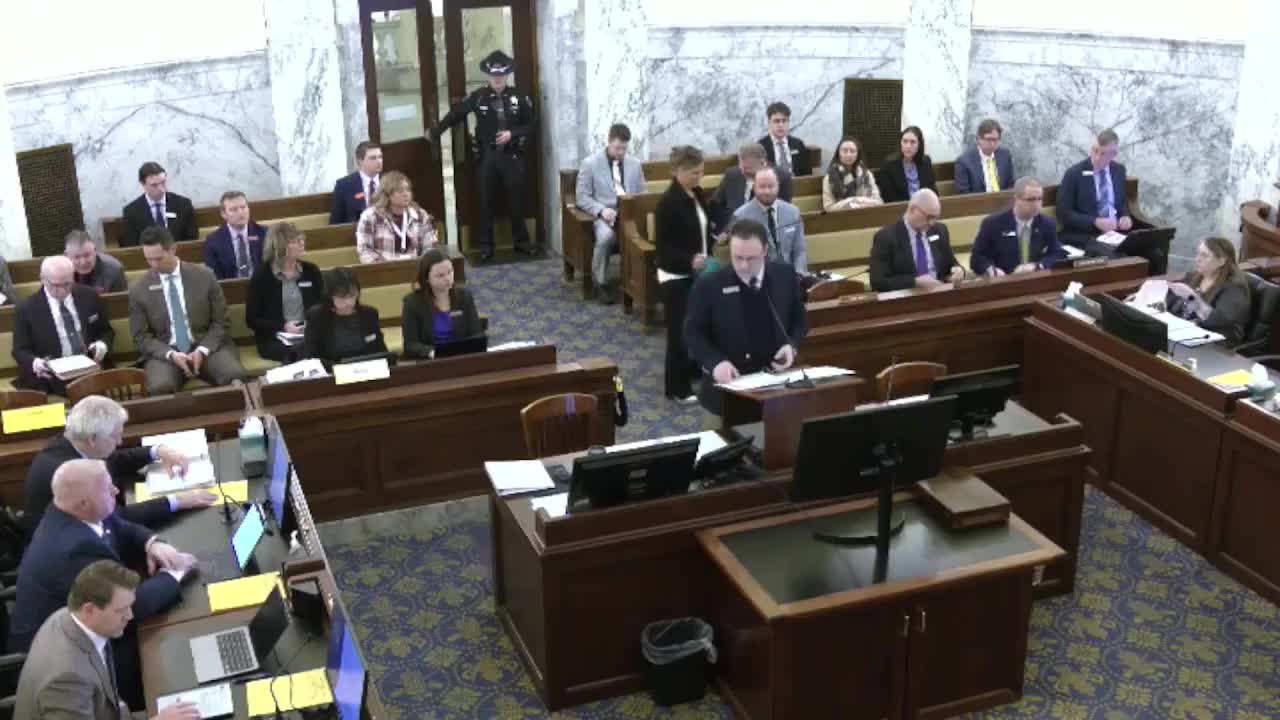
The State Public Defender, a new state agency created under Title 19, Chapter 60, Section 3 of Idaho Code, requested supplemental and ongoing appropriations at a budget hearing before the Idaho Joint Finance-Appropriations Committee. Christopher Lahoset of the Legislative Services Office summarized the agency's budget components; Eric Frederickson, the State Public Defender, and staff answered questions about transition issues, costs and operational scope.
Lahoset told the committee the agency’s base staffing authorization is 29 vacant positions and about $37.7 million in personnel budget; the office’s total current fiscal‑year appropriation after enacted enhancements is about $52.0 million. A central funding mechanism is the newly established state public defense fund, created in Idaho Code section 57‑8207; the statute directed a $39 million transfer from the tax relief fund into that dedicated fund. Lahoset said $2.5 million of appropriation tied to that transfer was omitted in the budget formulation and the agency seeks a one‑time supplemental of $2.5 million to fully utilize the cash transfer for the current fiscal year, specifically to provide representation under the Child Protective Act.
Frederickson described operational challenges in the agency's first five months. "We walked into 1,300 withdrawals and cases," he told the committee, saying transitional staffing strains, differing preexisting county contracts and a post‑pandemic case surge compelled the agency to triage work and rely on contractors in some places. The Idaho Supreme Court decision in State v. Blasick (Dec. 5) was cited as a driver of transcript costs; the governor recommended a one‑time supplemental of $390,200 for transcripts and an additional $5,427,600 one‑time appropriation for personnel and contract rate increases in the current fiscal year.
For fiscal 2026 the agency sought $2.5 million ongoing to fully use the transferred $39 million, an operating request of about $16.0 million (for primary and conflict contract attorneys, investigators, experts, capital litigation costs, training and transcripts), a request for roughly 17.96 new FTEs to open four institutional offices (Benewah, Elmore, Jerome and Shoshone counties) and one‑time cash transfers for recruitment and retention. Frederickson said counties must continue to provide facilities through 2029 per the transition legislation and that some county‑level expenditures (for example certain psychosexual evaluations and other valuation costs) historically paid by counties will require statutory clarity and funding transfers.
Committee members pressed on the distinction between county‑provided services and state responsibilities, whether the agency was being appointed to nonstatutory matters, and how a unified pay structure was being implemented. Frederickson said the office had moved to a uniform pay schedule with DHR to equalize compensation across counties and is working to increase rates for attorneys handling complex or capital cases. He also said the statewide case management system is being implemented to better measure workload and support a move from simple caseload counts to workload‑based staffing.
No formal appropriation action was taken at the hearing. Committee members asked for more detailed breakdowns of experts, miscellaneous expenditures and the mechanics of the tax relief fund transfer; staff and the agency offered to provide follow‑ups to committee requests.