Get Full Government Meeting Transcripts, Videos, & Alerts Forever!
Get email alerts on the Public Defense Funding topic
No spam. Unsubscribe anytime.
State counties' association urges action on public-defense costs, offers pooled solutions during Franklin County visit
Summary
Washington State Association of Counties representatives briefed the Franklin County commission on the public-defense funding lawsuit, juvenile-placement issues, an audit of motor-vehicle fuel tax allocations and proposed pooled services including a health-insurance trust and a solution center.
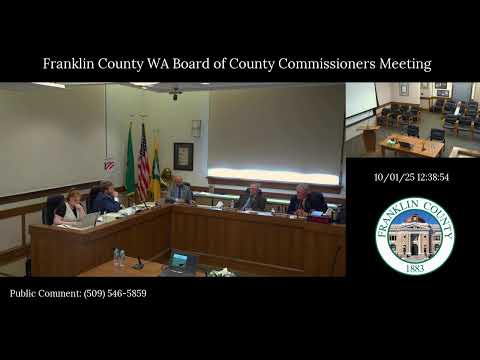
Representatives from the Washington State Association of Counties (WSAC) visited the Franklin County Board of Commissioners on Oct. 24 and urged coordinated action on rising county costs, particularly the fiscal strain from public-defense mandates.
Derek Young, WSAC executive director, and Commissioner Rob Kaufman, WSAC president, outlined several priorities: pending litigation and advocacy around state-level public-defense funding, an agreement with the state over juvenile-placement capacity, a newly identified miscalculation in motor-vehicle fuel-tax distributions that WSAC estimates could total more than $100 million statewide, and institutional efforts to lower county operating costs through pooled services.
Public defense and costs: Young summarized WSAC's ongoing work supporting counties in litigation and legislative advocacy over public-defense funding and caseload standards. He said the organization sought an expedited resolution and noted the legislature had provided some increased funding but that many counties face an "existential" budgetary threat if caseload standards are implemented without adequate state funding. County officials at the meeting, including the county's OPD director, described the new Supreme Court timing rules and other operational changes as adding pressure to county budgets.
Tax distribution audit: WSAC told the commissioners it had identified a miscalculation in the state treasurer's distribution of motor-vehicle fuel-tax revenue to counties tied to earlier legislative changes; WSAC said the underpayment likely exceeds $100 million for counties collectively and that the treasurer's office has agreed to correct future distributions but not to make full retroactive payments. WSAC said it will pursue audit and, if necessary, legal remedies.
Proposed pooled services and solution center: Young described a WSAC "solution center" to help counties adopt cost-saving technologies and services and a planned health-insurance trust that would pool medical coverage to reduce premiums for participating counties. The association is exploring partnerships, a pooled pharmacy benefit model, student consulting labs and internships to expand county recruitment. Young said the association aims to lower dues by generating non-dues revenue through those programs.
Other topics: Young highlighted a WSAC partnership with the University of Washington Evans School to offer a county-elected leaders institute, a policy-innovation collaborative for county problems, and student consulting labs to provide low-cost research. He and Kaufman urged Franklin County to join pooled efforts and said WSAC would support advocacy on interpreter-technology certification and other operational issues.
Ending: Commissioners said they would work with WSAC and local legislators to press for fixes on public-defense funding and the fuel-tax distribution, and they encouraged staff to evaluate the association's proposed pooled services and health-trust options.