Get Full Government Meeting Transcripts, Videos, & Alerts Forever!
Get email alerts on the Entity Regulation Pilot topic
No spam. Unsubscribe anytime.
Washington Supreme Court seeks applicants for entity regulation pilot
Summary
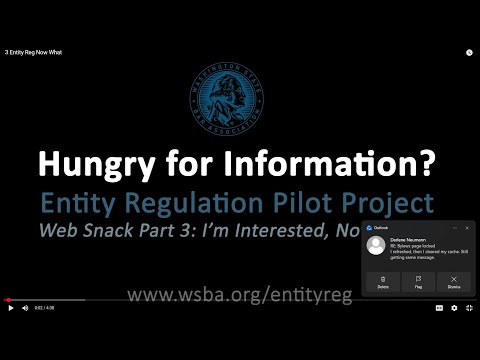
Craig Schenk, a volunteer with the Washington Supreme Court’s Practice of Law Board, urged organizations to review core materials and apply to the court’s entity regulation pilot, which would allow entities — not just individual attorneys — to deliver legal services.
The Washington Supreme Court is seeking organizations to apply to its entity regulation pilot, a program that would allow entities — not just individual attorneys — to deliver legal services, Craig Schenk, a volunteer with the court's Practice of Law Board, said in an online presentation.
Schenk said prospective participants should review the court order, application, operations manual and enforcement procedures before committing resources and should consider how new business models or technologies might expand service reach in their communities.
"I recommend reviewing all the core documents before you commit key resources. That's the court order, the application, the operations manual, and the enforcement procedures," Schenk said, adding that a law article cited in the court order outlines risk-assessment approaches the board will use.
Schenk encouraged applicants to adapt models used in other jurisdictions to local needs rather than adopting wholesale approaches. He cited Utah as an example where community organizations have used community justice workers and partnerships with universities for training and curriculum development to accelerate legal-service capacity.
Resources for prospective applicants include a public Q&A email address hosted on the pilot website and developing "communities of interest," Schenk said. He also advised applicants to use the pilot's online application form, which he described as "really user friendly" and having a savable feature so applicants do not lose work partway through the submission.
Schenk described the pilot as an opportunity to "develop new capabilities for your organization and for your communities" and to help the legal profession adapt to technological and societal changes and widening access gaps. He said the pilot seeks participants who can test models that expand services to underserved communities.
The presentation was informational; Schenk encouraged interested organizations to study the materials, ask questions via the pilot's Q&A channel and submit applications through the online form. He said additional resources will continue to come online as the pilot develops and closed by urging attendees to "learn more, sign up" and help shape the pilot's testing phase.