Get AI Briefings, Transcripts & Alerts on Local & National Government Meetings — Forever.
Bar Association approves FY2026–29 strategic plan with four focus areas
Loading...
Summary
The Bar Association board approved a three-year strategic plan covering fiscal years 2026–29 that centers on access to justice, technology, culture and governance. Discussion included concerns about technology's effect on collegiality and measures of success tied to perceptions of fairness and member opportunity.
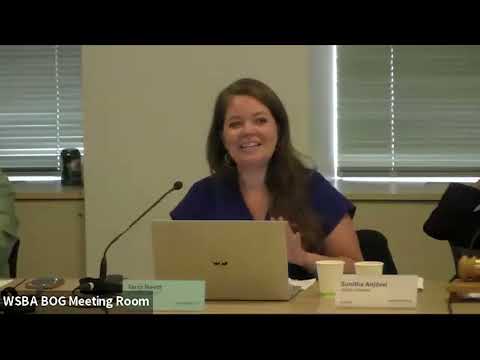
The Bar Association board approved the FY2026–29 strategic plan, adopting a multi-year framework that lists four areas of focus: access to justice, technology, culture and governance. President Francis Adewale and Executive Director Tara Navett led the discussion and presented the draft plan and supporting process documents.
Adewale described the plan as a continuation of prior work rather than a new annual reset, saying the goal is to "continue to work on issues until we are able" to complete priority areas. Tara Navett noted the materials are in the meeting packet and said the plan sets objectives and indicators of success but does not include detailed SMART targets at the board level; staff and volunteers will develop implementation-level metrics and report back over the three-year period.
Former governor Williams, speaking during the discussion, urged the board to consider how technology and culture interact. Williams said the move to virtual proceedings during COVID demonstrated a risk of eroding collegial relationships and cautioned against overreliance on virtual-only processes: "technology and culture are not independent. They are together." Williams described a recent courtroom instance in which reliance on remote appearances affected a client's case and urged balance between technology and in-person interaction.
Board member Tom Ahern emphasized measures of success tied to public and member perceptions, saying, "I think we're successful if the public feels like we have a fair, inclusive, effective, and accessible legal system," and that members should feel they have "a realistic opportunity to become the best that they can be." Nam Nguyen and the DEI (diversity, equity and inclusion) Council voiced support for the plan; the board noted a letter from the DEI Council among the late materials endorsing the plan.
Board members debated whether the plan should include more granular, time-bound SMART goals at the policy level. Navett and others said the board's role is to set policy-level goals and that staff and volunteers will set implementation metrics.
The board took a roll-call vote on the motion to approve the strategic plan as provided in the materials. The vote passed unanimously of those present; Kevin Fay was noted as not present. Members recorded as voting yes included Christina Larey, Todd Bloom, Jordan Couch, Chris Vang, Kari Petrasek, Tom Ahern, Allison Whitney, Mary Rathbone, Harvin Price, Alon Dunluth, Emily Arneson, Nam Nguyen and Matthew Dresden.
The strategic plan document in the packet identifies objectives and indicators of success and will be refined with measurable implementation goals by staff and the executive leadership team. The board did not adopt board-level SMART metrics during the meeting; the executive leadership team will return with implementation targets and measurement parameters for future review.