Get Full Government Meeting Transcripts, Videos, & Alerts Forever!
Get email alerts on the Legislative Comment Policy topic
No spam. Unsubscribe anytime.
Board of Governors adopts consolidated legislative and court-rule comment policy after debate on timing and scope
Summary
The Board of Governors approved a consolidated comment policy governing how WSBA entities comment on legislation and court rules, shifting legal-risk analysis responsibility from section executive committees to the board's legislative committee; the vote passed with one abstention after sections raised timing and Supreme Court board concerns.
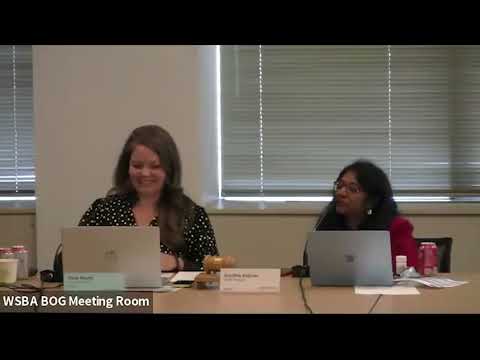
The Board of Governors voted to adopt a consolidated legislative and court-rule comment policy that centralizes legal-risk review with the board's legislative committee and clarifies when WSBA entities may submit comments to lawmakers or rulemaking bodies, board leaders said at the meeting.
Sanjay, a staff member who introduced the proposal, told governors the policy consolidates three separate policies into one for ease of use, transfers responsibility for legal-risk analysis from section executive committees to the board's legislative committee (with advice from general counsel), and clarifies the scope of permissible "technical advice" sections may offer. "We're consolidating 3 different policies into 1 policy that covers comments on legislation and court rules," Sanjay said.
The proposal drew extended discussion from governors representing subject-area sections. Nancy Hawkins, speaking for the Family Law Section, warned that the policy could hinder the ability of sections to respond quickly when the Legislature moves rapidly and said sections are best positioned to analyze some legislative risk. "If they can respond Monday evening and we can't respond till Thursday, well, we've lost our window," Hawkins said, urging the board to consider timing and to request that the Washington Supreme Court apply the policy to Supreme Court boards.
Other governors urged moderation. One governor noted the policy includes a carve-out permitting technical comments that improve the drafting of legislation or identify drafting issues, missed citations or conflicts with other laws; Sanjay and others said that carve-out was intended to preserve sections' ability to provide practice-focused input. Governors and former governors also described past examples in which informal outreach led legislators to assume broader WSBA support than existed, underscoring the need for clearer procedures.
After discussion, Director Nevitt conducted a roll-call vote. The chair announced the policy was approved with one abstention (Alonzo Moove recorded as abstaining). The roll call named multiple governors voting in the affirmative.
The new policy was developed over several months with input from general counsel and the board's legislative committee and had been discussed at the board meeting in July and at the legislative committee earlier in the summer, staff said. The board directed staff and the committee to publish guidance and training materials for bar entities so sections and other groups can follow the new procedures and to consider outreach to the Supreme Court regarding whether Supreme Court boards should be subject to similar procedures.
Ending: Board staff said they will post the adopted policy, produce an infographic and offer training for sections and other bar entities to help them comply with the new procedures before the upcoming legislative session.