Get Full Government Meeting Transcripts, Videos, & Alerts Forever!
Get email alerts on the Budget And Prioritization topic
No spam. Unsubscribe anytime.
Milpitas council ranks city referrals, delays final funding decisions until Nov. 4
Summary
At a Oct. 2 special meeting, the Milpitas City Council used ranked voting to prioritize council referrals tied to the city's fiscal strategy but postponed allocating one-time funds and asked staff for implementation plans and cost details.
The Milpitas City Council on Oct. 2 held a special priority-setting session and used an electronic, multi-round voting process to produce a ranked list of council referrals. Councilmembers prioritized transportation and public-safety items but deferred any final decisions on one-time funding and asked staff to return with implementation plans and cost estimates at a follow-up meeting on Nov. 4.
The council's action came amid continued emphasis by city management on reducing a structural budget gap. City staff presented a fiscal strategy and a menu of one-time funding options totaling about $3.3 million, and then guided the council through prioritization of 55 referrals submitted over the previous months.
Why this matters: Milpitas faces a multiyear structural deficit and staff made clear that any additional programs or service expansions must be matched to a realistic funding plan. The Oct. 2 session produced a manageable list of priorities that staff will now analyze for cost, timing and operational impact before the council approves spending.
Most important results
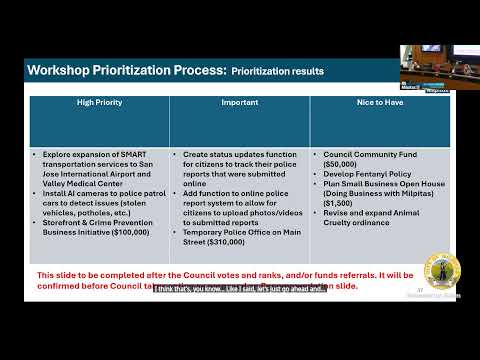
- Ranked outcomes. After two rounds of ranked voting and a final consolidation, the council identified three high-priority new referrals: expansion of the smart shuttle to San Jose International Airport (Referral 3); installation of AI-equipped cameras on some patrol vehicles to detect issues such as stolen vehicles and roadway hazards (Referral 8); and a storefront- and crime-prevention business initiative to expand storefront grants and security supports (Referral 11).
- Additional items moved to the 'important' tier included a request to add an upload function so residents can attach photos/videos to online police reports (Referral 7), a status-update function to let residents check the status of online police reports (Referral 6), and a temporary Main Street police office (Referral 17).
- The council did not authorize one-time appropriations at the meeting. Staff had presented a package of recommended one-time uses (library security and maintenance, park-matching funds, Main Street incentives, an economic development strategy update, FIFA/Super Bowl promotional activities and program expansions such as youth summer jobs and the emergency motel-stay fund). Councilmembers asked staff to return with more detail on costs, operational impacts and measures of effectiveness before any appropriation.
What the staff presented
City staff summarized the fiscal strategy that guided the prioritization session, saying the city has identified one-time revenue sources and cost-savings targets but still faces ongoing budget pressure. Staff reported approximately $3.3 million in one-time funds currently available, including a $1.0 million payment tied to a Stratford development agreement, a roughly $840,000 reimbursement from VTA, and about $1.0 million identified through a contract-review effort.
Staff also outlined proposed one-time allocations as examples for council consideration: continued evening security at the Milpitas Jose E. Estavez Library (staff said the security contract lapsed Sept. 30 and the prior pilot cost about $100,000 a year), a $200,000 park-matching reserve, $100,000 for Main Street incentives, $150,000 to update the economic development strategy, $75,000 for FIFA/Super Bowl marketing and events support, $80,000 over two years to expand the youth summer jobs program and $100,000 to extend the emergency motel-stay program. Staff emphasized that one-time funding should be used for time-limited needs and not for ongoing operating costs.
Key discussion points and staff clarifications
- Library security and facility condition: Public-works and recreation staff said the library experienced repeated vandalism in recent years and that overnight security was effective while it was in place, but the pilot contract ended Sept. 30. Staff estimated the security pilot cost roughly $100,000 per year and noted that the elevator modernization project has a scheduled capital improvement cost that will require ensuring the building is secured during construction. Public-works staff also presented a conceptual estimate of $2.6 million to $2.8 million to address chronic street flooding near the library; staff said that would require grant or capital funding.
- Economic development and revenue generation: Alex Andrade, the city's director of economic development, told the council that prior investments in economic development produced measurable returns and that updating the strategy would include performance metrics and an evaluation component. He also said Milpitas's industrial employment areas have become an increasing source of sales tax and property tax revenue.
- FIFA/Super Bowl and small-business promotion: Staff described a modest $75,000 request to fund in-house marketing and shop-local programs tied to region-wide sports events and noted a separate, larger private promoter's street-festival proposal that would require underwriting and could cost several hundred thousand dollars if the city were to subsidize it. Staff said licensing and event fees from the Bay Area host committee will be set later in the year.
- Police reporting, photo/video uploads, and status updates: Police Chief Hernandez warned the council that adding an automated status-update feature to the case-management system and allowing unrestricted photo/video uploads would change department operations and create data-storage and evidence-retention obligations. "Currently with our online report system, less than 5% of those have any follow-up," Hernandez said, adding that many online reports are screened and that officer contact often yields information not provided in the initial online report. The chief told the council that storing video and photos as evidence on the department's Axon/evidence platform would carry recurring costs and retention requirements and would increase staff workload for detectives.
Votes and formal actions at the meeting
- Remote participation: The council approved a request to allow one councilmember to participate remotely under AB 2449 and Government Code section 54953(f)(2)(A) (motion moved by Councilmember Evelyn Chua and seconded by Vice Mayor Barbara Deal; vote recorded as unanimous).
- Approval of the agenda and consent calendar: Both motions carried by roll call vote (all ayes).
- Prioritization process and ranked outcomes: The council completed an iterative, electronic prioritization process during the meeting; the facilitation and staff summary produced the high-priority and important lists described above. Council did not take a single formal motion to 'adopt' the final ranked list by ordinance, but the group accepted the results of the electronic ranking as the working council priority list to be acted on later.
- Continuance and next steps: The council voted to continue the funding and implementation decisions to a future meeting (council voted to defer the final funding decisions and asked staff to return with implementation options and cost analysis; roll-call vote carried with all members present voting aye). The council set a follow-up date for Nov. 4 for staff to return with briefings and recommendations.
What comes next
Staff will: (1) provide detailed cost estimates, operational implications and proposed performance measures for the items the council ranked as high and important; (2) recirculate recent sales-tax and revenue updates (HDL reports) requested by councilmembers; (3) return with a report on library security options and the elevator modernization schedule; (4) work with police and IT to analyze the feasibility, cost and privacy/data-retention implications of a police-report status function and a controlled photo/video upload capability; and (5) present a recommended plan for any one-time appropriations for council consideration at the Nov. 4 meeting.
Quotes
- Alex Andrade, Director of Economic Development: "I always like to say a healthy economy creates a healthy community."
- Police Chief Hernandez: "Currently with our online report system, less than 5% of those have any follow-up."
Ending
The council emerged from the Oct. 2 session with a shorter list of priorities to guide staff work but chose not to commit one-time funds until staff returns with implementation plans, cost estimates and measurable objectives. The Nov. 4 follow-up will determine which prioritized items receive short-term funding and which will require longer-term budget actions or ballot measures.