Get Full Government Meeting Transcripts, Videos, & Alerts Forever!
Get email alerts on the Tax Amnesty topic
No spam. Unsubscribe anytime.
Senate committee approves 90-day tax amnesty bill to waive penalties on delinquent property, income and gross-receipt taxes
Summary
The Committee on Budget, Appropriations and Finance approved a 90‑day amnesty that waives penalties and interest for taxpayers who file outstanding returns and pay balances within the window. Finance officials warned the length may depress near-term collections but provided outstanding-amount estimates and highlighted operational constraints.
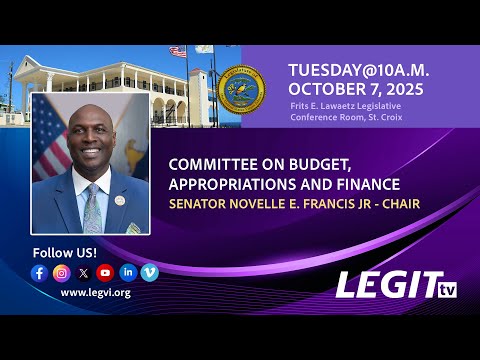
The Committee on Budget, Appropriations and Finance on Oct. 7 approved a measure establishing a 90‑day amnesty period that waives penalties and interest for taxpayers who voluntarily file outstanding returns and pay the entire tax balance within the amnesty window.
Sponsor Senator Kenneth L. Gittens said the program is meant to provide immediate relief to individuals and small businesses still carrying tax liabilities after multiple economic shocks, including hurricanes and rising costs. "This initiative is not about giving a free pass. It's about recognizing the extraordinary financial hardship our people have endured," Gittens told the committee.
What the bill does: The amended bill requires the director of the Virgin Islands Bureau of Internal Revenue to open the 90‑day amnesty within 10 days of the act's effective date and instructs the lieutenant governor (under existing statutory authority) to waive penalties and interest on delinquent real‑property taxes for taxes paid within the 90‑day period. To qualify, taxpayers must file each outstanding return for which they request amnesty and pay the full outstanding balance during the amnesty window. The bill also directs the bureau and lieutenant governor to publish outreach materials and to report results to the Legislature within 30 days after the amnesty closes.
Agency responses and concerns: Bureau of Internal Revenue Director Joel A. Lee provided estimates of existing overdue balances and cautioned that amnesties historically cause many taxpayers to wait until the last day of the window, producing a short-term delay in collections. He told the committee that, as of Sept. 30, 2025, realistic collectible delinquencies included roughly $93 million in gross‑receipts tax, $7 million in corporate tax and $30 million in individual income tax (about $130 million total). "If this bill becomes law, some portion of this balance will be collected and the associated penalties and interests will be abated," Lee said.
The office of the tax collector in the Lieutenant Governor’s office opposed the 90‑day period and urged a shorter amnesty, saying past practice usually limited amnesties to 30 or 60 days to avoid depressed collections during the early part of the amnesty. Brent Latham, tax collector, said that longer amnesties often show depressed collections in early months followed by a late spike that does not fully compensate for the earlier shortfall.
Numbers and precedent: Director Lee cited prior amnesty results: during a previous legislative amnesty (January–June 2021) gross‑receipts collections under amnesty were about $19 million with approximately $10 million in penalties/interest abated; income tax collections during that period were smaller. Committee members asked about outstanding property taxes; Latham estimated property tax delinquencies at roughly $120 million after the 2025 current‑year delinquency period ended Aug. 30.
Timing issues: Several senators asked about timing relative to corporate filing season and refund disbursements. Bureau staff warned that October corporate filings and routine refund cycles (traditionally before Thanksgiving) create a cash‑flow consideration; Director Lee recommended consideration of limiting the amnesty’s corporate scope to earlier tax years (for example, calendar year 2023 and earlier) to avoid reducing current‑year corporate payments.
Committee action: The committee voted to approve the bill as amended (committee tally reported as 6 yes, 0 no, 1 absent) and forwarded it to the Rules and Judiciary Committee. The amendment codified the 90‑day waiver of penalties/interest and required public notices and a post‑amnesty report to the Legislature.
Next steps and oversight: The bureau and the lieutenant governor’s office must publish outreach materials, accept filings and payments, and report results to the Legislature within 30 days after the amnesty ends. Tax officials told senators they will continue outreach to promote payment plans and electronic payment options and asked for cooperation on rules and operational support to process payments efficiently.
Closing: Supporters framed the measure as targeted relief for taxpayers and businesses grappling with long-term delinquencies; revenue and tax officials asked the Legislature to consider operational timing and a possible shorter window to limit negative effects on regular collections.