
Rockville amends parking-permit rules to let some residents get permits for nearby streets; city manager given exception power
Get AI-powered insights, summaries, and transcripts
Sign Up Free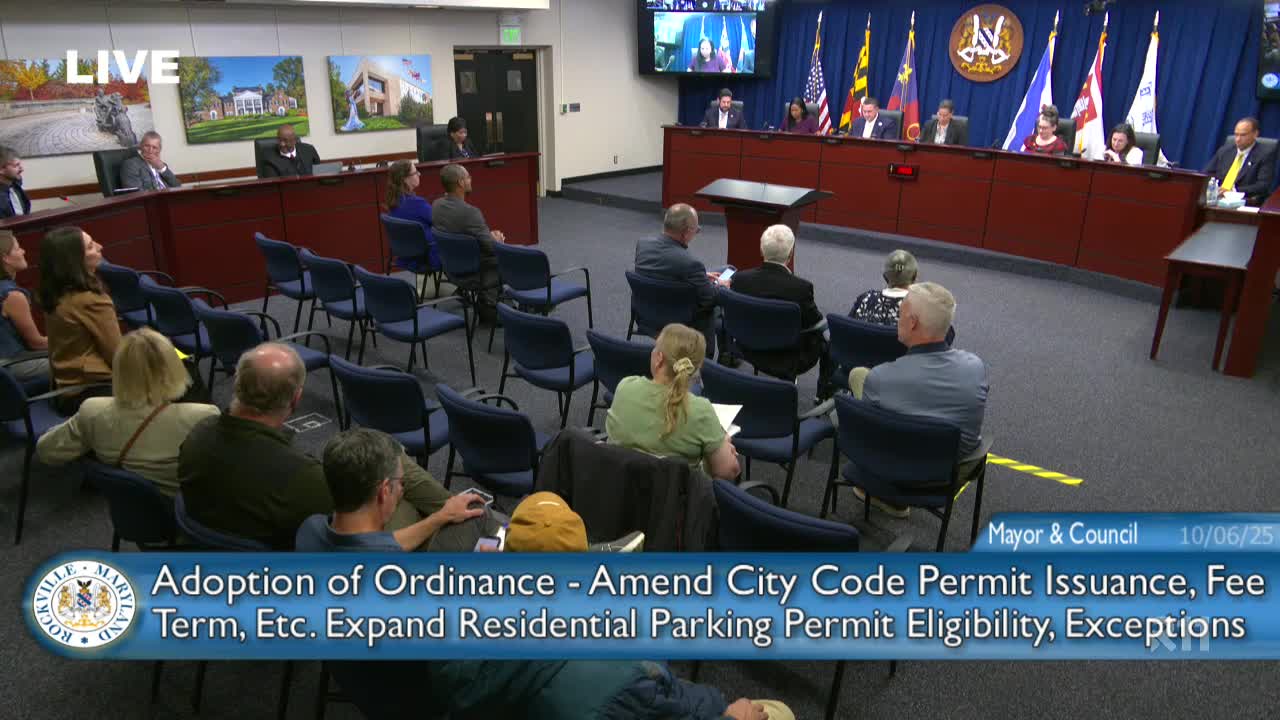
Summary
The Rockville Mayor and Council on Oct. 6 adopted an ordinance amending City Code §23-47 to expand residential parking-permit eligibility for some properties and to allow the city manager to grant exceptions for unforeseen circumstances. Council asked staff for monitoring, an annual review and better maps showing which properties qualify.
The Rockville Mayor and Council on Oct. 6 adopted an ordinance amending City Code §23-47 to expand eligibility for residential parking permits and to create a process by which the city manager may issue permits by exception for unforeseen circumstances.
The change responds to a narrow but recurring problem: some residents live on streets where on-street parking is prohibited and the nearest street is within a residential-permit district. Those residents and their visitors previously could not park on either street without breaking the law or obtaining a permit. Staff told the council that the proposed code language applies to roughly 100 properties citywide and identified clusters including about 64 homes near Redland Boulevard and a smaller number of addresses on nearby streets.
City staff from Public Works and Transportation presented the proposal and said it would not create new permit districts nor eliminate any existing ones. Instead the ordinance adjusts eligibility so residents on parking-prohibited streets can obtain permits on adjacent residential-permit streets where appropriate. The code also creates a narrowly tailored administrative path for the city manager to grant a residential parking permit when an unforeseen circumstance is demonstrated.
Council members asked how the city will prevent the change from producing a sudden surge of additional permits on already-full neighborhood streets. Staff said they will use the same analytic and administrative rubric that the Transportation and Mobility Division applies when establishing permit districts: staff will evaluate whether an area will be harmed by additional permits, whether the circumstance is temporary or permanent, and whether the request addresses a discrete need rather than convenience. Staff also told the council that a demonstration project on Redland Boulevard is ongoing and the project’s final findings will be shared with council and affected residents.
Council members asked for more public transparency about which properties would be eligible under the new language. Staff said they would add a map layer to the city’s GIS so residents can see whether a specific property qualifies under the new rules. Council also asked staff to track complaints and report back after a year to see whether adjustments are needed.
Before adopting the ordinance, council waived the required waiting period and then approved the ordinance. Council members said they would watch how the change affects nearby streets and requested an administrative report after one year. Staff also explained the fee structure and relief options: the city’s permit fee is modest and an income-based fee waiver process exists; staff described a typical fee cycle (a $5-per-year fee, or $15 if purchased at the beginning of a three-year cycle) and said they would provide a written breakdown of administrative costs and fee-waiver use.
What changed: the ordinance amends City Code §23-47 to (a) expand permit eligibility to properties that cannot legally park on their frontage but abut a residential-permit street, and (b) create an exception pathway allowing the city manager to issue a permit for unforeseen circumstances. The ordinance does not expand or create residential-permit districts; it changes eligibility only for a defined set of individual properties.
Next steps: staff will publish or add the eligible-property layer to the city GIS, continue the Redland Boulevard demonstration project and provide the council with monitoring metrics and complaint counts after about 12 months. Staff also said they will provide additional detail on permit fees and the income-qualified waiver practice.
Speakers quoted or summarized in this article appear in the speaker list below.