Get Full Government Meeting Transcripts, Videos, & Alerts Forever!
Get email alerts on the Unified Development Ordinance topic
No spam. Unsubscribe anytime.
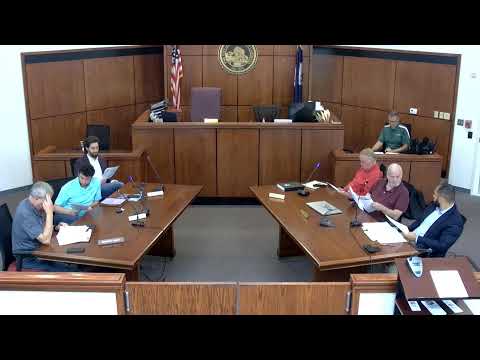
Easley planning commission reviews broad UDO amendments, debates sign rules, storage containers and ADU language
Summary
The Easley City Planning Commission reviewed a large package of proposed amendments to the Unified Development Ordinance (UDO) and related documents, discussing public-notice signage, temporary storage-container rules, sidewalks, accessory dwelling units and accessory-structure standards.
The Easley City Planning Commission reviewed a large package of proposed amendments to the city’s Unified Development Ordinance (UDO) and related planning documents, discussing in detail changes to public-notice signage, rules for temporary steel storage containers, sidewalk requirements, accessory dwelling unit (ADU) language and accessory-structure height and setback rules.
The discussion covered multiple discrete amendments that staff and commissioners said are intended to clarify existing requirements, improve public notice for annexations and rezonings and provide implementing language for recommendations in the 2022 comprehensive plan. Commissioners and staff disagreed at times over numeric limits and enforcement mechanisms — most prominently over how long temporary storage containers may remain on private property and whether rule changes should be restricted to residential parcels.
Commissioner/staff remarks and staff presentations
Alex, a planning commission member, said the commission should present two separate resolutions to the incoming city council: one “reaffirming commitment to the comprehensive plan” (the 2022 plan) and a second contingency resolution to direct a new comprehensive-plan process if needed. “I sent over a couple drafts of some resolutions,” Alex said, and added the resolutions were intended to put a shared position in front of the new council members.
Corey, who reviewed the UDO draft for staff, told the commission he found only “a few little tiny grammatical spelling errors” but also flagged substantive issues that he said the city attorney had reviewed; Corey said the packet had already completed a first reading with council and was scheduled to go to council again on Monday for further action.
What’s in the packet
Sign posting and public notice — The draft standardizes property-posting signs for rezonings and annexations (small, medium and large sizes) and proposes templates for applicant-provided signs so they are uniform and legible from the roadway. Commissioners discussed three elements: sign size by parcel, number/placement of signs by road frontage (options included at least one sign per road frontage and a larger sign with smaller repeat signs), and whether the city should produce signs and recover costs through a fee schedule. Mario, a staff member, said a template would be created and the city could explore a July fee-schedule change to let applicants pay the city to supply signs.
Temporary storage containers ("pods") — The packet would insert language in section 6.8 (temporary uses) to allow portable steel storage containers “for purposes of loading and unloading.” Staff and code enforcement recommended a 30-day initial allowance with extensions up to 90 days; others favored the existing 180-day allowance. The commission debated whether the rule should apply to residential property only or to all districts. Commissioners and staff repeatedly raised enforcement and right-of-way concerns, including a loophole where a container moved into the public right-of-way could reset the allowed period. The code-enforcement officer’s experience with repeated or long-term containers on residential lots motivated the proposed tightening.
Sidewalks and pedestrian connectivity — Proposed language would require 5-foot sidewalks on both sides of residential streets, with listed exceptions where development density is low or alternative pedestrian systems are provided. The change is framed as leverage during subdivision negotiations to secure better pedestrian infrastructure; commissioners said exceptions would still be allowed if infeasible.
Accessory dwelling units (ADUs) — The draft leaves placeholder language for ADUs rather than adopting a full ADU ordinance. Staff and several commissioners said the city attorney advised retaining a placeholder until a thoroughly drafted ADU ordinance is ready. Commissioners debated timing and enforcement (e.g., whether ADU occupancy or income limits should be recorded on deeds and how enforcement would be handled), and several urged quicker work on a detailed ADU program.
Accessory structures, heights and lot coverage — The draft proposes multiple edits affecting fences, pool setbacks and accessory-structure height and placement. Notable points: changing privacy fence maximum height from 10 feet to 8 feet; clarifying that “pavement edge of swimming pools must remain 5 feet from the side of your property line” to avoid ambiguity about pool decks; and increasing maximum lot coverage figures in some residential zones (examples discussed: raising total impervious coverage to 45% in certain zones). Commissioners debated how to measure accessory-structure height (percent of primary building height versus fixed feet), whether small sheds should have more lenient allowances, and how higher accessory structures should be treated when they exceed 15 feet in height (the draft included a provision setting a 10-foot side/rear setback for accessory units above 15 feet).
Parking, waivers and temporary uses — Staff proposed a new parking table (compiled from Easley’s prior chart and comparable cities) and a formal parking-waiver mechanism that would allow developers to provide additional landscaping or open space in lieu of extra parking spaces. Commissioners discussed retaining engineering review for special parking cases and removing language that would have allowed on-street parking away from a development site to count toward minimum parking requirements.
Short-term rentals and commercial land uses — The UDO draft would allow short-term rentals conditionally in the core commercial district and moves certain medical-office uses from permitted to special-exception review in some districts so those uses require additional oversight.
How the commission acted
A motion was offered at the meeting to accept the commission’s recommended changes (with the edits discussed during the meeting). The motion lacked a recorded second. The transcript records the call for a vote after the lack of a second; the meeting record does not show a formal adoption by the planning commission on the floor. Staff said the UDO package had already had a first reading at council and was scheduled to go to city council on Monday for further action.
Why it matters
The UDO changes affect how Easley notifies neighbors about rezonings and annexations, how code enforcement manages visible temporary storage on private property, how future accessory dwelling units can be regulated and where sidewalks and parking will be required. Several proposals aim to reduce ambiguity (for example, explicitly defining pool-deck setbacks and standardizing sign templates) while others will change the cost and implementation for developers and property owners (e.g., sign-fee recovery, impervious-coverage adjustments, and ADU permitting). Commissioners repeatedly emphasized the balance between clarity, enforceability and the city’s broader planning goals as expressed in the 2022 comprehensive plan.
What’s next
Staff said the packet will be transmitted to city council for consideration at its upcoming meeting; commissioners asked staff to refine numeric details (such as the permissible duration for temporary containers, accessory-structure height language and the sign-fee mechanism) before council review. Commissioners also asked staff to produce a concrete ADU ordinance draft for future meetings rather than leaving only placeholder language.
Quotes (selected and verbatim)
"So I, I sent over a couple drafts of some resolutions," Alex said when introducing the planning-commission resolutions on the comprehensive plan.
"Corey has, reviewed our UDO and goes without, question. There'll be a few little tiny grammatical spelling errors," a staff member said while summarizing the staff review and noting the city attorney had looked at the draft.
"If the language is such that this is a temporary thing, then then it would automatically exclude the, you know, companies and commercials," a planning commissioner said during the storage-container debate, summarizing a line of argument on commercial exemptions.
Ending
Commissioners asked staff to refine the draft wording on several contested items and requested the ADU ordinance be written and returned for review. Staff reiterated the packet’s near-term path to city council; the planning commission did not adopt a final omnibus motion on the record at this meeting.