Get Full Government Meeting Transcripts, Videos, & Alerts Forever!
Get email alerts on the Curb Management topic
No spam. Unsubscribe anytime.
Meatpacking BID presents curb-management study to Community Board 2; seeks parking-rule changes and DOT review
Summary
The Meatpacking Business Improvement District presented observations and data to the Creative Boards 2 traffic and transportation committee on Sept. 30, urging changes to curb regulations and parking management to reflect the neighborhood’s shift from industrial use to a pedestrian-oriented retail and cultural district.
The Meatpacking Business Improvement District presented a curb-management and parking study to the Creative Boards 2 traffic and transportation committee on Sept. 30 and asked the board for feedback on how to update parking regulations, curb uses and loading practices before the BID submits a package of recommendations to the New York City Department of Transportation.
The presentation matters because the district’s land use has shifted away from large-scale meat-processing logistics toward retail, restaurants, museums and nightlife, the BID said. That change, the BID argued, makes older commercial-parking rules designed for industrial activity a poor fit for current curb priorities.
Evan Siew, director of neighborhood planning and operations for the Meatpacking BID, told the committee the project is “to re-examine parking regulations and curb utilization within the neighborhood” and to “deliver a pedestrian-oriented neighborhood.” The BID contracted a third-party consultant to observe on-street activity in May and June and use those counts to shape proposals for the DOT, Siew said.
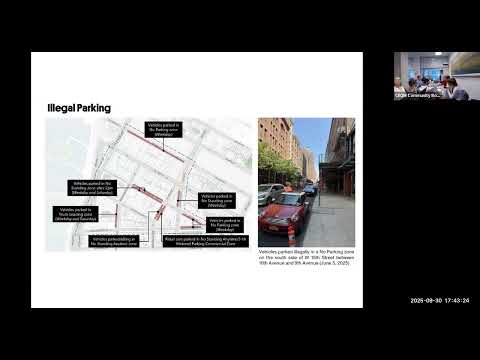
The BID’s data and observations included: - A modal split estimate the presentation described as about 60% of visitors arriving by public transit, 20% on foot and about 5% by private vehicle. The BID said weekday turnover of curb space is higher than weekend turnover, when personal-vehicle dwell time increases. - A prevalent daytime pattern of commercial loading and service activity; a concentration of for-hire vehicle pick-up and drop-off activity along Ninth Avenue that contributes to congestion and frequent double parking; and locations (for example, Gansevoort Street between Hudson and Thirteenth) where a weekday “no parking” rule appears underused or unexplained by current practice. - Confusing, adjacent regulations on some blocks — different permitted times and categories that make compliance difficult for drivers — and significant noncompliance in places labeled “no standing” or “no stopping.”
Jeffrey LaFrancois, executive director of the Meatpacking BID, framed the initiative as part of the BID’s Western Gateway public‑realm vision, which the BID said recently received industry recognition. LaFrancois said the BID wants a “data-driven” proposal to present to DOT that balances commercial deliveries, for-hire vehicle activity and continued pedestrian improvements.
Committee members and public attendees pressed for detail and suggested specific priorities. Janet Liff, chair of the committee, emphasized concern about congestion on Ninth Avenue and asked whether metering or enforcement could address persistent double parking near hotels and restaurants. Siew responded that metering alone probably would not solve Ninth Avenue’s problems and that some blocks may be better served by targeted enforcement, redesigned loading zones or dedicated high-vehicle pick-up space.
Several committee members urged the BID to consider micro-distribution hubs, secure bike parking and micro-mobility charging points; to pilot hardened daylighting (planters or other physical separators) where pedestrian safety requires it; and to explore overnight delivery pilots to move logistics out of peak street hours. The BID said it has discussed micro-hub locations with DOT and previously identified a state-owned lot near the Standard Hotel as a candidate, but that interest from state property managers has been limited.
The BID said the study period was May–June, and that detailed analysis and a full technical report will follow. Siew told the committee the BID aims to have recommendations ready to present to the DOT by the end of the calendar year and invited public comments for two weeks following the meeting.
The presentation named the firm TYLinn (formerly Sam Schwartz Engineering) as the consultant conducting counts and producing graphics. The BID also noted examples from other cities — case studies in London, San Francisco and Nashville — to illustrate outcomes such as increased clarity for drivers and, in some instances, modest boosts in sales tax receipts on pedestrianized blocks.
The BID and committee agreed on next steps: the BID will draft recommendations based on the data and the feedback received, publish its full report for stakeholders, and return to the committee with proposed curb-management strategies to carry to DOT for formal consideration. The BID described the effort as a proposal and said DOT retains authority to approve or modify any curb changes.
Public-comment and committee members’ requests — including clearer load-zone definitions, consideration of overnight freight programs, and specific enforcement strategies on Ninth Avenue — will be included in the BID’s outreach summary and the package to DOT, the BID said. The committee scheduled a future follow-up presentation to review the BID’s recommendations.