Get Full Government Meeting Transcripts, Videos, & Alerts Forever!
Get email alerts on the Community Choice Aggregation topic
No spam. Unsubscribe anytime.
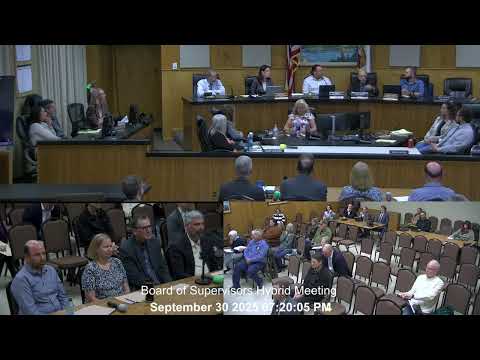
Lake County hears Sonoma Clean Power plan; officials debate joining, geothermal GeoZone
Summary
At a special Sept. 30 Lake County meeting, Sonoma Clean Power officials urged the county and the cities of Lakeport and Clear Lake to join the Community Choice Aggregation; discussion focused on potential bill savings, governance seats, enrollment rules and a proposed regional 'GeoZone' for geothermal development.
Sonoma Clean Power on Sept. 30 asked the Lake County Board of Supervisors and the councils of Lakeport and Clear Lake to approve joining the community-choice electricity supplier and to participate in a regional geothermal planning effort known as the GeoZone.
The nonprofit community choice aggregator’s chief executive officer, Jeff Siefers, told the joint meeting that joining would “capture a stream of revenues from generating power” that local jurisdictions could use for projects and to lower customer rates. He said Sonoma Clean Power has issued $775,000,000 in municipal bonds and has used bond proceeds to prepay supply contracts to lower rates for customers.
Supporters framed the proposal as a chance for local control, modest price protection and new local energy projects. Opponents — both elected officials and members of the public — urged caution over long-term contracts, land‑use impacts from geothermal development and the level of tribal and community engagement.
SCP proposal and timeline
Sonoma Clean Power (SCP) representatives presented a feasibility summary and a regulatory timeline. SCP recommended that the jurisdictions vote in October to begin the CPUC-required regulatory process that, if approved and completed, would allow SCP to begin service to Lake County customers in May 2027. SCP offered Lake County two seats on its board (one county seat and one shared seat for the cities) and said that, if Lake County joins, the SCP board would expand from 11 to 13 members.
“We've already issued $775,000,000 in municipal bonds,” Jeff Siefers, chief executive officer of Sonoma Clean Power, said. “Joining a CCA gives you local control over finances in a way that is unusual.”
SCP staff described enrollment, customer options and likely bill impacts. Erica Torgerson, managing director of customer service, said residents and businesses would be automatically enrolled at launch unless they opt out. “All residents and businesses will automatically be enrolled in May 2027 unless they proactively opt out of service,” Torgerson said. SCP’s default product, Clean Start, is described in the presentation as about 51% renewable and roughly 40% carbon‑free; SCP also offers an optional premium product (Evergreen) that it describes as 100% locally generated renewable power for an estimated $12 extra per month for a typical household.
SCP staff presented historical performance: SCP reported customer bill effects have varied year to year, typically trimming total bills by about 2–5% in many years, with one recent year about 7% cheaper than the incumbent utility and some years modestly more expensive. For planning, SCP said Lake County would represent roughly 15% of SCP’s regional customers if it joins, a share that underpins the two‑seat board offer.
GeoZone and geothermal development
A central focus of the discussion was SCP’s GeoZone proposal to promote new geothermal development across the three counties. Ryan Tracy, SCP director of planning and analytics, said the GeoZone concept currently targets about 600 megawatts of new geothermal capacity and would rely on cooperation agreements with industry partners to shape projects and secure first refusal on generated power for SCP customers.
“We're currently targeting 600 megawatts of total development,” Tracy said, adding that existing Geysers capacity is roughly 700–800 megawatts and that new geothermal technologies have expanded siting possibilities. Tracy and other SCP staff emphasized that GeoZone agreements would be negotiated with industry partners and that local permitting authority remains with the county or the local lead agency.
Regulatory and legal questions
SCP’s regulatory director, Neil Reardon, described SCP’s advocacy work before state regulators and legislative efforts to change permitting processes. Reardon said SCP has sponsored legislation in prior sessions intended to clarify local roles in permitting geothermal exploration; he framed the GeoZone as a vehicle to engage industry and communities early.
Multiple county officials and residents raised legal and process concerns. Supervisors and council members asked whether state bills (discussed during the meeting as AB 531 and other measures) could override local setback rules and whether joining SCP would reduce Lake County’s local control over physical siting and permitting. SCP staff repeatedly stated that local land‑use authority and permitting would remain with Lake County and the cities and that the GeoZone is a planning and partnership mechanism rather than an immediate change in land use.
Tribal and community outreach
Several speakers urged extended tribal consultation before any binding action. SCP staff acknowledged California law governing CCAs does not explicitly require tribal consent and said they would commit to additional tribal outreach if Lake County advances the matter. SCP offered to provide early outreach and noted that tribes in SCP territory would be able to opt out of SCP service if they chose.
Public comment and local concerns
Public commenters and some council members urged postponing a decision to allow more study of contracts, potential impacts of geothermal development on the county’s landscapes, and the details of any nondisclosure agreements or cooperation contracts with industry. Lisa Marie Benavides, a Worth area resident, urged “a no or a postponement for now,” citing uncertainty about rates, outage reduction and tribal engagement. Other public commenters urged the county to secure more information from PG&E about how losing generation revenue might affect undergrounding and post‑fire response.
Participation, opt-out and other clarifying details
SCP described practical enrollment rules and customer protections: outreach would start in 2026, customers would be notified by mail and email in advance of the May 2027 enrollment, and SCP said there is a five‑month free opt‑out window (two months prior to the enrollment month, the enrollment month, and two months after). After that window SCP said the residential opt‑out fee is $5 and the commercial opt‑out fee is $25. SCP staff also cited regional participation rates (about 89% in Sonoma County and about 80% in Mendocino County) as examples of typical customer takeup in areas already served by SCP.
What the meeting did not decide
No jurisdictions took a final vote at the Sept. 30 workshop. Several council members and supervisors said they will consider the offer and return to council/board chambers for potential October votes to start the regulatory process.
Why it matters
If Lake County joins a community choice aggregator it could gain a regular seat at decisions about future power supply, potential local clean‑energy projects and some degree of rate and program control that SCP and other CCAs say can favor local community programs. Conversely, critics caution that the GeoZone concept raises land‑use questions and that long‑term supply contracts have financial consequences that jurisdictions should review carefully before committing.
What’s next
SCP requested October action to begin the regulatory notice process and offered January 2026 board appointments for Lake County representation. SCP staff also committed to continued outreach, including meetings with tribes and municipal advisory committees. County staff and several elected officials asked SCP for additional details on contracts, maps and program rules before any final county decision.
Ending
The workshop closed without votes. Supervisors and council members signaled continued discussion in their respective jurisdictions and stressed that land‑use permitting would remain under local control. SCP representatives said they will return to answer follow‑up questions and to continue outreach if the county and cities decide to pursue the offer.