Get Full Government Meeting Transcripts, Videos, & Alerts Forever!
Get email alerts on the Complete Streets topic
No spam. Unsubscribe anytime.
Columbus council holds hearing on proposed complete streets policy; advocates press for codification, accountability
Summary
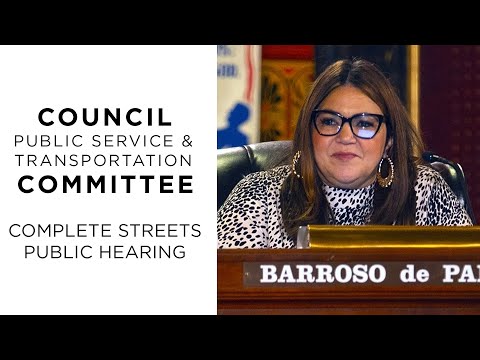
Columbus City Council convened a public hearing on a proposed Complete Streets policy on Oct. 24 to review draft guidance that would require street design and reconstruction to better accommodate pedestrians, cyclists, transit users and motorists of all ages and abilities.
Columbus City Council convened a public hearing on a proposed Complete Streets policy on Oct. 24 to review draft guidance that would require street design and reconstruction to better accommodate pedestrians, cyclists, transit users and motorists of all ages and abilities.
The hearing combined presentations from the Department of Public Service and public testimony from transit, health and bike‑safety advocates. Council member (hearing chair) opened the session by defining the policy: “a complete streets policy is a municipal policy that requires transportation planners and engineers to design and maintain roads to be safe and accessible for all users, including pedestrians, cyclists, transit riders, motorists of all ages and abilities.”
Advocates and experts said the policy formalizes existing practice but needs stronger enforceability and clearer accountability. “You can’t just build the infrastructure. You have to keep it in good repair,” said Ben Keith, a bike commuter and member of the Northland Area Commission, summarizing concerns about maintenance response times and street‑sweeping for bike lanes.
Department of Public Service deputy director James Young and staff described how the policy would be used across different project types — capital improvement projects, public‑private partnerships, developer‑funded work and permit projects — and how design guidance will rely on national best practices and locally developed design memos. “Anytime we touch one of our facilities, we are upgrading them,” Young said, describing projects such as roadway “road diets,” protected bike lanes and quick‑build interventions where the city has observed crash and speed reductions after redesigns.
Staff also detailed procedural changes they are pursuing: a documented exceptions process that would require justification, a public engagement hub and project pages that could publish exceptions, a planned prioritization study for street lighting, acquisition of equipment for narrow‑lane sweeping, and a promise to review the policy at least every two years and likely sooner after initial implementation.
Public commenters — including representatives of the American Heart Association, Transit Columbus, MORPC (Mid‑Ohio Regional Planning Commission), Yay Bikes and COTA (Central Ohio Transit Authority) — largely supported the policy but urged additional measures: codifying Complete Streets in city code to make standards durable across administrations, reinstating a Transportation and Pedestrian Commission or similar community advisory body to improve transparency and ongoing prioritization, and creating clear maintenance standards and measurable response timelines.
Parag Agrawal of MORPC urged a regional approach and noted that more than a dozen central Ohio jurisdictions have adopted Complete Streets policies or resolutions. COTA’s Patrick Harris said the LinkUs rapid‑transit initiative and associated sidewalks, bikeways and mobility hubs rely on Complete Streets principles to function efficiently and safely.
Speakers also raised common implementation constraints: funding source restrictions (for example, utility ratepayer funds that cannot be used for off‑system shared‑use paths), property and right‑of‑way limits that make some retrofits infeasible, and the need to coordinate across departments and with private utilities to avoid repetitive pavement cuts. Staff acknowledged those limits and said they will pursue “dig once” coordination and interdepartmental scoping earlier in planning.
The hearing produced no formal vote. Council members and staff said the session was intended to gather public input and refine the policy text and implementation procedures before returning to council. Advocates indicated they will press council to adopt more binding language and to set specific implementation and maintenance benchmarks. The department said it will circulate updates and technical guidance and continue coordination with partners including Columbus Water and Power, COTA and MORPC.
The meeting closed with the chair thanking staff and community partners and noting upcoming public engagement events, including an Open Streets demonstration scheduled for Oct. 26.