MSU and Whirlpool tell House panel circular economy could recover resources, create jobs; committee members ask about recycling and EV batteries
Loading...
Summary
Michigan State University researchers and a Whirlpool sustainability manager told the House Committee on Natural Resources and Tourism that a circular economy could recover hundreds of millions of dollars in materials and support thousands of jobs, while committee members pressed presenters on recycling capacity and EV battery recycling.
Michigan State University researchers and a Whirlpool Corporation sustainability manager briefed the Michigan House Committee on Natural Resources and Tourism on the concept of a circular economy, arguing it could capture materials now lost to landfills and support new jobs and competitiveness for Michigan industry.
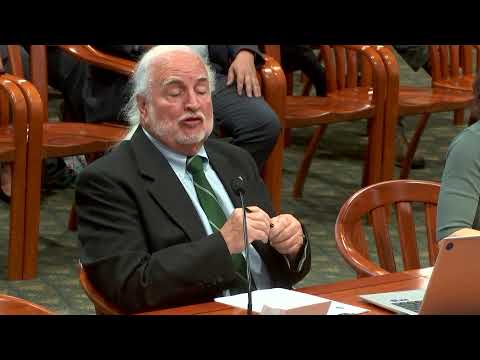
Dr. Rex Lamour, director of the Center for Community and Economic Development at Michigan State University, told the committee the state currently operates largely under a "linear" take‑make‑dispose model and estimated that capturing materials currently lost to landfills could secure about $600,000,000 in resources and create up to 4,500 jobs in recycling, reuse and remanufacturing sectors. He said the circular economy aims to "design out waste, to keep products and materials in circulation, and, where feasible, regenerate those materials." He added that multidisciplinary research at Michigan State involves more than 80 faculty across supply management, engineering, chemistry and social sciences.
Samantha Truesdell, Enterprise Circularity Manager at Whirlpool Corporation, described corporate efforts to extend product life, optimize efficiency in use, and recover materials at end of life. Truesdell said Whirlpool employs more than 2,000 Michiganders, has invested over $250 million in the state since 2022, and has set corporate targets including net‑zero and a goal of zero waste to landfill — a target the company reported achieving in its U.S. operations.
Committee members asked specific questions about recycling capacity and batteries. Lamour said Michigan's municipal recycling rate is about 35 percent and that construction and demolition waste recycles at a much lower rate — under 15 percent — and therefore represents an important opportunity. Truesdell said large home appliances are "highly recyclable" by weight because of their metal content; she estimated 90 to 95 percent of whole appliances enter some recycling process and that approximately 60 to 70 percent of the raw materials ultimately reach an end use. She and Lamour both said the remaining 30 to 40 percent of materials (plastic, foam, shredder residue) need further research and market development to reenter supply chains.
On electric vehicle batteries and electronic waste, presenters described recovery challenges and emerging research. Lamour referenced faculty research into recovering rare metals from solar panels and experimental approaches to recover materials from batteries; Truesdell said lithium and cobalt can be recovered but the processes are costly and secondary markets remain limited. Committee members noted that some jurisdictions and projects reuse batteries for stationary energy storage once the cells drop to roughly 40 percent of original capacity.
Presenters urged several state policy options: incentives for circular business models, workforce development for reuse/remanufacturing jobs, green procurement by state government, and expanded producer responsibility programs similar to bottle‑deposit laws. Lamour specifically suggested supporting higher‑education research partnerships to improve sorting, reprocessing and end‑market development for materials that today have little end use.
Committee members thanked the presenters and the committee scheduled its next meeting; the transcript shows no formal committee action on circular‑economy policy during this hearing.
Why it matters: presenters framed circular economy policy as both an environmental and economic development opportunity — capturing value from materials currently discarded, reducing landfill pressure, and supporting industry competitiveness and job creation, especially in sectors such as appliances and automotive supply chains.