Get Full Government Meeting Transcripts, Videos, & Alerts Forever!
Get email alerts on the Electric Vehicles Fleet topic
No spam. Unsubscribe anytime.
Jacksonville moves forward with 18-vehicle electric fleet pilot and city charging sites
Summary
The Transportation, Energy and Utilities Committee heard a city presentation on its pilot to add electric vehicles (EVs) to the municipal fleet, purchase 18 low-risk EVs, and deploy city-owned charging stations funded from a planning and development account rather than the general fund.
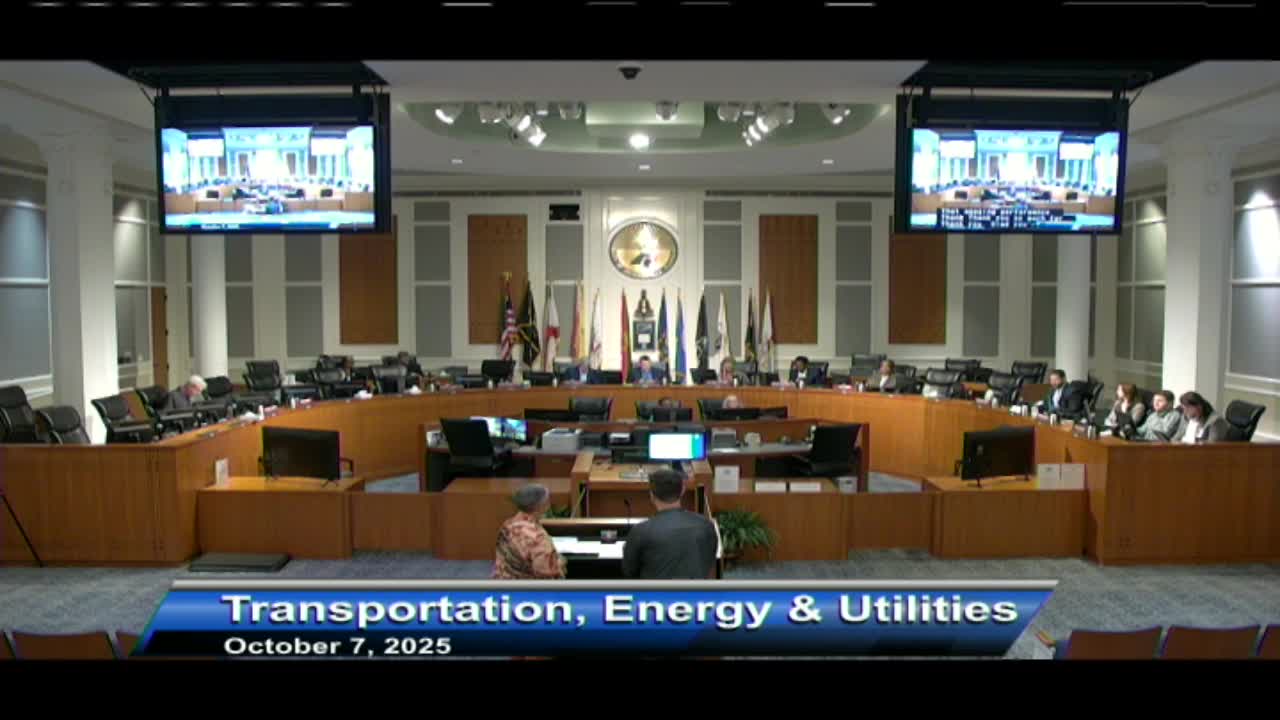
The Transportation, Energy and Utilities Committee on Oct. 7 heard a presentation on the city’s electric-vehicle pilot program and planned city charging infrastructure.
The pilot identified 18 low-risk city vehicles — primarily building-inspection vehicles that average 50–100 miles per day — and the city will install chargers at selected municipal sites. Richard Reichard, director of administrative services, said planning and development funds (not general-fund dollars) paid for the chargers and the selected vehicles.
The presentation said most of the 18 EVs purchased were at the same or a lower purchase price than comparable gasoline models and that charging costs for those vehicles are roughly half of what fueling with gasoline costs. "Cost of ownership of EVs is about 8 to 9% less than a gas powered vehicle," Reichard told the committee.
Eric Preacher, chief of fleet management, explained why inspectors were chosen for the pilot: "Many of the vehicles that we chose, if not all of them, are inspectors for the building inspection division ... These people go out, look at individual homes, job sites, and that thing every day." Preacher said the typical operational gain is that inspectors could leave home with a full charge and go straight to job sites, reducing downtime at fueling sites and increasing productive time in the field.
Officials described the fuel-management system in use at city fuel sites. The fleet uses EJ Ward software and a key-fob system to authorize and track charging sessions, mileage, kilowatt-hours and duration at city chargers. Reichard said the city is also using ChargePoint in the short term, which provides access to other public chargers around town while city-owned infrastructure is installed.
Reichard and Preacher gave cost details and timelines: work on site infrastructure will begin after a city purchase order is issued, with a 4–6 month timeline to install chargers at the selected sites. They reported that charging at third-party public sites currently costs about $0.40 per kilowatt-hour, while charging through the city’s arrangements with JEA would be about $0.07 per kilowatt-hour once the city-owned chargers are in place. Reichard said that if employees are allowed to charge at home with a reimbursement program, the installation could pay for itself in roughly three to four months.
Committee members asked about suitability and timeline for broader fleet conversion. Preacher said Jacksonville’s fleet has about 4,300 vehicles and roughly 800 of those are nonemergency and lower-risk — the set most likely to be converted first. "As the technology increases with a lot of the larger vehicles ... there'll be a lot more opportunities," Preacher said, adding that the city could see a much larger share of general government vehicles convert over the next three to four years depending on test results.
Councilmembers raised implementation questions. Councilman Ken Amaro asked how EVs increase productivity; Preacher repeated that bypassing fueling stops can save field staff 15–20 minutes per incident. Councilwoman Katrina Pittman asked about life expectancy and maintenance; Reichard said warranties are strong, routine maintenance is limited to tires and wipers, and battery lifespans are expected to be sufficient for roughly 10 years with the prospect of cheaper, longer-lasting batteries in the near future.
Officials said the pilot was developed in consultation with planning staff and that prior city policy supports purchasing the most fuel-efficient, least-polluting vehicles where cost and reliability are comparable — a direction first established by a 2008 executive order from then-Mayor John Peyton.
The committee received the update; no formal action to change city policy was taken at the meeting. The presentation and committee discussion indicated the city plans to continue evaluating vehicle replacements during the normal vehicle-replacement cycle and to pursue grants and other funding to expand charging infrastructure for the public and city fleet.
Details provided at the meeting include: 18 initial EVs targeted for the pilot; an expected 4–6 month timeline to install city-owned chargers after a purchase order is issued; an estimated charging cost differential of about $0.07/kWh on city chargers versus $0.40/kWh at some third-party public sites; and the plan to fund the pilot equipment and chargers from planning and development funds rather than the general fund.