Get Full Government Meeting Transcripts, Videos, & Alerts Forever!
Get email alerts on the Street Safety topic
No spam. Unsubscribe anytime.
Lexington street-safety task force presents partial report with engineering, education and enforcement recommendations
Summary
A city task force chaired by Councilmembers Savigny and Sheehan presented a partial report recommending roundabout studies, quick-build pilots, expanded education and data-driven enforcement, and asked council to consider funding and implementation steps.
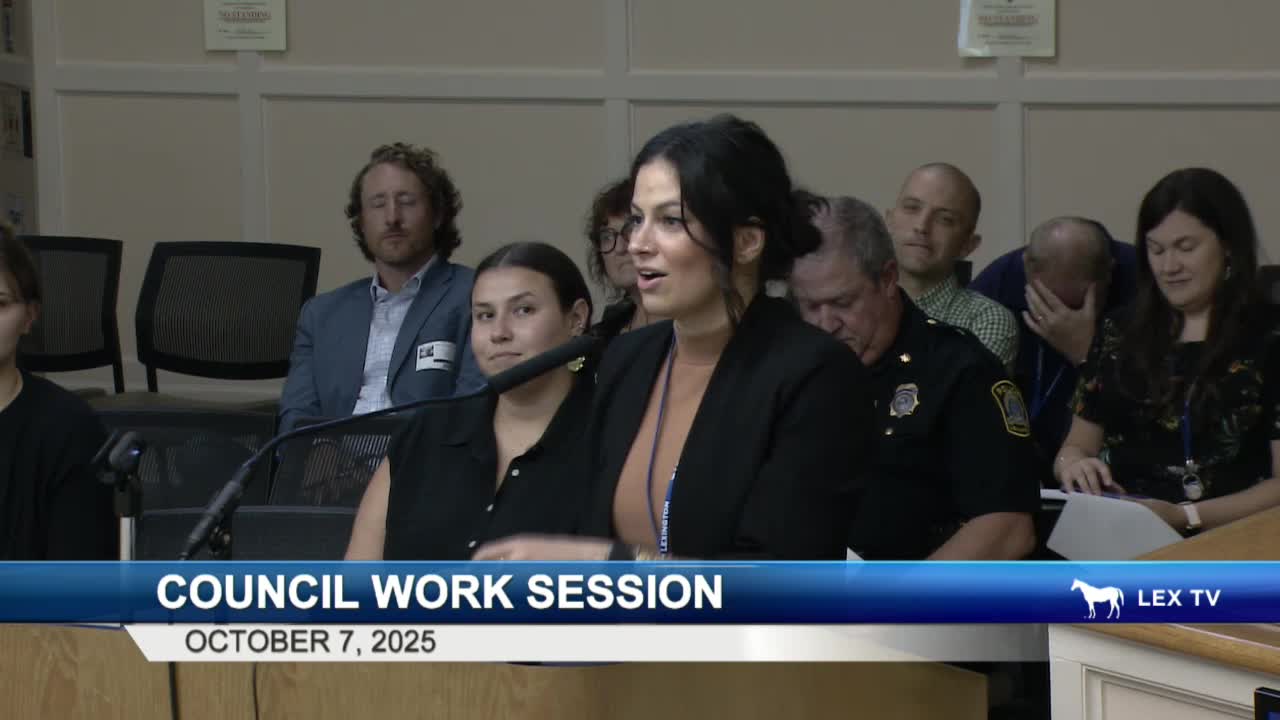
The Street Safety Task Force presented a partial report to the Lexington-Fayette Urban County Council on Oct. 7, outlining a set of engineering, education and enforcement recommendations intended to reduce traffic fatalities and serious injuries.
The task force, led by Councilmember Kevin Savigny and Councilmember Rebecca Sheehan, recommended a roundabout feasibility study, a quick-build traffic circle pilot, signal-timing adjustments to improve pedestrian crossings, a city quick-build program for low-cost safety fixes, expanded community engagement and a set of data-driven enforcement steps. The group asked council to consider fund-balance requests and future budget allocations to implement items in fiscal 2026 and beyond.
The report emphasized the human and economic toll of traffic crashes. “...fatal and serious traffic crashes cost Kentuckians $30,000,000,000 annually,” Alyssa McKenzie, 10th District legislative aide and a task force presenter, said while outlining crash and fatality trends. The task force said its recommendations align with Lexington’s comprehensive plan (Theme D, Goal 1), the Complete Streets Action Plan and the Vision 0 principles referenced in the presentation.
Engineering recommendations call for selecting five high-priority intersections for roundabout feasibility studies, plus a traffic-circle quick-build pilot using temporary materials such as bollards and paint to test designs before permanent construction. The task force also recommended analyzing signal timing to expand leading pedestrian intervals and integrating pedestrian-only phases where feasible.
On education and engagement, the task force proposed experiential events (asphalt art, street fêtes, open-streets), a community champions initiative to train residents to lead local projects, and internal capacity building across LFUCG staff and private designers. The presenters urged hiring or contracting a cross-departmental coordinator to align messaging and implementation.
Enforcement recommendations included focused enforcement using Lexington Police Department collision and volume data, a Miovision pilot to gather intersection behavior metrics and a pilot signage project to test whether monitoring notices reduce violations. The group also recommended pursuing state-level legislation authorizing automated civil enforcement (red-light cameras), drafting a no-parking-in-bike-lane ordinance with LexPark and city law, and considering a local drag-racing ordinance modeled on Louisville’s approach to strengthen enforcement and impoundment options.
Councilmembers in the chamber broadly praised the task force’s work and volunteered to participate in implementation. Councilmember Jennifer Curtis asked staff from traffic engineering about quick-build resource needs and data availability; Roger Mulvaney of Traffic Engineering described available crash-reporting datasets and traffic-volume subscriptions used to rank sites. Councilmember Katie Morton asked about fund-balance and FY27 budget requests; the presenters said they will present a specific fund-balance ask during upcoming budget discussions.
Task force members said three remaining meetings will focus on project handoffs, collaboration and refining implementation details. The group invited council participation and public engagement tools available on EngageLexington and the Lexington Police Department’s traffic complaint page.
The task force’s report was delivered as a partial update; no formal ordinance or budget appropriation was voted on during the Oct. 7 work session. The presenters asked council to review recommendations and consider funding in upcoming fiscal discussions.