Get Full Government Meeting Transcripts, Videos, & Alerts Forever!
Get email alerts on the State Legislation Cap And Invest topic
No spam. Unsubscribe anytime.
SFCTA staff: cap-and-invest extended to 2045; AB1085 and AB1532 signed, SB63 and SB71 pending
Summary
Staff reported the state’s cap-and-invest program was extended to 2045 with a new expenditure plan beginning July 1, 2026; two bills the authority supported (Assembly Bill 1085 and Assembly Bill 1532) were signed by the governor, while Senate Bills 63 and 71 remained pending.
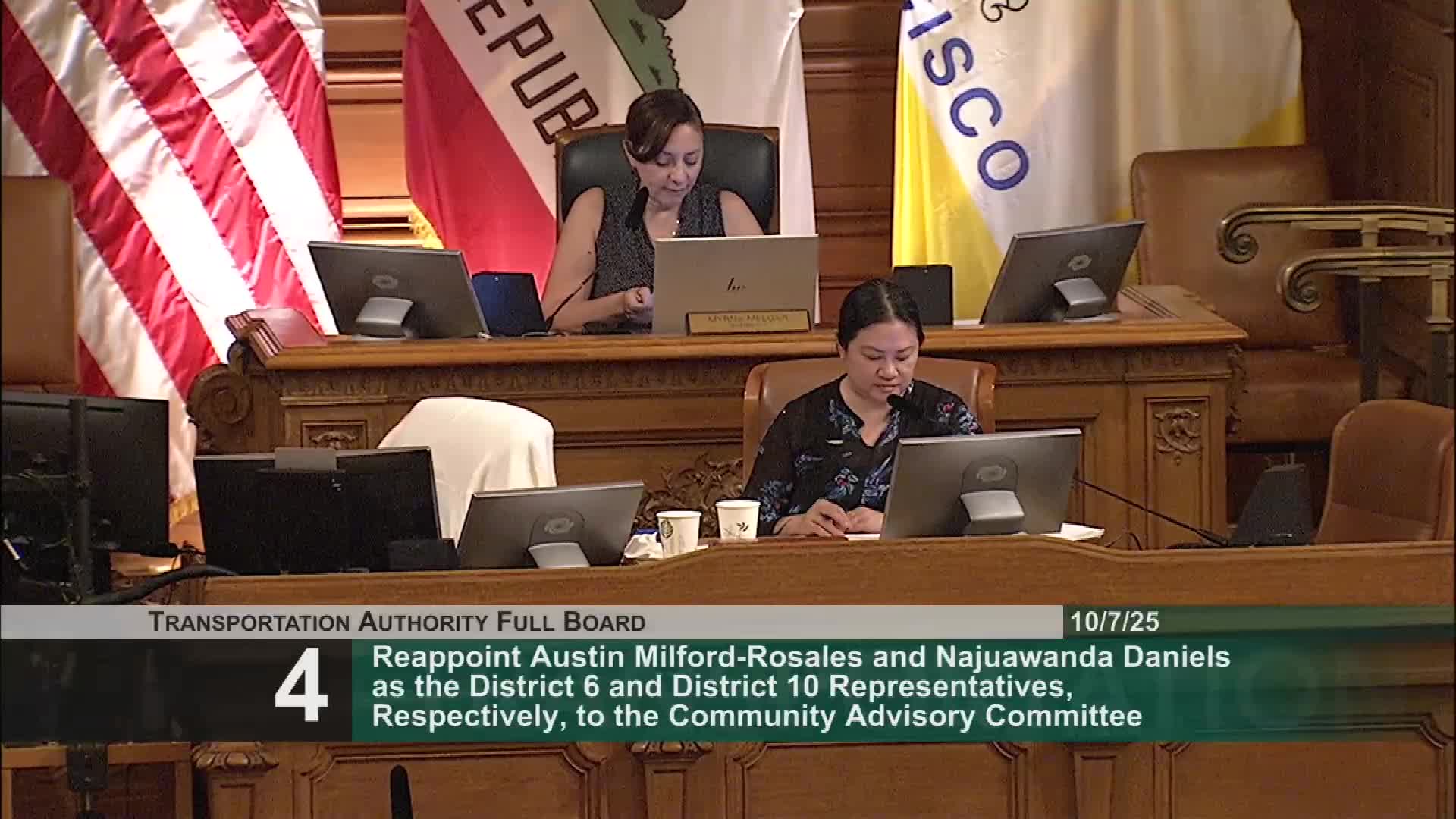
Amber Crabbe, the Transportation Authority’s legislative staff, briefed commissioners on state and federal legislation during an information item on Oct. 7.
Crabbe said the cap-and-invest program—the authority’s top legislative priority—was extended to 2045 with a new expenditure plan effective July 1, 2026. The new plan directs $1 billion off the top for high-speed rail, another $1 billion for legislative discretionary projects, and up to about $2 billion across continuously appropriated projects, including $400 million for the transit and intercity rail capital program and $200 million for the Low Carbon Transit Operations Program, Crabbe said.
Crabbe said two bills the authority supported have been signed into law: Assembly Bill 1085, which prohibits sale or manufacture of devices that shield license plates from being read, and Assembly Bill 1532, which extends the TNC Access for All program through Feb. 1, 2032 (as presented). Crabbe said SFCTA is still awaiting action by the governor on Senate Bill 63 (authorization for a regional transit revenue measure) and Senate Bill 71 (which would extend environmental-review exemptions for certain sustainable-transportation projects). The governor’s deadline to act is Oct. 12, Crabbe said.
Staff and the board discussed next steps to pursue state funding for SFCTA priorities, including potential sources to support the portal project; staff said it will continue advocacy at the state level.