Get Full Government Meeting Transcripts, Videos, & Alerts Forever!
Get email alerts on the Fire Downtown Cleanup topic
No spam. Unsubscribe anytime.
Torrington officials outline cleanup, grant and legal options after large downtown fire
Summary
City officials described damage to multiple downtown buildings after a multi-day fire, said state and federal environmental teams responded, and reported a pending $6 million remediation grant application plus foreclosure and blight-lien steps as possible paths to clean up the site.
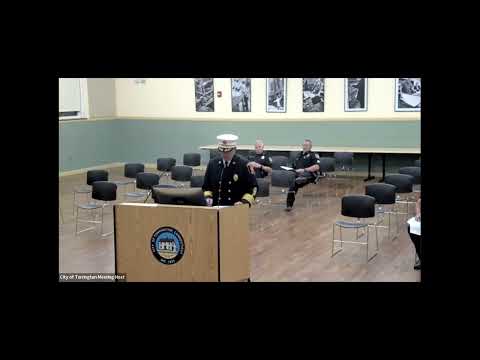
Fire Chief Tripp told the Torrington Board of Councilmen on Oct. 6 that firefighters contained what he called “Torrington’s second largest fire by area,” and that mutual-aid departments, state teams and city crews kept the incident from spreading to nearby businesses.
Chief Tripp said the department responded with minimum staffing and coordinated rotating operational periods with help from 23 mutual-aid departments, utility crews and state teams. He said there were no reported injuries. “Their calmness, experience, and leadership allowed them to set in motion a chain of events that contain the fire to those 3 buildings,” he said.
City staff and legal counsel briefed the council on environmental, insurance and legal steps the city has begun or is pursuing. William (staff), who presented maps and a status update, said the city submitted a $6,000,000 remediation grant application in September and expects an award decision in late November or early December. “We submitted in September. We anticipate hearing an award decision late November or early December,” he said.
Why it matters: council members said the site is heavily contaminated, is unsafe to re-enter without environmental assessment, and will require specialized demolition and abatement. The property includes several contiguous parcels near Litchfield and Summer streets and lies alongside railroad tracks, raising added logistical and environmental concerns for cleanup and track restoration.
What staff reported and asked the council to note
- Damage, parcels and status: William displayed a map identifying 200 Litchfield Street (the Longstreet building) and 105 Summer Street among the damaged parcels. He described some areas as completely demolished (rubble only), other sections as standing but heavily damaged and likely to need demolition, and one adjacent property as having only minimal fire damage and already back in operation.
- Historic-status change: Because of the extent of the damage and demolition, staff notified the State Historic Preservation Office (SHPO). William said SHPO determined the property “was so severely damaged that it did not rate listing anymore” and will be removed from the National Register listing.
- Environmental response and access: DEEP (the state environmental agency) and other state teams were on site to evaluate air monitoring and water runoff. William said the city will need a licensed environmental professional (LEP) to characterize hazardous building materials and soil contamination, remove contaminated materials, and then assess remaining soil impacts. That assessment must precede major remediation or demolition work.
- Funding path: The city applied for a $6 million remediation grant; staff emphasized that they have not been awarded the grant but are keeping state economic development staff updated. William said the grant, if received, would be used for remaining demolition, abatement and contaminated‑material removal.
- Railroad and DOT coordination: Staff said the city is working with the Connecticut Department of Transportation and the Naugatuck Railroad because firefighting and demolition displaced rubble near the rail corridor; both agencies inspected the tracks and will need clearance and potential restoration work before train service can resume fully.
- Legal remedies and liens: Corporation Counsel (Attorney Magistrale) reported foreclosure and blight-lien activity that pre‑dated the fire. He said foreclosure actions were initiated earlier against both parcels (105 Summer and 200 Litchfield) and that the city had blight liens “close to $500,000 on each parcel.” He added he did not know whether the properties carry insurance and said staff have been unable to locate the owner. He also noted state statutory authority exists to allow municipalities to access properties for environmental assessment when owners are nonresponsive; that specific statute was provided to council in staff memo.
- Taxes and priority: Counsel and staff said there is no mortgage on either parcel. The property owner is delinquent on real-estate taxes — staff reported roughly $55,000 in unpaid taxes — and those tax liens take priority over the city's blight liens. Counsel said that fact may affect how any foreclosure proceeds are handled and that strict foreclosure may be the likely judicial remedy if appraisals confirm low equity.
Council and staff perspective
Mayor and council members praised the fire department’s response and emphasized the complexity of the cleanup. Several council members described work to coordinate state and federal partners, and to seek funds and technical assistance through the Naugatuck Valley Council of Governments (NVCOG), the federal EPA and state agencies.
William and staff said their immediate next steps are to secure an LEP on site to complete assessment work and to press the remediation grant process while pursuing legal and administrative steps (foreclosure, blight enforcement and possible claims against any available insurance proceeds).
What the council did
The Oct. 6 meeting was informational on this topic; the council heard reports from the fire chief, staff and corporation counsel and received the map and status briefing. Council members did not vote to authorize demolition or to approve specific remediation contractors during the Oct. 6 meeting; staff said further actions and procurement will follow as the assessment and funding decisions proceed.
Looking ahead
Staff said cleanup is not immediate: characterization, abatement and remediation “is not something that’s going to happen in the next two weeks or two months,” and the work is likely to span multiple months and require coordination with state and federal partners. If the remediation grant is awarded, that funding would be applied to demolition and abatement costs; if not, the city will continue to pursue statutory enforcement, foreclosure, and potential use of city funds or other grants to protect public health and safety.
Ending
City officials said they will continue to brief the council as assessments, grant decisions and legal steps progress. Staff asked the council to expect follow-up items that could include procurement of an LEP, fencing and site securing, and later, formal requests to authorize remediation contracts if funding is secured.