Madera supervisors pass resolution opposing California Proposition 50; vote splits 3-2
Summary
The Board adopted a resolution opposing California Proposition 50, a November ballot measure on congressional redistricting, on a 3-2 vote after supervisors debated the measure's democratic effects and cost of the special election.
The Madera County Board of Supervisors on Tuesday adopted a resolution opposing California Proposition 50, a statewide ballot measure set for a special election, by a 3-2 vote.
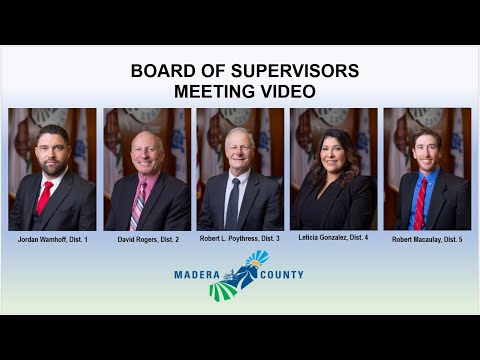
Supervisor Warmhoff introduced the resolution, arguing that Prop 50 would redraw congressional lines in a way that "weakens voter choice and dilutes the voice of millions of Californians" while costing taxpayers roughly $300 million for a special election. He said the measure would make the state delegation less representative of statewide voter preferences.
Supervisor Poitras and Supervisor Rogers also spoke in opposition, citing declining competitiveness in U.S. House districts and the effect on local swing districts. Supervisor McCauley and Chair Gonzales voted against bringing the county into opposition, with McCauley calling the subject a national political question and expressing concern about deepening division; Gonzales said she preferred to let voters decide in the upcoming election.
After public discussion the board moved to adopt the resolution. The roll-call result was 3 in favor (Warmhoff, Poitras, Rogers) and 2 opposed (McCauley, Gonzales), and the measure passed 3-2.
The resolution expresses the county's formal opposition to Prop 50 and cites concerns about competitiveness, the timing and cost of the special election, and representation of voters in districts that could become less competitive. The board did not identify specific county actions beyond adopting the resolution.
AI generated
The text on this page is AI generated. Summaries, highlights, analysis, and video transcripts are all produced from the original source material.
AI can make mistakes, so if you spot one, and we will fix it for everyone.
Note: the source content is unaltered by us. Any content source we link to, be it a video, an audio recording, or a document, is presented exactly as its publisher released it. That publisher is usually a government body, sometimes an individual official or another organisation.